






 5J3W
5J3W
Crystal structures reveal signaling states of a short blue light photoreceptor protein PpSB1-LOV (dark state)
Summary for 5J3W
| Entry DOI | 10.2210/pdb5j3w/pdb |
| Descriptor | Sensory box protein, FLAVIN MONONUCLEOTIDE (2 entities in total) |
| Functional Keywords | signaling protein, lov domain, pas domain |
| Biological source | Pseudomonas putida (strain KT2440) |
| Total number of polymer chains | 4 |
| Total formula weight | 76296.70 |
| Authors | Granzin, J.,Batra-Safferling, R. (deposition date: 2016-03-31, release date: 2016-06-22, Last modification date: 2024-01-10) |
| Primary citation | Rollen, K.,Granzin, J.,Panwalkar, V.,Arinkin, V.,Rani, R.,Hartmann, R.,Krauss, U.,Jaeger, K.E.,Willbold, D.,Batra-Safferling, R. Signaling States of a Short Blue-Light Photoreceptor Protein PpSB1-LOV Revealed from Crystal Structures and Solution NMR Spectroscopy. J.Mol.Biol., 428:3721-3736, 2016 Cited by PubMed Abstract: Light-Oxygen-Voltage (LOV) domains represent the photo-responsive domains of various blue-light photoreceptor proteins and are widely distributed in plants, algae, fungi, and bacteria. Here, we report the dark-state crystal structure of PpSB1-LOV, a slow-reverting short LOV protein from Pseudomonas putida that is remarkably different from our previously published "fully light-adapted" structure [1]. A direct comparison of the two structures provides insight into the light-activated signaling mechanism. Major structural differences involve a~11Å movement of the C terminus in helix Jα, ~4Å movement of Hβ-Iβ loop, disruption of hydrogen bonds in the dimer interface, and a~29° rotation of chain-B relative to chain-A as compared to the light-state dimer. Both crystal structures and solution NMR data are suggestive of the key roles of a conserved glutamine Q116 and the N-cap region consisting of A'α-Aβ loop and the A'α helix in controlling the light-activated conformational changes. The activation mechanism proposed here for the PpSB1-LOV supports a rotary switch mechanism and provides insights into the signal propagation mechanism in naturally existing and artificial LOV-based, two-component systems and regulators. PubMed: 27291287DOI: 10.1016/j.jmb.2016.05.027 PDB entries with the same primary citation |
| Experimental method | X-RAY DIFFRACTION (2.55 Å) |
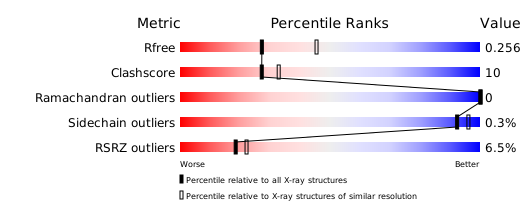
Structure validation
Download full validation report


