






 4WSZ
4WSZ
Crystal structure of the DNA binding domains of wild type LiaR from E. faecalis
Summary for 4WSZ
| Entry DOI | 10.2210/pdb4wsz/pdb |
| Related | 4WT0 4WU4 4WUH 4WUL |
| Descriptor | Response regulator receiver domain protein, PRASEODYMIUM ION, GLYCEROL, ... (5 entities in total) |
| Functional Keywords | helix-turn-helix, response regulator, enterococci, dna binding domain, dna binding protein |
| Total number of polymer chains | 2 |
| Total formula weight | 15856.64 |
| Authors | Davlieva, M.,Shamoo, Y. (deposition date: 2014-10-29, release date: 2015-05-06, Last modification date: 2023-12-27) |
| Primary citation | Davlieva, M.,Shi, Y.,Leonard, P.G.,Johnson, T.A.,Zianni, M.R.,Arias, C.A.,Ladbury, J.E.,Shamoo, Y. A variable DNA recognition site organization establishes the LiaR-mediated cell envelope stress response of enterococci to daptomycin. Nucleic Acids Res., 43:4758-4773, 2015 Cited by PubMed Abstract: LiaR is a 'master regulator' of the cell envelope stress response in enterococci and many other Gram-positive organisms. Mutations to liaR can lead to antibiotic resistance to a variety of antibiotics including the cyclic lipopeptide daptomycin. LiaR is phosphorylated in response to membrane stress to regulate downstream target operons. Using DNA footprinting of the regions upstream of the liaXYZ and liaFSR operons we show that LiaR binds an extended stretch of DNA that extends beyond the proposed canonical consensus sequence suggesting a more complex level of regulatory control of target operons. We go on to determine the biochemical and structural basis for increased resistance to daptomycin by the adaptive mutation to LiaR (D191N) first identified from the pathogen Enterococcus faecalis S613. LiaR(D191N) increases oligomerization of LiaR to form a constitutively activated tetramer that has high affinity for DNA even in the absence of phosphorylation leading to increased resistance. Crystal structures of the LiaR DNA binding domain complexed to the putative consensus sequence as well as an adjoining secondary sequence show that upon binding, LiaR induces DNA bending that is consistent with increased recruitment of RNA polymerase to the transcription start site and upregulation of target operons. PubMed: 25897118DOI: 10.1093/nar/gkv321 PDB entries with the same primary citation |
| Experimental method | X-RAY DIFFRACTION (1.769 Å) |
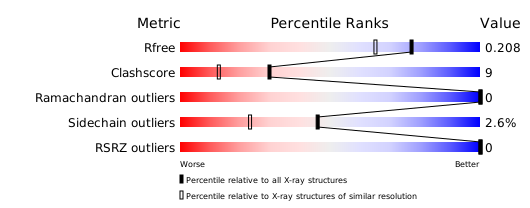
Structure validation
Download full validation report


