






 4OKO
4OKO
Crystal structure of Francisella tularensis REP34 (Rapid Encystment Phenotype Protein 34 KDa)
Summary for 4OKO
| Entry DOI | 10.2210/pdb4oko/pdb |
| Descriptor | Rapid Encystment Phenotype Protein 34 KDa, ZINC ION, ACETATE ION, ... (4 entities in total) |
| Functional Keywords | carboxypeptidase, secreted, hydrolase |
| Biological source | Francisella tularensis subsp. novicida |
| Total number of polymer chains | 4 |
| Total formula weight | 142024.38 |
| Authors | Feld, G.K.,Segelke, B.W.,Corzett, M.H.,Hunter, M.S.,Frank, M.,Rasley, A. (deposition date: 2014-01-22, release date: 2014-09-24, Last modification date: 2024-04-03) |
| Primary citation | Feld, G.K.,El-Etr, S.,Corzett, M.H.,Hunter, M.S.,Belhocine, K.,Monack, D.M.,Frank, M.,Segelke, B.W.,Rasley, A. Structure and Function of REP34 Implicates Carboxypeptidase Activity in Francisella tularensis Host Cell Invasion. J.Biol.Chem., 289:30668-30679, 2014 Cited by PubMed Abstract: Francisella tularensis is the etiological agent of tularemia, or rabbit fever. Although F. tularensis is a recognized biothreat agent with broad and expanding geographical range, its mechanism of infection and environmental persistence remain poorly understood. Previously, we identified seven F. tularensis proteins that induce a rapid encystment phenotype (REP) in the free-living amoeba, Acanthamoeba castellanii. Encystment is essential to the pathogen's long term intracellular survival in the amoeba. Here, we characterize the cellular and molecular function of REP34, a REP protein with a mass of 34 kDa. A REP34 knock-out strain of F. tularensis has a reduced ability to both induce encystment in A. castellanii and invade human macrophages. We determined the crystal structure of REP34 to 2.05-Å resolution and demonstrate robust carboxypeptidase B-like activity for the enzyme. REP34 is a zinc-containing monomeric protein with close structural homology to the metallocarboxypeptidase family of peptidases. REP34 possesses a novel topology and substrate binding pocket that deviates from the canonical funnelin structure of carboxypeptidases, putatively resulting in a catalytic role for a conserved tyrosine and distinct S1' recognition site. Taken together, these results identify REP34 as an active carboxypeptidase, implicate the enzyme as a potential key F. tularensis effector protein, and may help elucidate a mechanistic understanding of F. tularensis infection of phagocytic cells. PubMed: 25231992DOI: 10.1074/jbc.M114.599381 PDB entries with the same primary citation |
| Experimental method | X-RAY DIFFRACTION (2.053 Å) |
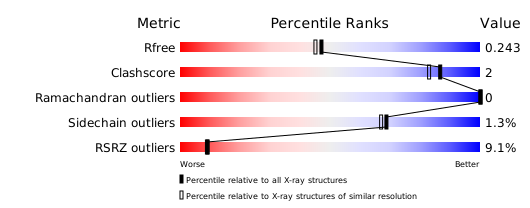
Structure validation
Download full validation report


