






 4D48
4D48
Crystal Structure of glucose-1-phosphate uridylyltransferase GalU from Erwinia amylovora.
Summary for 4D48
| Entry DOI | 10.2210/pdb4d48/pdb |
| Related | 4D47 |
| Descriptor | GLUCOSE-1-PHOSPHATE URIDYLYLTRANSFERASE (2 entities in total) |
| Functional Keywords | transferase, amylovoran biosynthesis, udp-glucose, fire blight |
| Biological source | ERWINIA AMYLOVORA |
| Total number of polymer chains | 2 |
| Total formula weight | 65845.95 |
| Authors | Toccafondi, M.,Wuerges, J.,Cianci, M.,Benini, S. (deposition date: 2014-10-27, release date: 2016-01-20, Last modification date: 2023-12-20) |
| Primary citation | Benini, S.,Toccafondi, M.,Rejzek, M.,Musiani, F.,Wagstaff, B.A.,Wuerges, J.,Cianci, M.,Field, R.A. Glucose-1-phosphate uridylyltransferase from Erwinia amylovora: Activity, structure and substrate specificity. Biochim. Biophys. Acta, 1865:1348-1357, 2017 Cited by PubMed Abstract: Erwinia amylovora, a Gram-negative plant pathogen, is the causal agent of Fire Blight, a contagious necrotic disease affecting plants belonging to the Rosaceae family, including apple and pear. E. amylovora is highly virulent and capable of rapid dissemination in orchards; effective control methods are still lacking. One of its most important pathogenicity factors is the exopolysaccharide amylovoran. Amylovoran is a branched polymer made by the repetition of units mainly composed of galactose, with some residues of glucose, glucuronic acid and pyruvate. E. amylovora glucose-1-phosphate uridylyltransferase (UDP-glucose pyrophosphorylase, EC 2.7.7.9) has a key role in amylovoran biosynthesis. This enzyme catalyses the production of UDP-glucose from glucose-1-phosphate and UTP, which the epimerase GalE converts into UDP-galactose, the main building block of amylovoran. We determined EaGalU kinetic parameters and substrate specificity with a range of sugar 1-phosphates. At time point 120min the enzyme catalysed conversion of the sugar 1-phosphate into the corresponding UDP-sugar reached 74% for N-acetyl-α-d-glucosamine 1-phosphate, 28% for α-d-galactose 1-phosphate, 0% for α-d-galactosamine 1-phosphate, 100% for α-d-xylose 1-phosphate, 100% for α-d-glucosamine 1-phosphate, 70% for α-d-mannose 1-phosphate, and 0% for α-d-galacturonic acid 1-phosphate. To explain our results we obtained the crystal structure of EaGalU and augmented our study by docking the different sugar 1-phosphates into EaGalU active site, providing both reliable models for substrate binding and enzyme specificity, and a rationale that explains the different activity of EaGalU on the sugar 1-phosphates used. These data demonstrate EaGalU potential as a biocatalyst for biotechnological purposes, as an alternative to the enzyme from Escherichia coli, besides playing an important role in E. amylovora pathogenicity. PubMed: 28844747DOI: 10.1016/j.bbapap.2017.08.015 PDB entries with the same primary citation |
| Experimental method | X-RAY DIFFRACTION (2.46 Å) |
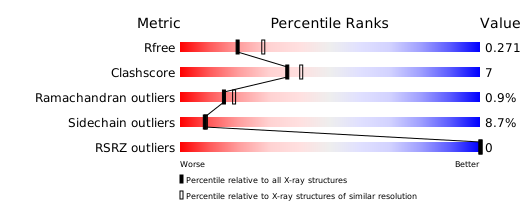
Structure validation
Download full validation report


