






 3RIW
3RIW
The Crystal Structure of Leishmania major Peroxidase mutant C197T
Summary for 3RIW
| Entry DOI | 10.2210/pdb3riw/pdb |
| Related | 3RIV |
| Descriptor | Ascorbate peroxidase, PROTOPORPHYRIN IX CONTAINING FE, CALCIUM ION, ... (5 entities in total) |
| Functional Keywords | alpha helical bundle, heme peroxidase, oxidoreductase |
| Biological source | Leishmania major |
| Total number of polymer chains | 2 |
| Total formula weight | 62778.91 |
| Authors | Jasion, V.S.,Li, H.,Poulos, T.L. (deposition date: 2011-04-14, release date: 2011-05-11, Last modification date: 2026-08-12) |
| Primary citation | Jasion, V.S.,Polanco, J.A.,Meharenna, Y.T.,Li, H.,Poulos, T.L. Crystal Structure of Leishmania major Peroxidase and Characterization of the Compound I Tryptophan Radical. J.Biol.Chem., 286:24608-24615, 2011 Cited by PubMed Abstract: The parasitic protozoa Leishmania major produces a peroxidase (L. major peroxidase; LmP) that exhibits activities characteristic of both yeast cytochrome c peroxidase (CCP) and plant cytosolic ascorbate peroxidase (APX). One common feature is a key Trp residue, Trp(208) in LmP and Trp(191) in CCP, that is situated adjacent to the proximal His heme ligand in CCP, APX, and LmP. In CCP, Trp(191) forms a stable cationic radical after reaction with H(2)O(2) to form Compound I; in APX, the radical is located on the porphyrin ring. In order to clarify the role of Trp(208) in LmP and to further probe peroxidase structure-function relationships, we have determined the crystal structure of LmP and have studied the role of Trp(208) using electron paramagnetic resonance spectroscopy (EPR), mutagenesis, and enzyme kinetics. Both CCP and LmP have an extended section of β structure near Trp(191) and Trp(208), respectively, which is absent in APX. This region provides stability to the Trp(191) radical in CCP. EPR of LmP Compound I exhibits an intense and stable signal similar to CCP Compound I. In the LmP W208F mutant, this signal disappears, indicating that Trp(208) forms a stable cationic radical. In LmP conversion of the Cys(197) to Thr significantly weakens the Compound I EPR signal and dramatically lowers enzyme activity. These results further support the view that modulation of the local electrostatic environment controls the stability of the Trp radical in peroxidases. Our results also suggest that the biological role of LmP is to function as a cytochrome c peroxidase. PubMed: 21566139DOI: 10.1074/jbc.M111.230524 PDB entries with the same primary citation |
| Experimental method | X-RAY DIFFRACTION (2.37 Å) |
Structure validation
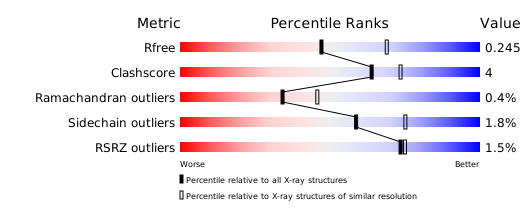
Download full validation report


