






 35UI
35UI
Crystal structure of TFPI K2 domain in complex with TFPI-24 Fab fragment
Summary for 35UI
| Entry DOI | 10.2210/pdb35ui/pdb |
| Descriptor | TFPI-24-Fab Heavy chain, TFPI-24-Fab light chain, Tissue factor pathway inhibitor, ... (5 entities in total) |
| Functional Keywords | tissue factor pathway inhibitor, antibody, fab fragment, tfpi, kunitz domain, factor xa, blood clotting |
| Biological source | Homo sapiens (human) More |
| Total number of polymer chains | 3 |
| Total formula weight | 54399.60 |
| Authors | Juo, Z.S.,Mosyak, L. (deposition date: 2026-05-18, release date: 2026-05-27, Last modification date: 2026-06-17) |
| Primary citation | Jin, M.,Hett, S.,Jasuja, R.,Rakhe, S.,Narula, J.,Tam, A.,Apgar, J.R.,Juo, Z.S.,Mosyak, L.,Holsti, M.,Joyce, A.,Hurst, S.,Webster, R.,Lin, L.,Stahl, M.,Pittman, D.D.,Bloom, L. Discovery and optimization of marstacimab, a human monoclonal antibody targeting tissue factor pathway inhibitor for the treatment of hemophilia A and B. Mabs, 18:2685362-2685362, 2026 Cited by PubMed Abstract: We report the discovery and optimization of marstacimab, a novel monoclonal antibody targeting tissue factor pathway inhibitor (TFPI), for the treatment of hemophilia A and B. Hybridoma and phage display approaches identified antibodies that blocked the TFPI: coagulation factor Xa (FXa) interaction. Antibodies bound TFPI with nanomolar affinity to multiple epitopes, including one that covered the entire FXa binding surface and others that partially overlapped the interface from different sides of the TFPI-K2 domain. Several antibodies reduced bleeding in a hemophilia A mouse injury model for up to 96 h following a single dose. Rabbit pharmacokinetic studies indicated that antibodies with ≤~1 nM TFPI-binding affinity were cleared rapidly from circulation, whereas TFPI-23 (5.72 nM) had a longer plasma residence time. Pharmacokinetic-pharmacodynamic modeling indicated that this intermediate affinity allowed circulating concentrations of antibodies such as TFPI-23 to maintain concentrations required for 50% residual activity; in contrast, higher-affinity antibodies quickly decreased to concentrations that would not effectively neutralize TFPI. The end-to-end process leading to final candidate selection incorporated rigorous assessment of biophysical properties, including thermal stability, aggregation propensity, viscosity, predicted immunogenicity, stable cell line productivity, and nonspecific binding. An optimized derivative of TFPI-23, TFPI-106 (PF-06741086, known as marstacimab), had the functional and biophysical properties with other characteristics suitable for clinical development and was selected as the final candidate. TFPI-106 elicited enhanced hemostasis in hemophilic plasma, shortened clotting time, and enhanced thrombin generation velocity. Marstacimab is now approved for patients with hemophilia A or B with or without inhibitors. PubMed: 42273738DOI: 10.1080/19420862.2026.2685362 PDB entries with the same primary citation |
| Experimental method | X-RAY DIFFRACTION (1.75 Å) |
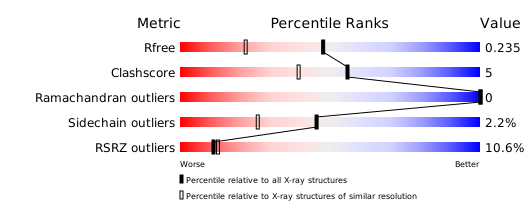
Structure validation
Download full validation report


