






 2ZFD
2ZFD
The crystal structure of plant specific calcium binding protein AtCBL2 in complex with the regulatory domain of AtCIPK14
Summary for 2ZFD
| Entry DOI | 10.2210/pdb2zfd/pdb |
| Related | 1UHN |
| Descriptor | Calcineurin B-like protein 2, Putative uncharacterized protein T20L15_90, CALCIUM ION, ... (5 entities in total) |
| Functional Keywords | calcium binding protein, protein-protein complex, atp-binding, kinase, nucleotide-binding, serine/threonine-protein kinase, transferase, signaling protein-transferase complex, signaling protein/transferase |
| Biological source | Arabidopsis thaliana (thale cress) More |
| Total number of polymer chains | 2 |
| Total formula weight | 40256.98 |
| Authors | Akaboshi, M.,Hashimoto, H.,Ishida, H.,Koizumi, N.,Sato, M.,Shimizu, T. (deposition date: 2007-12-29, release date: 2008-02-19, Last modification date: 2024-03-13) |
| Primary citation | Akaboshi, M.,Hashimoto, H.,Ishida, H.,Saijo, S.,Koizumi, N.,Sato, M.,Shimizu, T. The crystal structure of plant-specific calcium-binding protein AtCBL2 in complex with the regulatory domain of AtCIPK14 J.Mol.Biol., 377:246-257, 2008 Cited by PubMed Abstract: Calcium signals mediate a multitude of plant responses to external stimuli. Calcineurin B-like (CBL) proteins and their target kinases, CBL-interacting protein kinases (CIPKs), represent important relays in plant calcium signaling. CBL interacts with CIPK through a conserved motif (NAF/FISL motif) within the C-terminal regulatory domain. To better understand the functional role of the CBL-CIPK system, we determined the crystal structure of AtCBL2 in complex with the regulatory domain of AtCIPK14 at 1.2 A resolution. The NAF/FISL motif is inserted into a hydrophobic crevice within AtCBL2, accompanied by a large displacement of the helices and loop on the opposite side of the NAF/FISL motif from the C-terminal region, which shields the hydrophobic crevice in free form. Ca(2+) are coordinated within four EF hands in AtCBL2 in bound form. This calcium coordination pattern differs from that in the structure of the SOS3-SOS2 complex previously reported. Structural comparison of the two structures shows that the recognition of CBL by CIPK is performed in a similar manner, but inherent interactions confer binding affinity and specificity. PubMed: 18237745DOI: 10.1016/j.jmb.2008.01.006 PDB entries with the same primary citation |
| Experimental method | X-RAY DIFFRACTION (1.2 Å) |
Structure validation
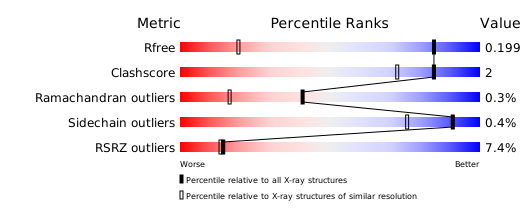
Download full validation report


