






 2P63
2P63
Suprafacial orientation of the SCFCdc4 dimer accommodates multiple geometries for substrate ubiquitination
Summary for 2P63
| Entry DOI | 10.2210/pdb2p63/pdb |
| Descriptor | Cell division control protein 4 (2 entities in total) |
| Functional Keywords | ubiquitination, helix bundle, scf complex, cell cycle |
| Biological source | Saccharomyces cerevisiae (baker's yeast) |
| Cellular location | Nucleus: P07834 |
| Total number of polymer chains | 4 |
| Total formula weight | 25719.77 |
| Authors | Orlicky, S.,Neculai, D.,Ceccarelli, D. (deposition date: 2007-03-16, release date: 2007-06-19, Last modification date: 2024-11-06) |
| Primary citation | Tang, X.,Orlicky, S.,Lin, Z.,Willems, A.,Neculai, D.,Ceccarelli, D.,Mercurio, F.,Shilton, B.H.,Sicheri, F.,Tyers, M. Suprafacial orientation of the SCFCdc4 dimer accommodates multiple geometries for substrate ubiquitination. Cell(Cambridge,Mass.), 129:1165-1176, 2007 Cited by PubMed Abstract: SCF ubiquitin ligases recruit substrates for degradation via F box protein adaptor subunits. WD40 repeat F box proteins, such as Cdc4 and beta-TrCP, contain a conserved dimerization motif called the D domain. Here, we report that the D domain protomers of yeast Cdc4 and human beta-TrCP form a superhelical homotypic dimer. Disruption of the D domain compromises the activity of yeast SCF(Cdc4) toward the CDK inhibitor Sic1 and other substrates. SCF(Cdc4) dimerization has little effect on the affinity for Sic1 but markedly stimulates ubiquitin conjugation. A model of the dimeric holo-SCF(Cdc4) complex based on small-angle X-ray scatter measurements reveals a suprafacial configuration, in which substrate-binding sites and E2 catalytic sites lie in the same plane with a separation of 64 A within and 102 A between each SCF monomer. This spatial variability may accommodate diverse acceptor lysine geometries in both substrates and the elongating ubiquitin chain and thereby increase catalytic efficiency. PubMed: 17574027DOI: 10.1016/j.cell.2007.04.042 PDB entries with the same primary citation |
| Experimental method | X-RAY DIFFRACTION (2.67 Å) |
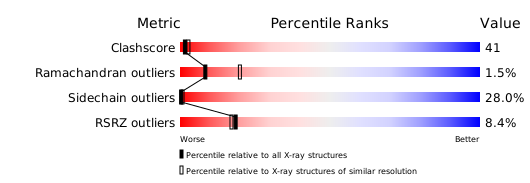
Structure validation
Download full validation report


