






 2AHF
2AHF
Unsaturated glucuronyl hydrolase mutant D88N
Summary for 2AHF
| Entry DOI | 10.2210/pdb2ahf/pdb |
| Related | 2AHG |
| Descriptor | unsaturated glucuronyl hydrolase (2 entities in total) |
| Functional Keywords | alpha6/alpha6 barrel, glycoside hydrolase family 88, hydrolase |
| Biological source | Bacillus sp. |
| Cellular location | Cytoplasm: Q9RC92 |
| Total number of polymer chains | 2 |
| Total formula weight | 85826.73 |
| Authors | Itoh, T.,Hashimoto, W.,Mikami, B.,Murata, K. (deposition date: 2005-07-28, release date: 2006-08-15, Last modification date: 2024-05-29) |
| Primary citation | Itoh, T.,Hashimoto, W.,Mikami, B.,Murata, K. Crystal Structure of Unsaturated Glucuronyl Hydrolase Complexed with Substrate: MOLECULAR INSIGHTS INTO ITS CATALYTIC REACTION MECHANISM J.Biol.Chem., 281:29807-29816, 2006 Cited by PubMed Abstract: Unsaturated glucuronyl hydrolase (UGL), which is a member of glycoside hydrolase family GH-88, is a bacterial enzyme that degrades mammalian glycosaminoglycans and bacterial biofilms. The enzyme, which acts on unsaturated oligosaccharides with an alpha-glycoside bond produced by microbial polysaccharide lyases responsible for bacterial invasion of host cells, was believed to release 4-deoxy-l-threo-5-hexosulose-uronate (unsaturated glucuronic acid, or DeltaGlcA) and saccharide with a new nonreducing terminus by hydrolyzing the glycosidic bond. We detail the crystal structures of wild-type inactive mutant UGL of Bacillus sp. GL1 and its complex with a substrate (unsaturated chondroitin disaccharide), identify active site residues, and postulate a reaction mechanism catalyzed by UGL that triggers the hydration of the vinyl ether group in DeltaGlcA, based on the structural analysis of the enzyme-substrate complex and biochemical analysis. The proposed catalytic mechanism of UGL is a novel case among known glycosidases. Under the proposed mechanism, Asp-149 acts as a general acid and base catalyst to protonate the DeltaGlcA C4 atom and to deprotonate the water molecule. The deprotonated water molecule attacks the DeltaGlcA C5 atom to yield unstable hemiketal; this is followed by spontaneous conversion to an aldehyde (4-deoxy-l-threo-5-hexosulose-uronate) and saccharide through hemiacetal formation and cleavage of the glycosidic bond. UGL is the first clarified alpha(6)/alpha(6)-barrel enzyme using aspartic acid as the general acid/base catalyst. PubMed: 16893885DOI: 10.1074/jbc.M604975200 PDB entries with the same primary citation |
| Experimental method | X-RAY DIFFRACTION (1.52 Å) |
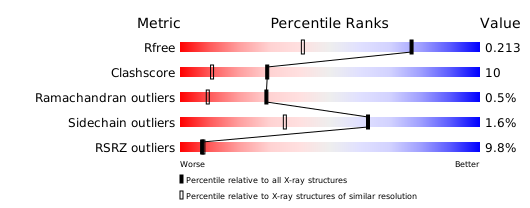
Structure validation
Download full validation report


