






 2A8B
2A8B
Crystal Structure of the Catalytic Domain of Human Tyrosine Phosphatase Receptor, Type R
「1ZEP」から置き換えられました2A8B の概要
| エントリーDOI | 10.2210/pdb2a8b/pdb |
| 関連するPDBエントリー | 1JLN |
| 分子名称 | Receptor-type tyrosine-protein phosphatase R, CHLORIDE ION (3 entities in total) |
| 機能のキーワード | protein tyrosine phosphatase, receptor, human, structural genomics, structural genomics consortium, sgc, hydrolase |
| 由来する生物種 | Homo sapiens (human) |
| 細胞内の位置 | Isoform Alpha: Cell membrane; Single-pass type I membrane protein. Isoform Delta: Cytoplasm, perinuclear region. Isoform Gamma: Cytoplasm, perinuclear region: Q15256 |
| タンパク質・核酸の鎖数 | 1 |
| 化学式量合計 | 32319.49 |
| 構造登録者 | Ugochukwu, E.,Eswaran, J.,Barr, A.,Longman, E.,Arrowsmith, C.,Edwards, A.,Sundstrom, M.,von Delft, F.,Knapp, S.,Structural Genomics Consortium (SGC) (登録日: 2005-07-07, 公開日: 2005-07-19, 最終更新日: 2023-08-23) |
| 主引用文献 | Eswaran, J.,von Kries, J.P.,Marsden, B.,Longman, E.,Debreczeni, J.E.,Ugochukwu, E.,Turnbull, A.,Lee, W.H.,Knapp, S.,Barr, A.J. Crystal structures and inhibitor identification for PTPN5, PTPRR and PTPN7: a family of human MAPK-specific protein tyrosine phosphatases. Biochem.J., 395:483-491, 2006 Cited by PubMed Abstract: Protein tyrosine phosphatases PTPN5, PTPRR and PTPN7 comprise a family of phosphatases that specifically inactivate MAPKs (mitogen-activated protein kinases). We have determined high-resolution structures of all of the human family members, screened them against a library of 24000 compounds and identified two classes of inhibitors, cyclopenta[c]quinolinecarboxylic acids and 2,5-dimethylpyrrolyl benzoic acids. Comparative structural analysis revealed significant differences within this conserved family that could be explored for the design of selective inhibitors. PTPN5 crystallized, in two distinct crystal forms, with a sulphate ion in close proximity to the active site and the WPD (Trp-Pro-Asp) loop in a unique conformation, not seen in other PTPs, ending in a 3(10)-helix. In the PTPN7 structure, the WPD loop was in the closed conformation and part of the KIM (kinase-interaction motif) was visible, which forms an N-terminal aliphatic helix with the phosphorylation site Thr66 in an accessible position. The WPD loop of PTPRR was open; however, in contrast with the structure of its mouse homologue, PTPSL, a salt bridge between the conserved lysine and aspartate residues, which has been postulated to confer a more rigid loop structure, thereby modulating activity in PTPSL, does not form in PTPRR. One of the identified inhibitor scaffolds, cyclopenta[c]quinoline, was docked successfully into PTPRR, suggesting several possibilities for hit expansion. The determined structures together with the established SAR (structure-activity relationship) propose new avenues for the development of selective inhibitors that may have therapeutic potential for treating neurodegenerative diseases in the case of PTPRR or acute myeloblastic leukaemia targeting PTPN7. PubMed: 16441242DOI: 10.1042/BJ20051931 主引用文献が同じPDBエントリー |
| 実験手法 | X-RAY DIFFRACTION (2.3 Å) |
構造検証レポート
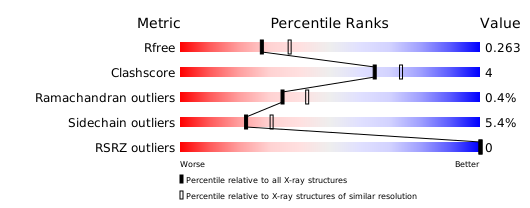
検証レポート(詳細版) をダウンロード
をダウンロード


