






 29CK
29CK
SOLUTION STRUCTURE OF GLUCAGON PEPTIDE AT pH 2.5
Summary for 29CK
| Entry DOI | 10.2210/pdb29ck/pdb |
| Related | 28TG 28UX 28UY |
| Descriptor | Pro-glucagon (1 entity in total) |
| Functional Keywords | hormone peptide, diabetes, hormone |
| Biological source | Homo sapiens (human) |
| Total number of polymer chains | 1 |
| Total formula weight | 3486.78 |
| Authors | Santoro, A.,Buonocore, M.,D'Ursi, A.M. (deposition date: 2026-03-05, release date: 2026-08-12, Last modification date: 2026-08-19) |
| Primary citation | Santoro, A.,Macis, M.,Buonocore, M.,Ricci, A.,D'Ursi, A.M. Conformational determinants of glucagon stability and aggregation kinetics in aqueous and commercial formulations. Protein Sci., 35:e70750-e70750, 2026 Cited by PubMed Abstract: Glucagon is a well-established therapeutic peptide, widely used to treat hypoglycemia. Like many peptide drugs, it offers advantages such as specificity, biocompatibility, and high affinity for receptor targets, but suffers from limited physical and chemical stability. In particular, improper conditions can promote the formation of amyloid fibrils, leading to loss of biological activity and, in some cases, cytotoxicity. Understanding the conditions that modulate the structural behavior of glucagon is therefore crucial. Currently, two injectable formulations are available on the market: a lyophilized vial of glucagon with lactose at acidic pH, and a more recent auto-injector ready-to-use (RTU) formulation containing glucagon in dimethyl sulfoxide (DMSO) with trehalose. In this study, we investigated the conformational properties of glucagon in these two marketed formulations and compared them with glucagon dissolved in aqueous solution at pH 3.5, a metastable condition prone to aggregation. Preliminary circular dichroism and fluorescence spectroscopy were used to confirm glucagon stability over time; subsequently, NMR analysis showed that structural destabilization consistently begins at the C-terminal region, while the Ser-Leu segment remains structured across all environments. These findings highlight two key determinants of glucagon stability and aggregation. Strategies that preserve the integrity of the C-terminal region while stabilizing the Ser-Leu motif may improve peptide solubility and extend shelf life, providing a rational basis for the design of next-generation glucagon formulations for emergency use. PubMed: 42557738DOI: 10.1002/pro.70750 PDB entries with the same primary citation |
| Experimental method | SOLUTION NMR |
Structure validation
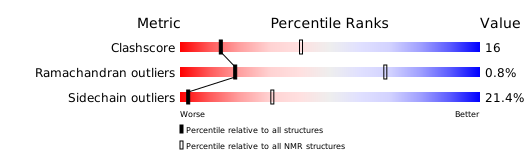
Download full validation report


