






 20YS
20YS
R583A mutant of glycogen phosphorylase from Segatella copri in the presence of AMP
Summary for 20YS
| Entry DOI | 10.2210/pdb20ys/pdb |
| EMDB information | 67418 |
| Descriptor | Alpha-glucan family phosphorylase (1 entity in total) |
| Functional Keywords | glycogen phosphorylase, transferase |
| Biological source | Segatella copri |
| Total number of polymer chains | 5 |
| Total formula weight | 505071.14 |
| Authors | Takai, M.,Fukuda, Y. (deposition date: 2025-12-03, release date: 2026-02-18, Last modification date: 2026-04-01) |
| Primary citation | Shobu, K.,Takai, M.,Tanino, H.,Fukuda, Y.,Inoue, T. Structural and mechanistic diversity of glycogen phosphorylases from gut bacteria. Proc.Natl.Acad.Sci.USA, 123:e2518513123-e2518513123, 2026 Cited by PubMed Abstract: Glycogen phosphorylase (GP) plays a central role in glycogen metabolism. While the structure and regulation of mammalian GPs have been extensively studied, the corresponding mechanisms in gut bacterial GPs remain poorly understood. Here, we investigate GPs from (GP), (GP), and (GP), which represent three phylogenetic clades of GPs, using enzymatic assays, cryo-electron microscopy (cryo-EM), and X-ray crystallography. We find that GP forms a unique pentamer that undergoes adenosine monophosphate (AMP)-dependent assembly into a dimer-of-pentamer, which inhibits activity by restricting substrate access to the catalytic site. GP exists in equilibrium among monomers, dimers, and tetramers, with AMP promoting tetramer dissociation and enhancing catalytic efficiency. In contrast, GP remains predominantly monomeric and is unresponsive to AMP. These findings uncover structural and regulatory diversity among gut bacterial GPs. Notably, the oligomeric states of GPs modulate substrate accessibility and enzyme activation, suggesting a distinct mode of allosteric regulation beyond the canonical T-to-R transition model. Because bacterial GPs contribute to the generation of glucose, their regulation may influence the composition of gut-derived metabolites that affect host glucose homeostasis and insulin sensitivity. Our study provides mechanistic insight into the structural and functional diversity of gut bacterial GPs and lays a foundation for future exploration of microbiome-mediated metabolic interactions. PubMed: 41662519DOI: 10.1073/pnas.2518513123 PDB entries with the same primary citation |
| Experimental method | ELECTRON MICROSCOPY (2.96 Å) |
Structure validation
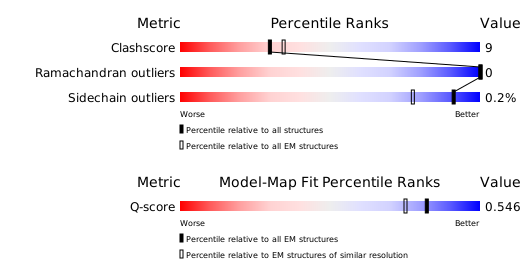
Download full validation report


