






 1BYY
1BYY
SODIUM CHANNEL IIA INACTIVATION GATE
Summary for 1BYY
| Entry DOI | 10.2210/pdb1byy/pdb |
| Descriptor | PROTEIN (SODIUM CHANNEL ALPHA-SUBUNIT) (1 entity in total) |
| Functional Keywords | sodium channel, membrane protein |
| Biological source | Rattus norvegicus (Norway rat) |
| Cellular location | Membrane; Multi-pass membrane protein: P04775 |
| Total number of polymer chains | 1 |
| Total formula weight | 6266.27 |
| Authors | Rohl, C.A.,Boeckman, F.A.,Baker, C.,Scheuer, T.,Catterall, W.A.,Klevit, R.E. (deposition date: 1998-10-21, release date: 1999-10-29, Last modification date: 2023-12-27) |
| Primary citation | Rohl, C.A.,Boeckman, F.A.,Baker, C.,Scheuer, T.,Catterall, W.A.,Klevit, R.E. Solution structure of the sodium channel inactivation gate. Biochemistry, 38:855-861, 1999 Cited by PubMed Abstract: The sodium channel initiates action potentials by opening in response to membrane depolarization. Fast channel inactivation, which is required for proper physiological function, is mediated by a cytoplasmic loop proposed to occlude the ion pore via a hinged lid mechanism with the triad IFM serving as a hydrophobic "latch". The NMR solution structure of the isolated inactivation gate reveals a stably folded core comprised of an alpha-helix capped by an N-terminal turn, supporting a model in which the tightly folded core containing the latch motif pivots on a more flexible hinge region to occlude the pore during inactivation. The structure, in combination with substituted cysteine mutagenesis experiments, indicates that the IFM triad and adjacent Thr are essential components of the latch and suggests differing roles for the residues of the IFMT motif in fast inactivation. PubMed: 9893979DOI: 10.1021/bi9823380 PDB entries with the same primary citation |
| Experimental method | SOLUTION NMR |
Structure validation
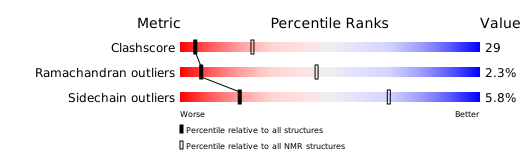
Download full validation report


