






 10IJ
10IJ
S305I Frontotemporal Lobar Degeneration (FTLD) type I tau filament
Summary for 10IJ
| Entry DOI | 10.2210/pdb10ij/pdb |
| EMDB information | 75195 |
| Descriptor | Microtubule-associated protein tau (1 entity in total) |
| Functional Keywords | tau, mapt, ftd, ftld, amyloid, neurodegeneration, protein fibril |
| Biological source | Homo sapiens More |
| Total number of polymer chains | 11 |
| Total formula weight | 127186.33 |
| Authors | Pan, H.S.,Merz, G.E.,Tse, E.,Southworth, D.R. (deposition date: 2026-01-21, release date: 2026-03-11) |
| Primary citation | Pan, H.S.,Merz, G.E.,Li, A.N.,Le, M.Q.,Jo, H.,Quddus, A.,Yung, A.,Kormos, R.C.,Melo, A.A.,Ramos, E.M.,Lago, A.L.,Spina, S.,Grinberg, L.T.,Rosen, H.J.,Tse, E.,Gorno-Tempini, M.L.,DeGrado, W.F.,Seeley, W.W.,Southworth, D.R. Distinct tau filament folds in familial frontotemporal dementia due to the MAPT S305I mutation. Biorxiv, 2026 Cited by PubMed Abstract: Frontotemporal lobar degeneration with tau inclusions (FTLD-tau) comprise a class of fatal heterogeneous neurodegenerative diseases. Approximately 10% arise from pathogenic MAPT mutations and often cause severe, early-onset disease with pathology that is distinct yet partially overlapping with sporadic cases. Here, we evaluated post-mortem tissue from a patient with FTLD-tau due to S305I showing neuropathology most consistent with argyrophilic grain disease (AGD), a prevalent limbic tauopathy of aging. Structures determined by cryo-electron microscopy reveal tau filament folds that differ from those found in sporadic AGD or other tauopathies and feature a 4-layer architecture stabilized by the Ile substitution within its core. Comparative structural analysis reveals conserved motifs are shared among AGD, corticobasal degeneration, and P301T. A well-defined density stacks along a cationic cleft, indicative of a bound RNA-like polyanion or small-molecule. analysis shows the S305I mutation promotes fibrilization relative to normal tau. These results demonstrate that stabilizes a distinct aggregation-prone tau fold that likely contributes to disease pathology and heterogeneity beyond its known splicing defects, and underscore potential limitations of using the most pathologically similar genetic form as a model for sporadic FTLD-tau. PubMed: 41726928DOI: 10.64898/2026.02.12.705620 PDB entries with the same primary citation |
| Experimental method | ELECTRON MICROSCOPY (3.1 Å) |
Structure validation
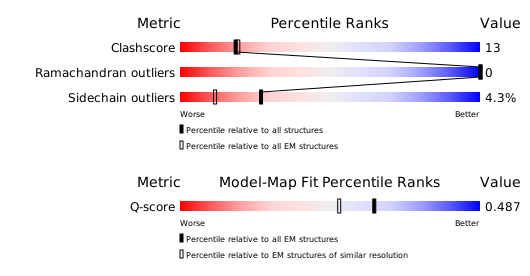
Download full validation report


