






 10EX
10EX
SK5A-Matured apo state in complex with GluN1-GluN2B, full refinement
Summary for 10EX
| Entry DOI | 10.2210/pdb10ex/pdb |
| EMDB information | 75121 |
| Descriptor | Isoform 4 of Glutamate receptor ionotropic, NMDA 1, Glutamate receptor ionotropic, NMDA 2B, Light chain, ... (4 entities in total) |
| Functional Keywords | nmdar, antibody, signaling protein, signaling protein-immune system complex, signaling protein/immune system |
| Biological source | Homo sapiens (human) More |
| Total number of polymer chains | 8 |
| Total formula weight | 409627.95 |
| Authors | Kleeman, S.O.,Furukawa, H.F. (deposition date: 2026-01-15, release date: 2026-03-25, Last modification date: 2026-06-10) |
| Primary citation | Kleeman, S.O.,Michalski, K.,Zhao, X.,Steigerwald, R.,Ferrer, M.,Levett, L.,Ertel, E.,Schultz, A.,Simorowski, N.,Moody, P.,Wee, T.L.,Valente, C.,Fox, S.,Makuch, M.,Thomsen, S.,Harrison, R.,Regan, C.,Preall, J.,Gao, Q.,Thomas, D.,Habel, J.,Rubino, R.,Irani, S.,Furukawa, H.,Janowitz, T. Ectopic NMDAR expression in cancer unmasks germline-encoded autoimmunity. Nature, 653:1216-1228, 2026 Cited by PubMed Abstract: Autoimmunity and anti-cancer immunity lie on the same biological continuum, but their link remains obscure. The paraneoplastic neurological syndrome ANRE (anti-NMDA receptor (NMDAR) encephalitis) is a paradigm for their connectivity, given that intratumoural NMDAR expression is correlated with the generation of anti-NMDAR antibodies. Here we verify ectopic expression of GluN1 and GluN2B NMDAR subunits in triple-negative breast cancer (TNBC) and model this using orthotopic TNBC tumours with inducible expression of GluN1-GluN2B NMDARs. We show that NMDAR expression is sufficient to induce the recruitment of B cells and their affinity maturation, consistent with an integrated adaptive immune response. Reconstruction of extended intratumoural B cell phylogenies and cryogenic electron microscopy structural analyses demonstrate that affinity-matured hypermutated and class-switched antibodies emerged from pre-existing germline-configuration lower-affinity anti-NMDAR antibodies. Distinct matured antibodies targeted specific epitopes and induced conformational rearrangements within the NMDAR amino-terminal domain, predictive of their functional effects, ranging from inhibition to potentiation. Passive transfer of an NMDAR-potentiating antibody caused autonomic dysregulation and lowered the seizure threshold in healthy female mice, recapitulating key diagnostic criteria of ANRE. We further identify a correlation between intratumoural NMDAR expression and anti-NMDAR antibody titres in patients with TNBC. Taken together, our data establish a direct connection between intratumoural NMDAR expression, antibody maturation and the onset of autoimmunity. These findings suggest that germline-encoded anti-NMDAR antibodies contribute to immune surveillance but can also trigger autoimmune disease after maturation, revealing a mechanistic trade-off between cancer immunity and neurotoxicity. PubMed: 41882353DOI: 10.1038/s41586-026-10278-0 PDB entries with the same primary citation |
| Experimental method | ELECTRON MICROSCOPY (4.08 Å) |
Structure validation
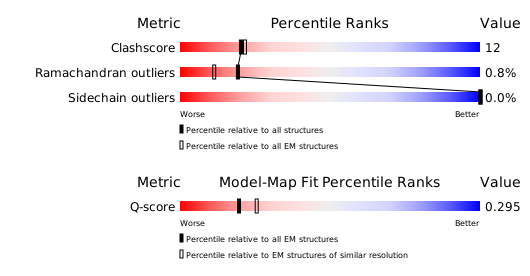
Download full validation report


