 Movie
Movie Controller

[English] 日本語
 Yorodumi
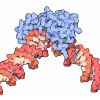
- PDB-8uqd: Crystal structure of RNF168 (RING)-UbcH5c fused to H2A-H2B via a ... -
+ Open data

- Basic information
| Entry | Database: PDB / ID: 8uqd | |||||||||
|---|---|---|---|---|---|---|---|---|---|---|
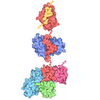
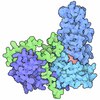
| Title | Crystal structure of RNF168 (RING)-UbcH5c fused to H2A-H2B via a 20-residue linker (condition 2. RING not modeled in density) | |||||||||
 Components Components | E3 ubiquitin-protein ligase RNF168,Ubiquitin-conjugating enzyme E2 D3,Histone H2B type 2-E,Histone H2A type 1-B/E | |||||||||
 Keywords Keywords | TRANSFERASE / RNF168 / UbcH5c / Histone H2A / Histone H2B / Chromatin / Ubiquitin ligase / Ubiquitin-conjugating enzyme / DNA damage response / DNA double-strand break repair / PROTEIN BINDING / PROTEIN BINDING-Transferase complex | |||||||||
| Function / homology |  Function and homology information Function and homology informationhistone H2AK15 ubiquitin ligase activity / histone ubiquitin ligase activity / isotype switching / Signaling by BMP / (E3-independent) E2 ubiquitin-conjugating enzyme / double-strand break repair via classical nonhomologous end joining / protein K11-linked ubiquitination / protein K6-linked ubiquitination / : / K63-linked polyubiquitin modification-dependent protein binding ...histone H2AK15 ubiquitin ligase activity / histone ubiquitin ligase activity / isotype switching / Signaling by BMP / (E3-independent) E2 ubiquitin-conjugating enzyme / double-strand break repair via classical nonhomologous end joining / protein K11-linked ubiquitination / protein K6-linked ubiquitination / : / K63-linked polyubiquitin modification-dependent protein binding / E2 ubiquitin-conjugating enzyme / response to ionizing radiation / negative regulation of transcription elongation by RNA polymerase II / negative regulation of BMP signaling pathway / ubiquitin conjugating enzyme activity / DNA repair-dependent chromatin remodeling / protein monoubiquitination / ubiquitin ligase complex / interstrand cross-link repair / protein K63-linked ubiquitination / SUMOylation of DNA damage response and repair proteins / protein autoubiquitination / nucleosome binding / protein localization to CENP-A containing chromatin / Replacement of protamines by nucleosomes in the male pronucleus / protein K48-linked ubiquitination / Packaging Of Telomere Ends / Recognition and association of DNA glycosylase with site containing an affected purine / Cleavage of the damaged purine / Deposition of new CENPA-containing nucleosomes at the centromere / positive regulation of DNA repair / Recognition and association of DNA glycosylase with site containing an affected pyrimidine / Cleavage of the damaged pyrimidine / RNA Polymerase I Promoter Opening / Inhibition of DNA recombination at telomere / protein modification process / Assembly of the ORC complex at the origin of replication / Meiotic synapsis / Regulation of endogenous retroelements by the Human Silencing Hub (HUSH) complex / TICAM1, RIP1-mediated IKK complex recruitment / ZNF598 and the Ribosome-associated Quality Trigger (RQT) complex dissociate a ribosome stalled on a no-go mRNA / DNA methylation / Condensation of Prophase Chromosomes / Chromatin modifications during the maternal to zygotic transition (MZT) / SIRT1 negatively regulates rRNA expression / HCMV Late Events / ERCC6 (CSB) and EHMT2 (G9a) positively regulate rRNA expression / IKK complex recruitment mediated by RIP1 / PINK1-PRKN Mediated Mitophagy / PRC2 methylates histones and DNA / Regulation of endogenous retroelements by KRAB-ZFP proteins / Defective pyroptosis / ubiquitin binding / HDACs deacetylate histones / Negative regulators of DDX58/IFIH1 signaling / Transcriptional regulation by small RNAs / Peroxisomal protein import / Regulation of endogenous retroelements by Piwi-interacting RNAs (piRNAs) / RNA Polymerase I Promoter Escape / Nonhomologous End-Joining (NHEJ) / Downregulation of SMAD2/3:SMAD4 transcriptional activity / epigenetic regulation of gene expression / Regulation of TNFR1 signaling / Activated PKN1 stimulates transcription of AR (androgen receptor) regulated genes KLK2 and KLK3 / RUNX1 regulates genes involved in megakaryocyte differentiation and platelet function / RING-type E3 ubiquitin transferase / Negative Regulation of CDH1 Gene Transcription / Inactivation of CSF3 (G-CSF) signaling / NoRC negatively regulates rRNA expression / G2/M DNA damage checkpoint / Formation of the beta-catenin:TCF transactivating complex / double-strand break repair via nonhomologous end joining / B-WICH complex positively regulates rRNA expression / DNA Damage/Telomere Stress Induced Senescence / Meiotic recombination / Pre-NOTCH Transcription and Translation / Oxygen-dependent proline hydroxylation of Hypoxia-inducible Factor Alpha / Activation of anterior HOX genes in hindbrain development during early embryogenesis / Transcriptional regulation of granulopoiesis / protein polyubiquitination / Metalloprotease DUBs / RMTs methylate histone arginines / innate immune response in mucosa / HCMV Early Events / ubiquitin-protein transferase activity / double-strand break repair / structural constituent of chromatin / nucleosome / ubiquitin protein ligase activity / Regulation of PD-L1(CD274) transcription / UCH proteinases / site of double-strand break / nucleosome assembly / Antigen processing: Ubiquitination & Proteasome degradation / HATs acetylate histones / E3 ubiquitin ligases ubiquitinate target proteins / Recruitment and ATM-mediated phosphorylation of repair and signaling proteins at DNA double strand breaks / MLL4 and MLL3 complexes regulate expression of PPARG target genes in adipogenesis and hepatic steatosis / RUNX1 regulates transcription of genes involved in differentiation of HSCs / Neddylation Similarity search - Function | |||||||||
| Biological species |  Homo sapiens (human) Homo sapiens (human) | |||||||||
| Method |  X-RAY DIFFRACTION / SYNCHROTRON / MOLECULAR REPLACEMENT / Resolution: 3.893 Å X-RAY DIFFRACTION / SYNCHROTRON / MOLECULAR REPLACEMENT / Resolution: 3.893 Å | |||||||||
 Authors Authors | Hu, Q. / Botuyan, M.V. / Mer, G. | |||||||||
| Funding support |  United States, 2items United States, 2items
| |||||||||
 Citation Citation | Journal: Mol Cell / Year: 2024 Title: Mechanisms of RNF168 nucleosome recognition and ubiquitylation. Authors: Qi Hu / Debiao Zhao / Gaofeng Cui / Janarjan Bhandari / James R Thompson / Maria Victoria Botuyan / Georges Mer / Abstract: RNF168 plays a central role in the DNA damage response (DDR) by ubiquitylating histone H2A at K13 and K15. These modifications direct BRCA1-BARD1 and 53BP1 foci formation in chromatin, essential for ...RNF168 plays a central role in the DNA damage response (DDR) by ubiquitylating histone H2A at K13 and K15. These modifications direct BRCA1-BARD1 and 53BP1 foci formation in chromatin, essential for cell-cycle-dependent DNA double-strand break (DSB) repair pathway selection. The mechanism by which RNF168 catalyzes the targeted accumulation of H2A ubiquitin conjugates to form repair foci around DSBs remains unclear. Here, using cryoelectron microscopy (cryo-EM), nuclear magnetic resonance (NMR) spectroscopy, and functional assays, we provide a molecular description of the reaction cycle and dynamics of RNF168 as it modifies the nucleosome and recognizes its ubiquitylation products. We demonstrate an interaction of a canonical ubiquitin-binding domain within full-length RNF168, which not only engages ubiquitin but also the nucleosome surface, clarifying how such site-specific ubiquitin recognition propels a signal amplification loop. Beyond offering mechanistic insights into a key DDR protein, our study aids in understanding site specificity in both generating and interpreting chromatin ubiquitylation. | |||||||||
| History |
|
- Structure visualization
| Structure viewer | Molecule: MolmilJmol/JSmol |
|---|
- Downloads & links
-Download
| PDBx/mmCIF format | 8uqd.cif.gz | 81 KB | Display | PDBx/mmCIF format |
|---|---|---|---|---|
| PDB format | pdb8uqd.ent.gz | 57.9 KB | Display | PDB format |
| PDBx/mmJSON format | 8uqd.json.gz | Tree view | PDBx/mmJSON format | |
| Others |  Other downloads Other downloads |
-Validation report
| Arichive directory | https://data.pdbj.org/pub/pdb/validation_reports/uq/8uqdftp://data.pdbj.org/pub/pdb/validation_reports/uq/8uqd | HTTPS FTP |
|---|
-Related structure data
| Related structure data |  8smwC  8smxC  8smyC  8smzC  8sn0C  8sn1C  8sn2C 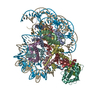 8sn3C  8sn4C  8sn5C  8sn6C  8sn7C  8sn8C  8sn9C 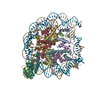 8snaC 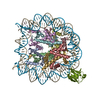 8txvC 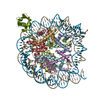 8txwC 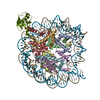 8txxC 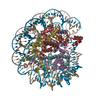 8u13C 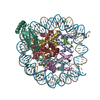 8u14C  8upfC 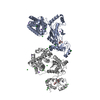 8uq8C 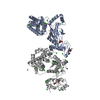 8uq9C 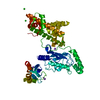 8uqaC 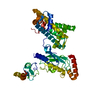 8uqbC 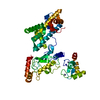 8uqcC 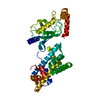 8uqeC 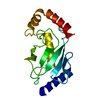 5eggS S: Starting model for refinement C: citing same article ( |
|---|---|
| Similar structure data |



-Links
 PDBj
PDBj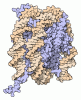

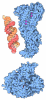
- Assembly
| Deposited unit | 
| ||||||||
|---|---|---|---|---|---|---|---|---|---|
| 1 |
| ||||||||
| Unit cell |
|
-Components
| #1: Protein | Mass: 50040.320 Da / Num. of mol.: 1 / Mutation: C85K in UbcH5c Source method: isolated from a genetically manipulated source Details: residues 1-94 of RNF168, followed by residues 2-147 of UbcH5c, followed by residues 33-123 of H2B, followed by residues 12-105 of H2A Source: (gene. exp.) Homo sapiens (human)Gene: RNF168, UBE2D3, UBC5C, UBCH5C, H2BC21, H2BFQ, HIST2H2BE, H2AC4, H2AFM, HIST1H2AB, H2AC8, H2AFA, HIST1H2AE Production host:   Escherichia coli (E. coli) Escherichia coli (E. coli)References: UniProt: Q8IYW5, UniProt: P61077, UniProt: Q16778, UniProt: P04908, RING-type E3 ubiquitin transferase, E2 ubiquitin-conjugating enzyme, (E3-independent) E2 ubiquitin-conjugating enzyme |
|---|
-Experimental details
-Experiment
| Experiment | Method: X-RAY DIFFRACTION / Number of used crystals: 1 |
|---|
- Sample preparation
| Crystal | Density Matthews: 3.77 Å3/Da / Density % sol: 67.36 % |
|---|---|
| Crystal grow | Temperature: 288 K / Method: vapor diffusion, hanging drop / pH: 6 Details: Crystals were obtained by mixing 2 microliters of the protein fusion (12 mg/mL) in 10 mM HEPES, pH 7.5, 600 mM NaCl, 1 mM TCEP and 2 microliters of the reservoir solution containing 4% ...Details: Crystals were obtained by mixing 2 microliters of the protein fusion (12 mg/mL) in 10 mM HEPES, pH 7.5, 600 mM NaCl, 1 mM TCEP and 2 microliters of the reservoir solution containing 4% tacsimate, pH 6, 13.5% PEG3350 |
-Data collection
| Diffraction | Mean temperature: 100 K / Serial crystal experiment: N |
|---|---|
| Diffraction source | Source: SYNCHROTRON / Site: APS / Beamline: 19-BM / Wavelength: 0.9792 Å |
| Detector | Type: ADSC QUANTUM 315r / Detector: CCD / Date: Nov 28, 2018 |
| Radiation | Protocol: SINGLE WAVELENGTH / Monochromatic (M) / Laue (L): M / Scattering type: x-ray |
| Radiation wavelength | Wavelength: 0.9792 Å / Relative weight: 1 |
| Reflection | Resolution: 3.893→50 Å / Num. obs: 5587 / % possible obs: 98.27 % / Redundancy: 5.1 % / CC1/2: 0.997 / CC star: 0.999 / Rmerge(I) obs: 0.1091 / Rpim(I) all: 0.04916 / Rrim(I) all: 0.1207 / Net I/σ(I): 11.47 |
| Reflection shell | Resolution: 3.893→3.97 Å / Redundancy: 5 % / Rmerge(I) obs: 0.393 / Mean I/σ(I) obs: 3.26 / Num. unique obs: 544 / CC1/2: 0.952 / CC star: 0.988 / Rpim(I) all: 0.1756 / Rrim(I) all: 0.4343 / % possible all: 99.27 |
- Processing
| Software |
| |||||||||||||||||||||||||||||||||||
|---|---|---|---|---|---|---|---|---|---|---|---|---|---|---|---|---|---|---|---|---|---|---|---|---|---|---|---|---|---|---|---|---|---|---|---|---|
| Refinement | Method to determine structure: MOLECULAR REPLACEMENT Starting model: 5EGG Resolution: 3.893→46.02 Å / SU ML: 0.61 / Cross valid method: FREE R-VALUE / σ(F): 1.34 / Phase error: 39.54 / Stereochemistry target values: ML
| |||||||||||||||||||||||||||||||||||
| Solvent computation | Shrinkage radii: 0.9 Å / VDW probe radii: 1.11 Å / Solvent model: FLAT BULK SOLVENT MODEL | |||||||||||||||||||||||||||||||||||
| Refinement step | Cycle: LAST / Resolution: 3.893→46.02 Å
| |||||||||||||||||||||||||||||||||||
| Refine LS restraints |
| |||||||||||||||||||||||||||||||||||
| LS refinement shell |
|
