negative regulation of immature T cell proliferation in thymus / negative regulation of alpha-beta T cell differentiation / Formation of lateral plate mesoderm / cholesterol-protein transferase activity / HHAT G278V doesn't palmitoylate Hh-Np / RUNX2 regulates chondrocyte maturation / Ligand-receptor interactions / positive regulation of T cell differentiation in thymus / negative regulation of T cell differentiation in thymus / somite development ...negative regulation of immature T cell proliferation in thymus / negative regulation of alpha-beta T cell differentiation / Formation of lateral plate mesoderm / cholesterol-protein transferase activity / HHAT G278V doesn't palmitoylate Hh-Np / RUNX2 regulates chondrocyte maturation / Ligand-receptor interactions / positive regulation of T cell differentiation in thymus / negative regulation of T cell differentiation in thymus / somite development / patched binding / self proteolysis / Activation of SMO / Release of Hh-Np from the secreting cell / cell fate specification / positive regulation of alpha-beta T cell differentiation / intein-mediated protein splicing / smoothened signaling pathway / Class B/2 (Secretin family receptors) / heart looping / positive regulation of smoothened signaling pathway / protein autoprocessing / maternal process involved in female pregnancy / skeletal system development / response to mechanical stimulus / liver regeneration / positive regulation of epithelial cell proliferation / Hedgehog ligand biogenesis / Hedgehog 'on' state / regulation of gene expression / peptidase activity / response to estradiol / cell-cell signaling / extracellular matrix / Hydrolases; Acting on ester bonds / Golgi membrane / calcium ion binding / negative regulation of apoptotic process / endoplasmic reticulum membrane / positive regulation of transcription by RNA polymerase II / : / plasma membrane Similarity search - Function
Muramoyl-pentapeptide Carboxypeptidase; domain 2 - #10 / Hedgehog, N-terminal signalling domain / Hedgehog protein / Hedgehog protein, Hint domain / : / Hint module / Hedgehog amino-terminal signalling domain / Muramoyl-pentapeptide Carboxypeptidase; domain 2 / Hedgehog signalling/DD-peptidase zinc-binding domain superfamily / Hint domain C-terminal ...Muramoyl-pentapeptide Carboxypeptidase; domain 2 - #10 / Hedgehog, N-terminal signalling domain / Hedgehog protein / Hedgehog protein, Hint domain / : / Hint module / Hedgehog amino-terminal signalling domain / Muramoyl-pentapeptide Carboxypeptidase; domain 2 / Hedgehog signalling/DD-peptidase zinc-binding domain superfamily / Hint domain C-terminal / Hint (Hedgehog/Intein) domain C-terminal region / Intein N-terminal splicing region / Intein N-terminal splicing motif profile. / Hint domain N-terminal / Hint (Hedgehog/Intein) domain N-terminal region / Hint domain superfamily / 2-Layer Sandwich / Alpha Beta Similarity search - Domain/homology
In the structure databanks used in Yorodumi, some data are registered as the other names, "COVID-19 virus" and "2019-nCoV". Here are the details of the virus and the list of structure data.
Jan 31, 2019. EMDB accession codes are about to change! (news from PDBe EMDB page)
EMDB accession codes are about to change! (news from PDBe EMDB page)
The allocation of 4 digits for EMDB accession codes will soon come to an end. Whilst these codes will remain in use, new EMDB accession codes will include an additional digit and will expand incrementally as the available range of codes is exhausted. The current 4-digit format prefixed with “EMD-” (i.e. EMD-XXXX) will advance to a 5-digit format (i.e. EMD-XXXXX), and so on. It is currently estimated that the 4-digit codes will be depleted around Spring 2019, at which point the 5-digit format will come into force.
The EM Navigator/Yorodumi systems omit the EMD- prefix.
Related info.:Q: What is EMD? / ID/Accession-code notation in Yorodumi/EM Navigator
Yorodumi is a browser for structure data from EMDB, PDB, SASBDB, etc.
This page is also the successor to EM Navigator detail page, and also detail information page/front-end page for Omokage search.
The word "yorodu" (or yorozu) is an old Japanese word meaning "ten thousand". "mi" (miru) is to see.
Related info.:EMDB / PDB / SASBDB / Comparison of 3 databanks / Yorodumi Search / Aug 31, 2016. New EM Navigator & Yorodumi / Yorodumi Papers / Jmol/JSmol / Function and homology information / Changes in new EM Navigator and Yorodumi
 Movie
Movie Controller

 Yorodumi
 Open data
 Basic information
 Components
 Keywords
 Function and homology information
 Homo sapiens (human)
 X-RAY DIFFRACTION /
  Authors
 Citation
 Structure visualization
 Downloads & links
 Other downloads




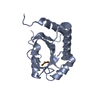

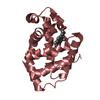
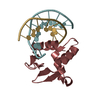
 PDBj
PDBj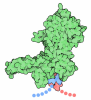
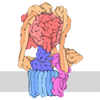
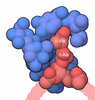
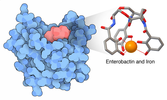
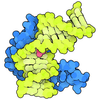
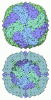
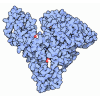
 Assembly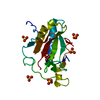

 Escherichia coli (E. coli) / Strain (production host): Rosseta / References: UniProt: Q14623
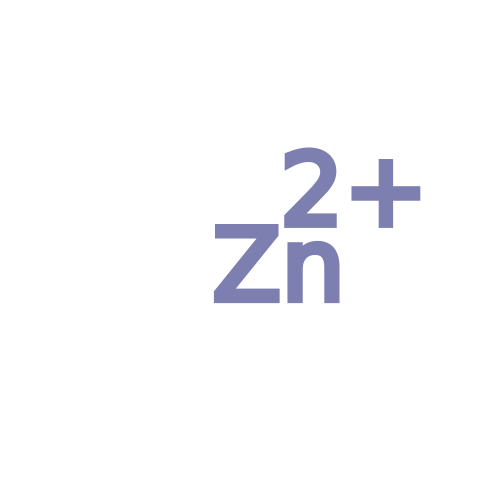 Mass: 65.409 Da / Num. of mol.: 1 / Source method: obtained synthetically / Formula: Zn
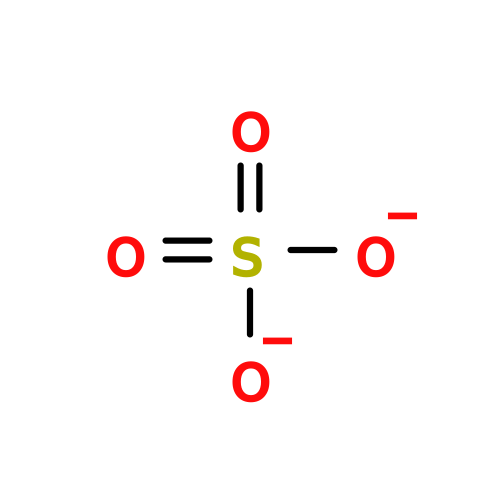 Mass: 96.063 Da / Num. of mol.: 5 / Source method: obtained synthetically / Formula: SO4
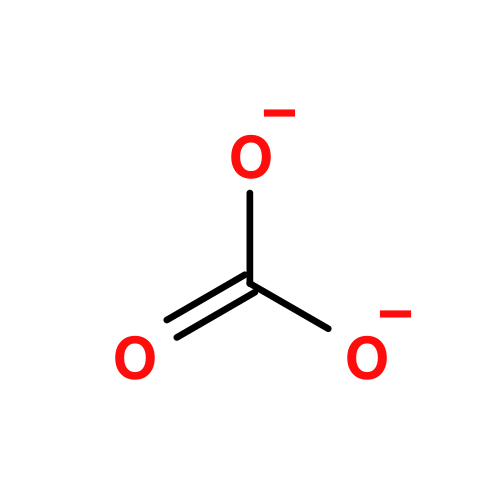 Mass: 60.009 Da / Num. of mol.: 1 / Source method: obtained synthetically / Formula: CO3
 Mass: 18.015 Da / Num. of mol.: 102 / Source method: isolated from a natural source / Formula: H2O
 Sample preparation
 Processing