 Movie
Movie Controller

[English] 日本語
 Yorodumi
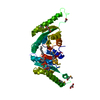
- PDB-2yt1: Solution structure of the chimera of the C-terminal tail peptide ... -
+ Open data

- Basic information
| Entry | Database: PDB / ID: 2yt1 | ||||||
|---|---|---|---|---|---|---|---|
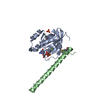
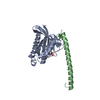
| Title | Solution structure of the chimera of the C-terminal tail peptide of APP and the C-terminal PID domain of Fe65L | ||||||
 Components Components | Amyloid beta A4 protein and Amyloid beta A4 precursor protein-binding family B member 2 | ||||||
 Keywords Keywords | PROTEIN BINDING / Chimera / Fe65L / PID domain / amyloid precursor protein / Structural Genomics / NPPSFA / National Project on Protein Structural and Functional Analyses / RIKEN Structural Genomics/Proteomics Initiative / RSGI | ||||||
| Function / homology |  Function and homology information Function and homology informationnegative regulation of cell cycle phase transition / regulation of response to calcium ion / positive regulation of protein import / Formyl peptide receptors bind formyl peptides and many other ligands / cytosolic mRNA polyadenylation / regulation of neurotransmitter uptake / regulation of endoplasmic reticulum stress-induced neuron intrinsic apoptotic signaling pathway / positive regulation of response to endoplasmic reticulum stress / negative regulation of presynapse assembly / Advanced glycosylation endproduct receptor signaling ...negative regulation of cell cycle phase transition / regulation of response to calcium ion / positive regulation of protein import / Formyl peptide receptors bind formyl peptides and many other ligands / cytosolic mRNA polyadenylation / regulation of neurotransmitter uptake / regulation of endoplasmic reticulum stress-induced neuron intrinsic apoptotic signaling pathway / positive regulation of response to endoplasmic reticulum stress / negative regulation of presynapse assembly / Advanced glycosylation endproduct receptor signaling / smooth endoplasmic reticulum calcium ion homeostasis / positive regulation of gene expression, epigenetic / endosome to plasma membrane transport vesicle / low-density lipoprotein particle mediated signaling / ECM proteoglycans / phospholipase D-activating G protein-coupled receptor signaling pathway / Insertion of tail-anchored proteins into the endoplasmic reticulum membrane / regulation of dendritic spine maintenance / negative regulation of blood circulation / positive regulation of endothelin production / positive regulation of Toll signaling pathway / maintenance of lens transparency / TRAF6 mediated NF-kB activation / response to yeast / Lysosome Vesicle Biogenesis / positive regulation of G protein-coupled receptor internalization / regulation of toll-like receptor signaling pathway / positive regulation of long-term synaptic depression / Regulation of Insulin-like Growth Factor (IGF) transport and uptake by Insulin-like Growth Factor Binding Proteins (IGFBPs) / Post-translational protein phosphorylation / protein trimerization / G alpha (q) signalling events / TAK1-dependent IKK and NF-kappa-B activation / positive regulation of amyloid precursor protein catabolic process / lipoprotein particle / regulation of amyloid-beta clearance / intermediate-density lipoprotein particle / synaptic assembly at neuromuscular junction / Platelet degranulation / RAGE receptor binding / smooth muscle contraction / ciliary rootlet / G alpha (i) signalling events / antifungal humoral response / regulation of amyloid fibril formation / very-low-density lipoprotein particle / positive regulation of G protein-coupled receptor signaling pathway / Mitochondrial protein degradation / low-density lipoprotein particle / neuromuscular process controlling balance / suckling behavior / high-density lipoprotein particle / COPII-coated ER to Golgi transport vesicle / acetylcholine receptor binding / frizzled binding / amyloid-beta complex / growth cone lamellipodium / cellular response to norepinephrine stimulus / positive regulation of monocyte chemotaxis / collateral sprouting in absence of injury / growth cone filopodium / microglia development / forebrain development / hippocampal neuron apoptotic process / heparan sulfate proteoglycan binding / positive regulation of membrane protein ectodomain proteolysis / axo-dendritic transport / axon midline choice point recognition / regulation of synapse structure or activity / positive regulation of synaptic transmission, cholinergic / positive regulation of extrinsic apoptotic signaling pathway / astrocyte activation involved in immune response / negative regulation of dendritic spine maintenance / regulation of spontaneous synaptic transmission / negative regulation of protein localization to nucleus / negative regulation of neuron differentiation / mating behavior / growth factor receptor binding / positive regulation of cAMP/PKA signal transduction / presynaptic active zone / positive regulation of amyloid fibril formation / peptidase activator activity / PTB domain binding / Golgi-associated vesicle / neuron remodeling / astrocyte projection / spindle midzone / regulation of multicellular organism growth / dendrite development / nuclear envelope lumen / chemoattractant activity / intracellular vesicle / smooth endoplasmic reticulum / positive regulation of protein metabolic process / negative regulation of Wnt signaling pathway / negative regulation of long-term synaptic potentiation / signaling receptor activator activity / associative learning / cholesterol metabolic process / regulation of MAPK cascade Similarity search - Function | ||||||
| Biological species |   Mus musculus (house mouse) Mus musculus (house mouse) | ||||||
| Method | SOLUTION NMR / torsion angle dynamics | ||||||
 Authors Authors | Li, H. / Koshiba, S. / Watanabe, S. / Harada, T. / Kigawa, T. / Yokoyama, S. / RIKEN Structural Genomics/Proteomics Initiative (RSGI) | ||||||
 Citation Citation | Journal: J.Biol.Chem. / Year: 2008 Title: Structure of the C-terminal phosphotyrosine interaction domain of Fe65L1 complexed with the cytoplasmic tail of amyloid precursor protein reveals a novel peptide binding mode Authors: Li, H. / Koshiba, S. / Hayashi, F. / Tochio, N. / Tomizawa, T. / Kasai, T. / Yabuki, T. / Motoda, Y. / Harada, T. / Watanabe, S. / Inoue, M. / Hayashizaki, Y. / Tanaka, A. / Kigawa, T. / Yokoyama, S. | ||||||
| History |
| ||||||
| Remark 650 | HELIX Determination method: Author determined | ||||||
| Remark 700 | SHEET Determination method: Author determined |
- Structure visualization
| Structure viewer | Molecule: MolmilJmol/JSmol |
|---|
- Downloads & links
-Download
| PDBx/mmCIF format | 2yt1.cif.gz | 1 MB | Display | PDBx/mmCIF format |
|---|---|---|---|---|
| PDB format | pdb2yt1.ent.gz | 882.4 KB | Display | PDB format |
| PDBx/mmJSON format | 2yt1.json.gz | Tree view | PDBx/mmJSON format | |
| Others |  Other downloads Other downloads |
-Validation report
| Arichive directory | https://data.pdbj.org/pub/pdb/validation_reports/yt/2yt1ftp://data.pdbj.org/pub/pdb/validation_reports/yt/2yt1 | HTTPS FTP |
|---|
-Related structure data
| Related structure data |  1wguC  2rozC  2yszC  2yt0C C: citing same article ( |
|---|---|
| Similar structure data | |
| Other databases |



-Links
 PDBj
PDBj
- Assembly
| Deposited unit | 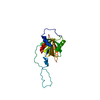
| |||||||||
|---|---|---|---|---|---|---|---|---|---|---|
| 1 |
| |||||||||
| NMR ensembles |
|
-Components
| #1: Protein | Mass: 20007.113 Da / Num. of mol.: 1 / Fragment: APP peptide and PID domain Source method: isolated from a genetically manipulated source Source: (gene. exp.) Mus musculus (house mouse) / Description: cell-free protein synthesis / Plasmid: P060710-08 / References: UniProt: P12023, UniProt: Q9DBR4 |
|---|
-Experimental details
-Experiment
| Experiment | Method: SOLUTION NMR | ||||||||||||
|---|---|---|---|---|---|---|---|---|---|---|---|---|---|
| NMR experiment |
|
- Sample preparation
| Details | Contents: 1.00mM chimera sample U-15N, 13C; 20mM d-Tris-HCl; 100mM NaCl; 1mM d-DTT; 0.02% NaN3; 90% H2O, 10% D2O Solvent system: 90% H2O/10% D2O |
|---|---|
| Sample conditions | Ionic strength: 120mM / pH: 7 / Pressure: ambient / Temperature: 296 K |
-NMR measurement
| NMR spectrometer | Type: Bruker AVANCE / Manufacturer: Bruker / Model: AVANCE / Field strength: 900 MHz |
|---|
- Processing
| NMR software |
| ||||||||||||||||||||||||||||
|---|---|---|---|---|---|---|---|---|---|---|---|---|---|---|---|---|---|---|---|---|---|---|---|---|---|---|---|---|---|
| Refinement | Method: torsion angle dynamics / Software ordinal: 1 | ||||||||||||||||||||||||||||
| NMR representative | Selection criteria: lowest energy | ||||||||||||||||||||||||||||
| NMR ensemble | Conformer selection criteria: structures with the least restraint violations, target function Conformers calculated total number: 100 / Conformers submitted total number: 20 |
 NMRPipe