[English] 日本語
Yorodumi
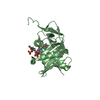
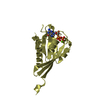
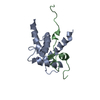
- PDB-2kje: NMR structure of CBP TAZ2 and adenoviral E1A complex -

+
Open data


ID or keywords:

Loading...

-
Basic information

Entry
Database: PDB / ID: 2kje
TitleNMR structure of CBP TAZ2 and adenoviral E1A complex
Components
  • CREB-binding protein
  • Early E1A 32 kDa protein
KeywordsTRANSCRIPTION / CBP / TAZ2 / E1A / adenoviral / Acetylation / Activator / Bromodomain / Chromosomal rearrangement / Disease mutation / Host-virus interaction / Isopeptide bond / Metal-binding / Methylation / Nucleus / Phosphoprotein / Transcription regulation / Transferase / Ubl conjugation / Zinc / Zinc-finger / Alternative splicing / DNA-binding / Early protein / Oncogene
Function / homology
Function and homology information


regulation by virus of viral protein levels in host cell / Phosphorylation of CLOCK, acetylation of BMAL1 (ARNTL) at target gene promoters / The CRY:PER:kinase complex represses transactivation by the BMAL:CLOCK (ARNTL:CLOCK) complex / positive regulation of protein sumoylation / peptide lactyltransferase (CoA-dependent) activity / NFE2L2 regulating ER-stress associated genes / NFE2L2 regulating inflammation associated genes / Activation of the TFAP2 (AP-2) family of transcription factors / histone H3K18 acetyltransferase activity / N-terminal peptidyl-lysine acetylation ...regulation by virus of viral protein levels in host cell / Phosphorylation of CLOCK, acetylation of BMAL1 (ARNTL) at target gene promoters / The CRY:PER:kinase complex represses transactivation by the BMAL:CLOCK (ARNTL:CLOCK) complex / positive regulation of protein sumoylation / peptide lactyltransferase (CoA-dependent) activity / NFE2L2 regulating ER-stress associated genes / NFE2L2 regulating inflammation associated genes / Activation of the TFAP2 (AP-2) family of transcription factors / histone H3K18 acetyltransferase activity / N-terminal peptidyl-lysine acetylation / histone H3K27 acetyltransferase activity / NFE2L2 regulates pentose phosphate pathway genes / LRR FLII-interacting protein 1 (LRRFIP1) activates type I IFN production / regulation of smoothened signaling pathway / NFE2L2 regulating MDR associated enzymes / MRF binding / Phosphorylated BMAL1:CLOCK (ARNTL:CLOCK) activates expression of core clock genes / RUNX1 regulates transcription of genes involved in differentiation of myeloid cells / Regulation of gene expression in late stage (branching morphogenesis) pancreatic bud precursor cells / Regulation of FOXO transcriptional activity by acetylation / RUNX3 regulates NOTCH signaling / NOTCH4 Intracellular Domain Regulates Transcription / Regulation of NFE2L2 gene expression / Nuclear events mediated by NFE2L2 / Regulation of gene expression by Hypoxia-inducible Factor / negative regulation of transcription by RNA polymerase I / NOTCH3 Intracellular Domain Regulates Transcription / TRAF6 mediated IRF7 activation / NFE2L2 regulating tumorigenic genes / NFE2L2 regulating anti-oxidant/detoxification enzymes / embryonic digit morphogenesis / protein acetylation / Notch-HLH transcription pathway / Formation of paraxial mesoderm / acetyltransferase activity / positive regulation of transforming growth factor beta receptor signaling pathway / FOXO-mediated transcription of cell death genes / stimulatory C-type lectin receptor signaling pathway / homeostatic process / Zygotic genome activation (ZGA) / TP53 Regulates Transcription of Genes Involved in Cytochrome C Release / symbiont-mediated perturbation of host cell cycle G1/S transition checkpoint / histone acetyltransferase activity / molecular sequestering activity / histone acetyltransferase complex / protein-lysine-acetyltransferase activity / canonical NF-kappaB signal transduction / cAMP/PKA signal transduction / Attenuation phase / RORA,B,C and NR1D1 (REV-ERBA) regulate gene expression / Expression of BMAL (ARNTL), CLOCK, and NPAS2 / histone acetyltransferase / regulation of cellular response to heat / positive regulation of double-strand break repair via homologous recombination / Regulation of lipid metabolism by PPARalpha / NPAS4 regulates expression of target genes / symbiont-mediated suppression of host JAK-STAT cascade via inhibition of STAT1 activity / cellular response to nutrient levels / Transcriptional and post-translational regulation of MITF-M expression and activity / CD209 (DC-SIGN) signaling / BMAL1:CLOCK,NPAS2 activates circadian expression / Transferases; Acyltransferases; Transferring groups other than aminoacyl groups / SUMOylation of transcription cofactors / Activation of gene expression by SREBF (SREBP) / Heme signaling / PPARA activates gene expression / Transcriptional activation of mitochondrial biogenesis / Cytoprotection by HMOX1 / Formation of the beta-catenin:TCF transactivating complex / chromatin DNA binding / Transcriptional regulation of white adipocyte differentiation / positive regulation of protein localization to nucleus / Evasion by RSV of host interferon responses / NOTCH1 Intracellular Domain Regulates Transcription / Pre-NOTCH Transcription and Translation / protein destabilization / Constitutive Signaling by NOTCH1 PEST Domain Mutants / Constitutive Signaling by NOTCH1 HD+PEST Domain Mutants / tau protein binding / transcription coactivator binding / Activation of anterior HOX genes in hindbrain development during early embryogenesis / p53 binding / cellular response to UV / transcription corepressor activity / rhythmic process / regulation of protein localization / HATs acetylate histones / MLL4 and MLL3 complexes regulate expression of PPARG target genes in adipogenesis and hepatic steatosis / protein-containing complex assembly / TRAF3-dependent IRF activation pathway / transcription regulator complex / Estrogen-dependent gene expression / DNA-binding transcription factor binding / molecular adaptor activity / damaged DNA binding / RNA polymerase II-specific DNA-binding transcription factor binding / symbiont-mediated perturbation of host ubiquitin-like protein modification / response to hypoxia / transcription coactivator activity / symbiont-mediated suppression of host innate immune response
Similarity search - Function
Adenovirus early E1A protein / Early E1A protein / CREB-binding Protein; Chain A / TAZ domain / Nuclear receptor coactivator, CREB-bp-like, interlocking / Nuclear receptor coactivator, CREB-bp-like, interlocking domain superfamily / Creb binding / Zinc finger, TAZ-type / TAZ domain superfamily / TAZ zinc finger ...Adenovirus early E1A protein / Early E1A protein / CREB-binding Protein; Chain A / TAZ domain / Nuclear receptor coactivator, CREB-bp-like, interlocking / Nuclear receptor coactivator, CREB-bp-like, interlocking domain superfamily / Creb binding / Zinc finger, TAZ-type / TAZ domain superfamily / TAZ zinc finger / Zinc finger TAZ-type profile. / TAZ zinc finger, present in p300 and CBP / : / Histone acetyltransferase p300-like, PHD domain / Coactivator CBP, KIX domain / CREB-binding protein/p300, atypical RING domain / CBP/p300-type histone acetyltransferase domain / CBP/p300, atypical RING domain superfamily / KIX domain / CREB-binding protein/p300, atypical RING domain / KIX domain profile. / CBP/p300-type histone acetyltransferase (HAT) domain profile. / Histone acetyltransferase Rtt109/CBP / Histone acetylation protein / Histone acetylation protein / Coactivator CBP, KIX domain superfamily / Zinc finger ZZ-type signature. / Zinc finger, ZZ type / Zinc-binding domain, present in Dystrophin, CREB-binding protein. / Zinc finger, ZZ-type / Zinc finger, ZZ-type superfamily / Zinc finger ZZ-type profile. / Nuclear receptor coactivator, interlocking / Bromodomain, conserved site / Bromodomain signature. / Bromodomain / bromo domain / Bromodomain / Bromodomain (BrD) profile. / Bromodomain-like superfamily / Zinc finger, RING/FYVE/PHD-type / Up-down Bundle / Mainly Alpha
Similarity search - Domain/homology
Early E1A protein / CREB-binding protein
Similarity search - Component
Biological speciesHomo sapiens (human)
Human adenovirus 5
MethodSOLUTION NMR / molecular dynamics
Model detailslowest energy, model 1
AuthorsFerreon, J.C. / Martinez-Yamout, M. / Dyson, H. / Wright, P.E.
CitationJournal: Proc.Natl.Acad.Sci.USA / Year: 2009
Title: Structural basis for subversion of cellular control mechanisms by the adenoviral E1A oncoprotein.
Authors: Ferreon, J.C. / Martinez-Yamout, M.A. / Dyson, H.J. / Wright, P.E.
History
DepositionMay 27, 2009Deposition site: BMRB / Processing site: RCSB
Revision 1.0Sep 15, 2009Provider: repository / Type: Initial release
Revision 1.1Jul 13, 2011Group: Version format compliance
Revision 1.2Mar 16, 2022Group: Data collection / Database references / Derived calculations
Category: database_2 / pdbx_nmr_software ...database_2 / pdbx_nmr_software / pdbx_nmr_spectrometer / pdbx_struct_assembly / pdbx_struct_oper_list / struct_conn / struct_ref_seq_dif / struct_site
Item: _database_2.pdbx_DOI / _database_2.pdbx_database_accession ..._database_2.pdbx_DOI / _database_2.pdbx_database_accession / _pdbx_nmr_software.name / _pdbx_nmr_spectrometer.model / _struct_conn.ptnr1_auth_comp_id / _struct_conn.ptnr1_auth_seq_id / _struct_conn.ptnr1_label_asym_id / _struct_conn.ptnr1_label_atom_id / _struct_conn.ptnr1_label_comp_id / _struct_conn.ptnr1_label_seq_id / _struct_conn.ptnr2_auth_comp_id / _struct_conn.ptnr2_auth_seq_id / _struct_conn.ptnr2_label_asym_id / _struct_conn.ptnr2_label_atom_id / _struct_conn.ptnr2_label_comp_id / _struct_conn.ptnr2_label_seq_id / _struct_ref_seq_dif.details / _struct_site.pdbx_auth_asym_id / _struct_site.pdbx_auth_comp_id / _struct_site.pdbx_auth_seq_id
Revision 1.3May 22, 2024Group: Data collection / Category: chem_comp_atom / chem_comp_bond

-
Structure visualization

Structure viewerMolecule:
MolmilJmol/JSmol

Downloads & links

-
Assembly

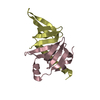
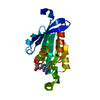
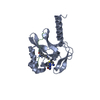
Deposited unit
A: CREB-binding protein
B: Early E1A 32 kDa protein
hetero molecules


Theoretical massNumber of molelcules
Total (without water)15,1895
Polymers14,9922
Non-polymers1963
Water00
1


  • Idetical with deposited unit
  • defined by author
TypeNameSymmetry operationNumber
identity operation1_555x,y,z1
NMR ensembles
DataCriteria
Number of conformers (submitted / calculated)20 / 200structures with the lowest energy
RepresentativeModel #1lowest energy

-
Components

#1: Protein CREB-binding protein


Mass: 10527.567 Da / Num. of mol.: 1 / Fragment: UNP residues 1763-1854
Source method: isolated from a genetically manipulated source
Source: (gene. exp.) Homo sapiens (human) / Gene: CREBBP, CBP / Plasmid: pET21a / Production host: Escherichia coli (E. coli) / References: UniProt: Q92793, histone acetyltransferase

#2: Protein/peptide Early E1A 32 kDa protein


Mass: 4464.908 Da / Num. of mol.: 1 / Fragment: UNP residues 53-91
Source method: isolated from a genetically manipulated source
Source: (gene. exp.) Human adenovirus 5 / Plasmid: pET21a / Production host: Escherichia coli (E. coli) / References: UniProt: P03255
#3: Chemical ChemComp-ZN / ZINC ION


Mass: 65.409 Da / Num. of mol.: 3 / Source method: obtained synthetically / Formula: Zn

-
Experimental details

-
Experiment

ExperimentMethod: SOLUTION NMR
NMR experiment
Conditions-IDExperiment-IDSolution-IDType
1112D 1H-15N HSQC
1213D HNCA

-
Sample preparation

DetailsContents: 1-1.5 mM [U-100% 13C; U-100% 15N] TRIS-1, 1-1.5 mM [U-100% 15N] TRIS-2, 100% D2O
Solvent system: 100% D2O
Sample
UnitsComponentIsotopic labelingConc. range (mg/ml)Solution-ID
mMTRIS-1[U-100% 13C; U-100% 15N]1-1.51
mMTRIS-2[U-100% 15N]1-1.51
Sample conditionsIonic strength: 0 / pH: 6.8 / Pressure: ambient / Temperature: 298 K

-
NMR measurement

NMR spectrometer
TypeManufacturerModelField strength (MHz)Spectrometer-ID
Bruker DRXBrukerDRX6001
Bruker DRXBrukerDRX8002
Bruker AvanceBrukerAVANCE9003

-
Processing

NMR software
NameDeveloperClassification
AmberCase, Darden, Cheatham, III, Simmerling, Wang, Duke, Luo, ... and Kollmdata analysis
AmberCase, Darden, Cheatham, III, Simmerling, Wang, Duke, Luo, ... and Kollmrefinement
RefinementMethod: molecular dynamics / Software ordinal: 1
NMR representativeSelection criteria: lowest energy
NMR ensembleConformer selection criteria: structures with the lowest energy
Conformers calculated total number: 200 / Conformers submitted total number: 20

+
About Yorodumi

-
News

-
Feb 9, 2022. New format data for meta-information of EMDB entries

New format data for meta-information of EMDB entries

  • Version 3 of the EMDB header file is now the official format.
  • The previous official version 1.9 will be removed from the archive.

Related info.:EMDB header

External links:wwPDB to switch to version 3 of the EMDB data model

-
Aug 12, 2020. Covid-19 info

Covid-19 info

URL: https://pdbj.org/emnavi/covid19.php

New page: Covid-19 featured information page in EM Navigator.

Related info.:Covid-19 info / Mar 5, 2020. Novel coronavirus structure data

+
Mar 5, 2020. Novel coronavirus structure data

Novel coronavirus structure data

Related info.:Yorodumi Speices / Aug 12, 2020. Covid-19 info

External links:COVID-19 featured content - PDBj / Molecule of the Month (242):Coronavirus Proteases

+
Jan 31, 2019. EMDB accession codes are about to change! (news from PDBe EMDB page)

EMDB accession codes are about to change! (news from PDBe EMDB page)

  • The allocation of 4 digits for EMDB accession codes will soon come to an end. Whilst these codes will remain in use, new EMDB accession codes will include an additional digit and will expand incrementally as the available range of codes is exhausted. The current 4-digit format prefixed with “EMD-” (i.e. EMD-XXXX) will advance to a 5-digit format (i.e. EMD-XXXXX), and so on. It is currently estimated that the 4-digit codes will be depleted around Spring 2019, at which point the 5-digit format will come into force.
  • The EM Navigator/Yorodumi systems omit the EMD- prefix.

Related info.:Q: What is EMD? / ID/Accession-code notation in Yorodumi/EM Navigator

External links:EMDB Accession Codes are Changing Soon! / Contact to PDBj

+
Jul 12, 2017. Major update of PDB

Major update of PDB

  • wwPDB released updated PDB data conforming to the new PDBx/mmCIF dictionary.
  • This is a major update changing the version number from 4 to 5, and with Remediation, in which all the entries are updated.
  • In this update, many items about electron microscopy experimental information are reorganized (e.g. em_software).
  • Now, EM Navigator and Yorodumi are based on the updated data.

External links:wwPDB Remediation / Enriched Model Files Conforming to OneDep Data Standards Now Available in the PDB FTP Archive

-
Yorodumi

Thousand views of thousand structures

  • Yorodumi is a browser for structure data from EMDB, PDB, SASBDB, etc.
  • This page is also the successor to EM Navigator detail page, and also detail information page/front-end page for Omokage search.
  • The word "yorodu" (or yorozu) is an old Japanese word meaning "ten thousand". "mi" (miru) is to see.

Related info.:EMDB / PDB / SASBDB / Comparison of 3 databanks / Yorodumi Search / Aug 31, 2016. New EM Navigator & Yorodumi / Yorodumi Papers / Jmol/JSmol / Function and homology information / Changes in new EM Navigator and Yorodumi

Read more