leading edge cell differentiation / positive regulation of aldosterone biosynthetic process / positive regulation of aldosterone secretion / positive regulation of clathrin-dependent endocytosis / positive regulation of Wnt signaling pathway, planar cell polarity pathway / positive regulation of early endosome to late endosome transport / clathrin coat assembly / clathrin-coated vesicle membrane / response to salt / clathrin-cargo adaptor activity ...leading edge cell differentiation / positive regulation of aldosterone biosynthetic process / positive regulation of aldosterone secretion / positive regulation of clathrin-dependent endocytosis / positive regulation of Wnt signaling pathway, planar cell polarity pathway / positive regulation of early endosome to late endosome transport / clathrin coat assembly / clathrin-coated vesicle membrane / response to salt / clathrin-cargo adaptor activity / negative regulation of androgen receptor signaling pathway / Formation of annular gap junctions / Gap junction degradation / response to steroid hormone / clathrin-coated vesicle / cargo receptor activity / low-density lipoprotein particle receptor binding / SMAD binding / positive regulation of SMAD protein signal transduction / positive regulation of endocytosis / negative regulation of protein localization to plasma membrane / positive regulation of epithelial to mesenchymal transition / positive regulation of substrate adhesion-dependent cell spreading / transforming growth factor beta receptor signaling pathway / clathrin-coated pit / receptor-mediated endocytosis / cellular response to epidermal growth factor stimulus / negative regulation of canonical Wnt signaling pathway / negative regulation of ERK1 and ERK2 cascade / negative regulation of cell growth / negative regulation of epithelial cell proliferation / Wnt signaling pathway / negative regulation of neuron projection development / positive regulation of proteasomal ubiquitin-dependent protein catabolic process / Cargo recognition for clathrin-mediated endocytosis / protein transport / Clathrin-mediated endocytosis / positive regulation of cell migration / lysosomal membrane / focal adhesion / apoptotic process / negative regulation of apoptotic process / perinuclear region of cytoplasm / negative regulation of transcription by RNA polymerase II / positive regulation of transcription by RNA polymerase II / plasma membrane / cytosol / cytoplasm Similarity search - Function
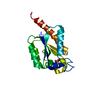
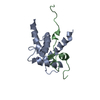
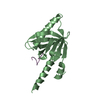
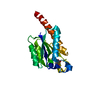
Evidence: gel filtration, The purified Dab2-DH construct is a monomer in solution, isothermal titration calorimetry, ITC experiments demonstrate a 1:1 binding between the peptide STA02 and Dab2-DH protein.
Evidence: gel filtration, The purified Dab2-DH construct is a monomer in solution, isothermal titration calorimetry, ITC experiments demonstrate a 1:1 binding between the peptide STA02 and Dab2-DH protein.
In the structure databanks used in Yorodumi, some data are registered as the other names, "COVID-19 virus" and "2019-nCoV". Here are the details of the virus and the list of structure data.
Jan 31, 2019. EMDB accession codes are about to change! (news from PDBe EMDB page)
EMDB accession codes are about to change! (news from PDBe EMDB page)
The allocation of 4 digits for EMDB accession codes will soon come to an end. Whilst these codes will remain in use, new EMDB accession codes will include an additional digit and will expand incrementally as the available range of codes is exhausted. The current 4-digit format prefixed with “EMD-” (i.e. EMD-XXXX) will advance to a 5-digit format (i.e. EMD-XXXXX), and so on. It is currently estimated that the 4-digit codes will be depleted around Spring 2019, at which point the 5-digit format will come into force.
The EM Navigator/Yorodumi systems omit the EMD- prefix.
Related info.:Q: What is EMD? / ID/Accession-code notation in Yorodumi/EM Navigator
Yorodumi is a browser for structure data from EMDB, PDB, SASBDB, etc.
This page is also the successor to EM Navigator detail page, and also detail information page/front-end page for Omokage search.
The word "yorodu" (or yorozu) is an old Japanese word meaning "ten thousand". "mi" (miru) is to see.
Related info.:EMDB / PDB / SASBDB / Comparison of 3 databanks / Yorodumi Search / Aug 31, 2016. New EM Navigator & Yorodumi / Yorodumi Papers / Jmol/JSmol / Function and homology information / Changes in new EM Navigator and Yorodumi
 Movie
Movie Controller

 Yorodumi
 Open data
 Basic information
 Components
 Keywords
 Function and homology information
 Homo sapiens (human)
 X-RAY DIFFRACTION /
  Authors
 United States, 3items
  Citation
 Structure visualization
 Downloads & links
 Other downloads

 PDBj
PDBj
 Assembly
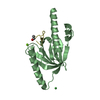

 Escherichia coli (E. coli) / References: UniProt: P98082
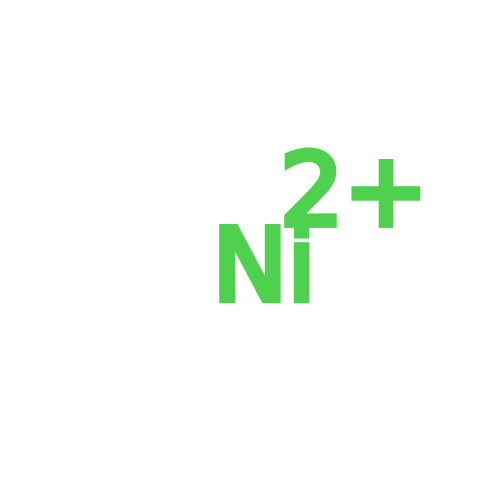 Mass: 58.693 Da / Num. of mol.: 4 / Source method: obtained synthetically / Formula: Ni
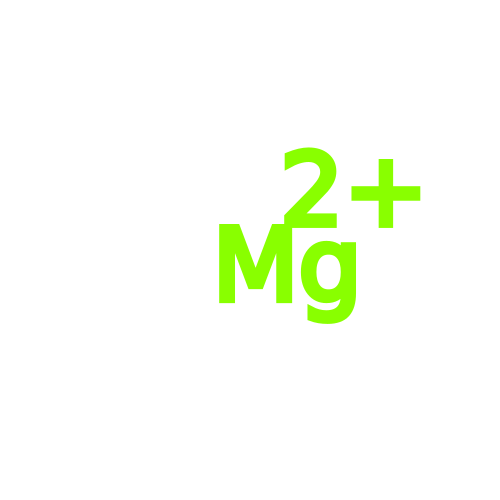 Mass: 24.305 Da / Num. of mol.: 2 / Source method: obtained synthetically / Formula: Mg
 Mass: 18.015 Da / Num. of mol.: 343 / Source method: isolated from a natural source / Formula: H2O
 Sample preparation
 Processing