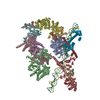
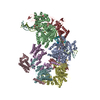
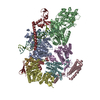
Movie
Movie Controller


+ Open data

- Basic information
| Entry | Database: PDB / ID: 9pcp | ||||||||||||||||||||||||
|---|---|---|---|---|---|---|---|---|---|---|---|---|---|---|---|---|---|---|---|---|---|---|---|---|---|
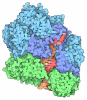
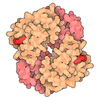
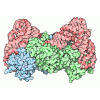
| Title | NER dual incision complex - NoG | ||||||||||||||||||||||||
 Components Components |
| ||||||||||||||||||||||||
 Keywords Keywords | DNA binding protein/DNA / NER / XPA / XPG / XPF / DNA binding protein / DNA binding protein-DNA complex | ||||||||||||||||||||||||
| Function / homology |  Function and homology information Function and homology informationheteroduplex DNA loop binding / positive regulation of t-circle formation / pyrimidine dimer repair by nucleotide-excision repair / telomeric DNA-containing double minutes formation / ERCC4-ERCC1 complex / negative regulation of protection from non-homologous end joining at telomere / nucleotide-excision repair factor 2 complex / nucleotide-excision repair factor 1 complex / nucleotide-excision repair involved in interstrand cross-link repair / XPC complex ...heteroduplex DNA loop binding / positive regulation of t-circle formation / pyrimidine dimer repair by nucleotide-excision repair / telomeric DNA-containing double minutes formation / ERCC4-ERCC1 complex / negative regulation of protection from non-homologous end joining at telomere / nucleotide-excision repair factor 2 complex / nucleotide-excision repair factor 1 complex / nucleotide-excision repair involved in interstrand cross-link repair / XPC complex / nucleotide-excision repair, DNA damage recognition / nucleotide-excision repair complex / MMXD complex / core TFIIH complex portion of holo TFIIH complex / photoreceptor connecting cilium / regulation of proteasomal ubiquitin-dependent protein catabolic process / negative regulation of telomere maintenance / DNA damage sensor activity / Cytosolic iron-sulfur cluster assembly / single-stranded DNA endonuclease activity / central nervous system myelin formation / heterotrimeric G-protein binding / transcription export complex 2 / positive regulation of mitotic recombination / resolution of meiotic recombination intermediates / hair cell differentiation / nucleotide-excision repair factor 3 complex / histone H4K20 demethylase activity / nucleotide-excision repair, preincision complex assembly / hair follicle maturation / response to auditory stimulus / t-circle formation / nuclear pore nuclear basket / CAK-ERCC2 complex / embryonic cleavage / mitotic recombination / bubble DNA binding / cellular response to interleukin-7 / UV protection / Oxidoreductases; Acting on paired donors, with incorporation or reduction of molecular oxygen; With 2-oxoglutarate as one donor, and incorporation of one atom of oxygen into each donor / regulation of cyclin-dependent protein serine/threonine kinase activity / response to UV-B / transcription factor TFIIH core complex / transcription factor TFIIH holo complex / G protein-coupled receptor internalization / mitotic intra-S DNA damage checkpoint signaling / DNA 5'-3' helicase / hematopoietic stem cell proliferation / nuclear thyroid hormone receptor binding / transcription preinitiation complex / RNA Polymerase I Transcription Termination / negative regulation of telomere maintenance via telomere lengthening / UV-damage excision repair / transcription factor TFIID complex / erythrocyte maturation / HDR through Single Strand Annealing (SSA) / RNA polymerase II general transcription initiation factor activity / regulation of mitotic cell cycle phase transition / bone mineralization / RNA Pol II CTD phosphorylation and interaction with CE during HIV infection / RNA Pol II CTD phosphorylation and interaction with CE / hematopoietic stem cell differentiation / Formation of the Early Elongation Complex / Formation of the HIV-1 Early Elongation Complex / spinal cord development / mRNA Capping / HIV Transcription Initiation / RNA Polymerase II HIV Promoter Escape / Transcription of the HIV genome / RNA Polymerase II Promoter Escape / RNA Polymerase II Transcription Pre-Initiation And Promoter Opening / RNA Polymerase II Transcription Initiation / RNA Polymerase II Transcription Initiation And Promoter Clearance / centriole replication / ATPase activator activity / proteasome binding / DNA topological change / TFIID-class transcription factor complex binding / intrinsic apoptotic signaling pathway by p53 class mediator / RNA Polymerase I Transcription Initiation / DNA 3'-5' helicase / embryonic organ development / post-embryonic development / 3'-5' DNA helicase activity / response to UV / protein localization to nucleus / polyubiquitin modification-dependent protein binding / Tat-mediated elongation of the HIV-1 transcript / Formation of HIV-1 elongation complex containing HIV-1 Tat / mismatch repair / SUMOylation of DNA damage response and repair proteins / Formation of HIV elongation complex in the absence of HIV Tat / mRNA export from nucleus / RNA Polymerase II Transcription Elongation / Formation of RNA Pol II elongation complex / hormone-mediated signaling pathway / extracellular matrix organization / determination of adult lifespan / site of DNA damage / transcription elongation by RNA polymerase I Similarity search - Function | ||||||||||||||||||||||||
| Biological species |  Homo sapiens (human) Homo sapiens (human)synthetic construct (others) | ||||||||||||||||||||||||
| Method | ELECTRON MICROSCOPY / single particle reconstruction / cryo EM / Resolution: 4.3 Å | ||||||||||||||||||||||||
 Authors Authors | Kim, J. / Li, C.L. / Yang, W. | ||||||||||||||||||||||||
| Funding support |  United States, 1items United States, 1items
| ||||||||||||||||||||||||
 Citation Citation | Journal: Nature / Year: 2026 Title: Pre-incision structures reveal principles of DNA nucleotide excision repair. Authors: Eric C L Li / Jinseok Kim / Sem J Brussee / Kaoru Sugasawa / Martijn S Luijsterburg / Wei Yang /   Abstract: Nucleotide excision repair (NER) removes bulky adducts from genomic DNA and prevents the ultraviolet light-sensitivity disease xeroderma pigmentosum, cancer and premature ageing. After initial lesion ...Nucleotide excision repair (NER) removes bulky adducts from genomic DNA and prevents the ultraviolet light-sensitivity disease xeroderma pigmentosum, cancer and premature ageing. After initial lesion recognition by XPC in global genome repair or by stalled RNA polymerases in transcription-coupled repair, a lesion and surrounding DNA duplex are unwound by TFIIH, which includes the ATPases XPB and XPD, and additional NER factors XPA, XPF, XPG and RPA, to form a DNA bubble comprising around 27 nucleotides. The double strand-single strand (ds-ss) junction-specific endonucleases XPF and XPG cleave DNA on the 5' and 3' sides of the lesion, respectively. Here we report the functional steps and atomic structures of the ATPase-driven and lesion-dependent DNA bubble formation and arrangement of the complete NER factors for dual incision. The unwinding of nearly 30 base pairs of DNA depends mainly on the double strand DNA translocase XPB and the duplex dividers XPA and XPF. XPD binds the lesion strand with XPF at the 5' ds-ss junction. XPF cuts the lesion strand only after XPG binds the 3' ds-ss junction. The ERCC1 subunit of XPF facilitates DNA strand separation and recruitment of RPA to the non-lesion strand. These findings provide insights on the causes of human diseases and potential targets for enhancing chemotherapeutic efficacy. | ||||||||||||||||||||||||
| History |
|
- Structure visualization
| Structure viewer | Molecule: MolmilJmol/JSmol |
|---|
- Downloads & links
-Download
| PDBx/mmCIF format | 9pcp.cif.gz | 863.7 KB | Display | PDBx/mmCIF format |
|---|---|---|---|---|
| PDB format | pdb9pcp.ent.gz | 670.3 KB | Display | PDB format |
| PDBx/mmJSON format | 9pcp.json.gz | Tree view | PDBx/mmJSON format | |
| Others |  Other downloads Other downloads |
-Validation report
| Arichive directory | https://data.pdbj.org/pub/pdb/validation_reports/pc/9pcpftp://data.pdbj.org/pub/pdb/validation_reports/pc/9pcp | HTTPS FTP |
|---|
-Related structure data
| Related structure data |  71512MC  9pd3C  9pd4C  9pd5C  9xyuC M: map data used to model this data C: citing same article ( |
|---|---|
| Similar structure data |


-Links
 PDBj
PDBj
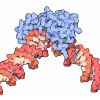
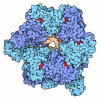
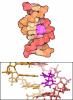
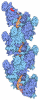
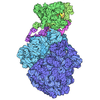
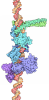
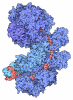
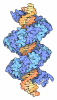
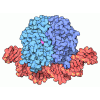



- Assembly
| Deposited unit | 
|
|---|---|
| 1 |
|
-Components
-Protein , 6 types, 6 molecules ABIJQR
| #1: Protein | Mass: 89404.734 Da / Num. of mol.: 1 Source method: isolated from a genetically manipulated source Source: (gene. exp.) Homo sapiens (human) / Gene: ERCC3, XPB, XPBC / Production host:   Spodoptera frugiperda (fall armyworm) / References: UniProt: P19447, DNA helicase Spodoptera frugiperda (fall armyworm) / References: UniProt: P19447, DNA helicase |
|---|---|
| #2: Protein | Mass: 88018.047 Da / Num. of mol.: 1 Source method: isolated from a genetically manipulated source Source: (gene. exp.) Homo sapiens (human) / Gene: ERCC2, XPD, XPDC / Production host: Spodoptera frugiperda (fall armyworm) / References: UniProt: P18074, DNA helicase |
| #9: Protein | Mass: 43203.914 Da / Num. of mol.: 1 Source method: isolated from a genetically manipulated source Source: (gene. exp.) Homo sapiens (human) / Gene: RAD23B / Production host:   Escherichia coli (E. coli) / References: UniProt: P54727 Escherichia coli (E. coli) / References: UniProt: P54727 |
| #10: Protein | Mass: 19769.486 Da / Num. of mol.: 1 Source method: isolated from a genetically manipulated source Source: (gene. exp.) Homo sapiens (human) / Gene: CETN2, CALT, CEN2 / Production host: Escherichia coli (E. coli) / References: UniProt: P41208 |
| #14: Protein | Mass: 104636.156 Da / Num. of mol.: 1 Source method: isolated from a genetically manipulated source Source: (gene. exp.) Homo sapiens (human) / Gene: ERCC4, ERCC11, XPF / Production host: Homo sapiens (human)References: UniProt: Q92889, Hydrolases; Acting on ester bonds |
| #15: Protein | Mass: 32598.301 Da / Num. of mol.: 1 Source method: isolated from a genetically manipulated source Source: (gene. exp.) Homo sapiens (human) / Gene: ERCC1 / Production host: Homo sapiens (human) / References: UniProt: P07992 |
-General transcription factor IIH subunit ... , 5 types, 5 molecules CDEFG
| #3: Protein | Mass: 62116.492 Da / Num. of mol.: 1 Source method: isolated from a genetically manipulated source Source: (gene. exp.) Homo sapiens (human) / Gene: GTF2H1, BTF2 / Production host: Spodoptera frugiperda (fall armyworm) / References: UniProt: P32780 |
|---|---|
| #4: Protein | Mass: 52245.156 Da / Num. of mol.: 1 Source method: isolated from a genetically manipulated source Source: (gene. exp.) Homo sapiens (human) / Gene: GTF2H4 / Production host: Spodoptera frugiperda (fall armyworm) / References: UniProt: Q92759 |
| #5: Protein | Mass: 44481.996 Da / Num. of mol.: 1 Source method: isolated from a genetically manipulated source Source: (gene. exp.) Homo sapiens (human) / Gene: GTF2H2, BTF2P44 / Production host: Spodoptera frugiperda (fall armyworm) / References: UniProt: Q13888 |
| #6: Protein | Mass: 34416.008 Da / Num. of mol.: 1 Source method: isolated from a genetically manipulated source Source: (gene. exp.) Homo sapiens (human) / Gene: GTF2H3 / Production host: Spodoptera frugiperda (fall armyworm) / References: UniProt: Q13889 |
| #7: Protein | Mass: 8060.362 Da / Num. of mol.: 1 Source method: isolated from a genetically manipulated source Source: (gene. exp.) Homo sapiens (human) / Gene: GTF2H5, C6orf175, TTDA / Production host: Spodoptera frugiperda (fall armyworm) / References: UniProt: Q6ZYL4 |
-DNA repair protein complementing XP- ... , 2 types, 2 molecules HK
| #8: Protein | Mass: 106171.312 Da / Num. of mol.: 1 Source method: isolated from a genetically manipulated source Source: (gene. exp.) Homo sapiens (human) / Gene: XPC, XPCC / Production host: Spodoptera frugiperda (fall armyworm) / References: UniProt: Q01831 |
|---|---|
| #11: Protein | Mass: 31422.053 Da / Num. of mol.: 1 Source method: isolated from a genetically manipulated source Source: (gene. exp.) Homo sapiens (human) / Gene: XPA, XPAC / Production host: Escherichia coli (E. coli) / References: UniProt: P23025 |
-DNA chain , 2 types, 2 molecules LM
| #12: DNA chain | Mass: 28705.611 Da / Num. of mol.: 1 / Source method: obtained synthetically / Source: (synth.) synthetic construct (others) |
|---|---|
| #13: DNA chain | Mass: 29180.648 Da / Num. of mol.: 1 / Source method: obtained synthetically / Source: (synth.) synthetic construct (others) |
-Non-polymers , 3 types, 9 molecules 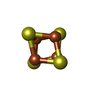


| #16: Chemical | ChemComp-SF4 / 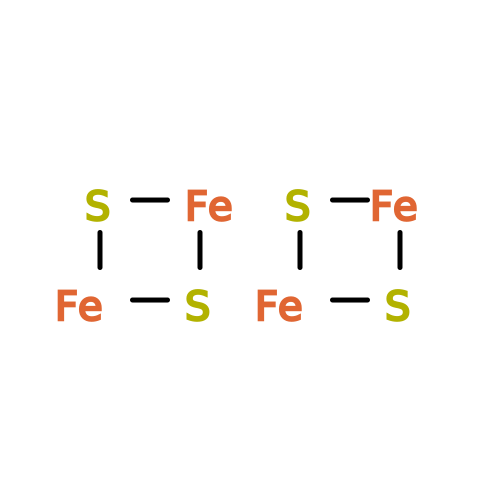 Mass: 351.640 Da / Num. of mol.: 1 / Source method: obtained synthetically / Formula: Fe4S4 Mass: 351.640 Da / Num. of mol.: 1 / Source method: obtained synthetically / Formula: Fe4S4 | ||
|---|---|---|---|
| #17: Chemical | ChemComp-ZN /  Mass: 65.409 Da / Num. of mol.: 6 / Source method: obtained synthetically / Formula: Zn Mass: 65.409 Da / Num. of mol.: 6 / Source method: obtained synthetically / Formula: Zn#18: Chemical | 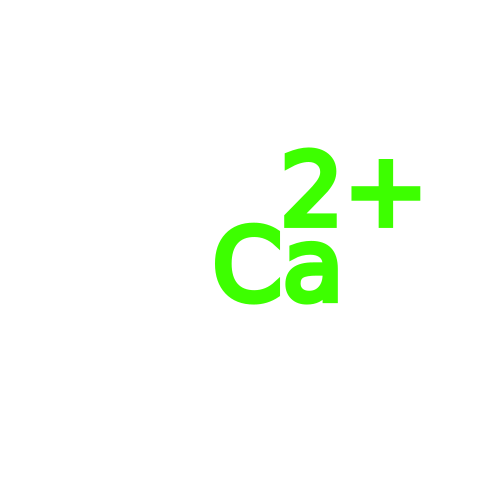 Mass: 40.078 Da / Num. of mol.: 2 / Source method: obtained synthetically / Formula: Ca Mass: 40.078 Da / Num. of mol.: 2 / Source method: obtained synthetically / Formula: Ca |
-Details
| Has ligand of interest | N |
|---|---|
| Has protein modification | Y |
-Experimental details
-Experiment
| Experiment | Method: ELECTRON MICROSCOPY |
|---|---|
| EM experiment | Aggregation state: PARTICLE / 3D reconstruction method: single particle reconstruction |
- Sample preparation
| Component | Name: NER dual incision complex without XPG / Type: COMPLEX / Entity ID: #1-#15 / Source: RECOMBINANT | |||||||||||||||||||||||||||||||||||
|---|---|---|---|---|---|---|---|---|---|---|---|---|---|---|---|---|---|---|---|---|---|---|---|---|---|---|---|---|---|---|---|---|---|---|---|---|
| Molecular weight | Value: 0.88 MDa / Experimental value: NO | |||||||||||||||||||||||||||||||||||
| Source (natural) | Organism: Homo sapiens (human) | |||||||||||||||||||||||||||||||||||
| Source (recombinant) | Organism: Spodoptera frugiperda (fall armyworm) | |||||||||||||||||||||||||||||||||||
| Buffer solution | pH: 7.9 | |||||||||||||||||||||||||||||||||||
| Buffer component |
| |||||||||||||||||||||||||||||||||||
| Specimen | Conc.: 0.6 mg/ml / Embedding applied: NO / Shadowing applied: NO / Staining applied: NO / Vitrification applied: YES | |||||||||||||||||||||||||||||||||||
| Specimen support | Grid material: COPPER / Grid mesh size: 300 divisions/in. / Grid type: Quantifoil R1.2/1.3 | |||||||||||||||||||||||||||||||||||
| Vitrification | Instrument: FEI VITROBOT MARK IV / Cryogen name: ETHANE / Humidity: 100 % / Chamber temperature: 277.15 K |
- Electron microscopy imaging
| Experimental equipment |  Model: Titan Krios / Image courtesy: FEI Company |
|---|---|
| Microscopy | Model: TFS KRIOS |
| Electron gun | Electron source:  FIELD EMISSION GUN / Accelerating voltage: 300 kV / Illumination mode: FLOOD BEAM FIELD EMISSION GUN / Accelerating voltage: 300 kV / Illumination mode: FLOOD BEAM |
| Electron lens | Mode: BRIGHT FIELD / Nominal magnification: 105000 X / Nominal defocus max: 2400 nm / Nominal defocus min: 800 nm / Cs: 2.7 mm / C2 aperture diameter: 70 µm / Alignment procedure: COMA FREE |
| Specimen holder | Cryogen: NITROGEN / Specimen holder model: FEI TITAN KRIOS AUTOGRID HOLDER |
| Image recording | Electron dose: 55.8 e/Å2 / Film or detector model: GATAN K3 (6k x 4k) |
- Processing
| EM software |
| ||||||||||||||||||||||||||||||||||||||||
|---|---|---|---|---|---|---|---|---|---|---|---|---|---|---|---|---|---|---|---|---|---|---|---|---|---|---|---|---|---|---|---|---|---|---|---|---|---|---|---|---|---|
| CTF correction | Type: PHASE FLIPPING AND AMPLITUDE CORRECTION | ||||||||||||||||||||||||||||||||||||||||
| Symmetry | Point symmetry: C1 (asymmetric) | ||||||||||||||||||||||||||||||||||||||||
| 3D reconstruction | Resolution: 4.3 Å / Resolution method: FSC 0.143 CUT-OFF / Num. of particles: 81380 / Algorithm: FOURIER SPACE / Symmetry type: POINT | ||||||||||||||||||||||||||||||||||||||||
| Atomic model building | Protocol: AB INITIO MODEL / Space: REAL | ||||||||||||||||||||||||||||||||||||||||
| Atomic model building |
| ||||||||||||||||||||||||||||||||||||||||
| Refinement | Stereochemistry target values: REAL-SPACE (WEIGHTED MAP SUM AT ATOM CENTERS) | ||||||||||||||||||||||||||||||||||||||||
| Refine LS restraints |
|