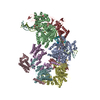
General transcription and DNA repair factor IIH helicase subunit XPD / General transcription and DNA repair factor IIH helicase/translocase subunit XPB / DNA repair protein complementing XP-A cells / General transcription factor IIH subunit 1 / DNA repair protein complementing XP-C cells / General transcription factor IIH subunit 2 / General transcription factor IIH subunit 3 / General transcription factor IIH subunit 5 / General transcription factor IIH subunit 4 Similarity search - Component
Biological species
Homo sapiens (human) / synthetic construct (others)
Method
single particle reconstruction / cryo EM / Resolution: 3.5 Å
National Institutes of Health/National Institute of Diabetes and Digestive and Kidney Disease (NIH/NIDDK)
DK075037
United States
Citation
Journal: Nature / Year: 2026 Title: Pre-incision structures reveal principles of DNA nucleotide excision repair. Authors: Eric C L Li / Jinseok Kim / Sem J Brussee / Kaoru Sugasawa / Martijn S Luijsterburg / Wei Yang / Abstract: Nucleotide excision repair (NER) removes bulky adducts from genomic DNA and prevents the ultraviolet light-sensitivity disease xeroderma pigmentosum, cancer and premature ageing. After initial lesion ...Nucleotide excision repair (NER) removes bulky adducts from genomic DNA and prevents the ultraviolet light-sensitivity disease xeroderma pigmentosum, cancer and premature ageing. After initial lesion recognition by XPC in global genome repair or by stalled RNA polymerases in transcription-coupled repair, a lesion and surrounding DNA duplex are unwound by TFIIH, which includes the ATPases XPB and XPD, and additional NER factors XPA, XPF, XPG and RPA, to form a DNA bubble comprising around 27 nucleotides. The double strand-single strand (ds-ss) junction-specific endonucleases XPF and XPG cleave DNA on the 5' and 3' sides of the lesion, respectively. Here we report the functional steps and atomic structures of the ATPase-driven and lesion-dependent DNA bubble formation and arrangement of the complete NER factors for dual incision. The unwinding of nearly 30 base pairs of DNA depends mainly on the double strand DNA translocase XPB and the duplex dividers XPA and XPF. XPD binds the lesion strand with XPF at the 5' ds-ss junction. XPF cuts the lesion strand only after XPG binds the 3' ds-ss junction. The ERCC1 subunit of XPF facilitates DNA strand separation and recruitment of RPA to the non-lesion strand. These findings provide insights on the causes of human diseases and potential targets for enhancing chemotherapeutic efficacy.
UniProtKB: General transcription and DNA repair factor IIH helicase/translocase subunit XPB
+
Macromolecule #2: General transcription and DNA repair factor IIH helicase subunit XPD
Macromolecule
Name: General transcription and DNA repair factor IIH helicase subunit XPD type: protein_or_peptide / ID: 2 / Number of copies: 1 / Enantiomer: LEVO / EC number: DNA helicase
Name: ZINC ION / type: ligand / ID: 13 / Number of copies: 6 / Formula: ZN
Molecular weight
Theoretical: 65.409 Da
-
Experimental details
-
Structure determination
Method
cryo EM
Processing
single particle reconstruction
Aggregation state
particle
-
Sample preparation
Concentration
0.4 mg/mL
Buffer
pH: 8 Component:
Concentration
Formula
Name
100.0 mM
KOAc
potassium acetate
25.0 mM
Tris
2-Amino-2-(hydroxymethyl)propane-1,3-diol
2.0 mM
CaCl2
calcium chloride
2.0 mM
TCEP
(Tris(2-carboxyethyl)phospine)
1.0 %
Glycerol
glycerol
0.05 %
C14H28O6
Octyl glucoside
Vitrification
Cryogen name: ETHANE / Chamber humidity: 100 % / Chamber temperature: 277.15 K / Instrument: FEI VITROBOT MARK IV
-
Electron microscopy
Microscope
TFS KRIOS
Image recording
Film or detector model: GATAN K3 (6k x 4k) / Number grids imaged: 1 / Number real images: 13842 / Average exposure time: 3.0 sec. / Average electron dose: 50.0 e/Å2
Electron beam
Acceleration voltage: 300 kV / Electron source: FIELD EMISSION GUN
In the structure databanks used in Yorodumi, some data are registered as the other names, "COVID-19 virus" and "2019-nCoV". Here are the details of the virus and the list of structure data.
Jan 31, 2019. EMDB accession codes are about to change! (news from PDBe EMDB page)
EMDB accession codes are about to change! (news from PDBe EMDB page)
The allocation of 4 digits for EMDB accession codes will soon come to an end. Whilst these codes will remain in use, new EMDB accession codes will include an additional digit and will expand incrementally as the available range of codes is exhausted. The current 4-digit format prefixed with “EMD-” (i.e. EMD-XXXX) will advance to a 5-digit format (i.e. EMD-XXXXX), and so on. It is currently estimated that the 4-digit codes will be depleted around Spring 2019, at which point the 5-digit format will come into force.
The EM Navigator/Yorodumi systems omit the EMD- prefix.
Related info.:Q: What is EMD? / ID/Accession-code notation in Yorodumi/EM Navigator
Yorodumi is a browser for structure data from EMDB, PDB, SASBDB, etc.
This page is also the successor to EM Navigator detail page, and also detail information page/front-end page for Omokage search.
The word "yorodu" (or yorozu) is an old Japanese word meaning "ten thousand". "mi" (miru) is to see.
Related info.:EMDB / PDB / SASBDB / Comparison of 3 databanks / Yorodumi Search / Aug 31, 2016. New EM Navigator & Yorodumi / Yorodumi Papers / Jmol/JSmol / Function and homology information / Changes in new EM Navigator and Yorodumi
 Movie
Movie Controller


 Open data
 Basic information
 Map data
 Sample
 Keywords
 Function and homology information
 Homo sapiens (human) / synthetic construct (others)
 Authors
 United States, 1 items
  Citation

 Structure visualization
 Downloads & links
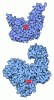
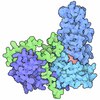
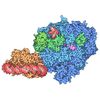
 emd_72341.png
 https://data.pdbj.org/pub/emdb/structures/EMD-72341


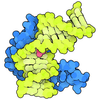
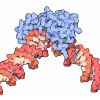
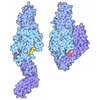
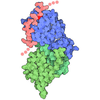
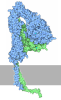
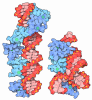
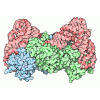


 Z (Sec.)
 Y (Row.)
 X (Col.)


 Sample components
 Spodoptera frugiperda (fall armyworm)
 Escherichia coli BL21 (bacteria)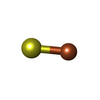
 Processing
 Electron microscopy
 FIELD EMISSION GUN