- PDB-6wou: Cryo-EM structure of recombinant mouse Ryanodine Receptor type 2 ... -
+
データを開く
IDまたはキーワード:
読み込み中...
-
基本情報
登録情報
データベース: PDB / ID: 6wou
タイトル
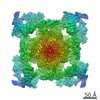
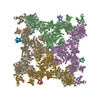
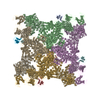
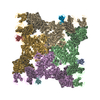
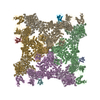
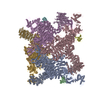
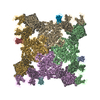
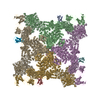
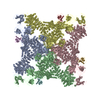
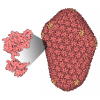
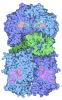
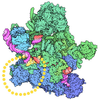
Cryo-EM structure of recombinant mouse Ryanodine Receptor type 2 mutant R176Q in complex with FKBP12.6 in nanodisc
要素
Peptidyl-prolyl cis-trans isomerase FKBP1B
Ryanodine receptor 2
キーワード
TRANSPORT PROTEIN/ISOMERASE / Ryanodine receptor / Calcium channel / Mutation / NTDA mutation / RyR2 / Polymorphic catecholergic ventricular tachycardia / Arrhythmogenic Right Ventricular Dysplasia 2 / TRANSPORT PROTEIN-ISOMERASE complex
機能・相同性
機能・相同性情報
manganese ion transmembrane transport / establishment of protein localization to endoplasmic reticulum / type B pancreatic cell apoptotic process / Purkinje myocyte to ventricular cardiac muscle cell signaling / regulation of atrial cardiac muscle cell action potential / left ventricular cardiac muscle tissue morphogenesis / suramin binding / regulation of AV node cell action potential / regulation of SA node cell action potential / sarcoplasmic reticulum calcium ion transport ...manganese ion transmembrane transport / establishment of protein localization to endoplasmic reticulum / type B pancreatic cell apoptotic process / Purkinje myocyte to ventricular cardiac muscle cell signaling / regulation of atrial cardiac muscle cell action potential / left ventricular cardiac muscle tissue morphogenesis / suramin binding / regulation of AV node cell action potential / regulation of SA node cell action potential / sarcoplasmic reticulum calcium ion transport / A band / calcium-induced calcium release activity / Stimuli-sensing channels / regulation of ventricular cardiac muscle cell action potential / : / ventricular cardiac muscle cell action potential / embryonic heart tube morphogenesis / negative regulation of calcium-mediated signaling / Ion homeostasis / cardiac muscle hypertrophy / negative regulation of insulin secretion involved in cellular response to glucose stimulus / calcium ion transport into cytosol / neuronal action potential propagation / insulin secretion involved in cellular response to glucose stimulus / negative regulation of release of sequestered calcium ion into cytosol / ryanodine-sensitive calcium-release channel activity / response to caffeine / release of sequestered calcium ion into cytosol by sarcoplasmic reticulum / response to redox state / regulation of cardiac muscle contraction by calcium ion signaling / negative regulation of heart rate / cellular response to caffeine / extrinsic component of cytoplasmic side of plasma membrane / 'de novo' protein folding / calcium ion transmembrane import into cytosol / FK506 binding / response to muscle activity / negative regulation of cytosolic calcium ion concentration / protein kinase A regulatory subunit binding / protein kinase A catalytic subunit binding / positive regulation of the force of heart contraction / intracellularly gated calcium channel activity / smooth endoplasmic reticulum / smooth muscle contraction / response to magnesium ion / T cell proliferation / detection of calcium ion / regulation of cardiac muscle contraction / positive regulation of heart rate / regulation of cytosolic calcium ion concentration / calcium channel inhibitor activity / striated muscle contraction / cardiac muscle contraction / Ion homeostasis / regulation of release of sequestered calcium ion into cytosol by sarcoplasmic reticulum / response to muscle stretch / release of sequestered calcium ion into cytosol / regulation of cardiac muscle contraction by regulation of the release of sequestered calcium ion / sarcoplasmic reticulum membrane / cellular response to epinephrine stimulus / calcium channel complex / regulation of heart rate / sarcomere / sarcoplasmic reticulum / peptidylprolyl isomerase / peptidyl-prolyl cis-trans isomerase activity / calcium channel regulator activity / calcium-mediated signaling / protein maturation / response to calcium ion / sarcolemma / Stimuli-sensing channels / calcium ion transmembrane transport / calcium channel activity / Z disc / intracellular calcium ion homeostasis / calcium ion transport / nuclear envelope / protein refolding / positive regulation of cytosolic calcium ion concentration / scaffold protein binding / monoatomic ion transmembrane transport / transmembrane transporter binding / response to hypoxia / calmodulin binding / signaling receptor binding / calcium ion binding / protein kinase binding / enzyme binding / protein-containing complex / membrane / identical protein binding / cytoplasm 類似検索 - 分子機能
National Institutes of Health/National Institute of Arthritis and Musculoskeletal and Skin Diseases (NIH/NIAMS)
R01 AR068431
米国
National Institutes of Health/National Heart, Lung, and Blood Institute (NIH/NHLBI)
R01 HL133182
米国
Other private
MDA 352845
米国
American Heart Association
19POST34430178
米国
National Institutes of Health/National Cancer Institute (NIH/NCI)
HSSN26120080001E
米国
National Institutes of Health/National Institute of General Medical Sciences (NIH/NIGMS)
U24 GM116789
米国
National Institutes of Health/National Institute of General Medical Sciences (NIH/NIGMS)
U24 GM116790
米国
引用
ジャーナル: Sci Adv / 年: 2020 タイトル: Structural mechanism of two gain-of-function cardiac and skeletal RyR mutations at an equivalent site by cryo-EM. 著者: Kavita A Iyer / Yifan Hu / Ashok R Nayak / Nagomi Kurebayashi / Takashi Murayama / Montserrat Samsó / 要旨: Mutations in ryanodine receptors (RyRs), intracellular Ca channels, are associated with deadly disorders. Despite abundant functional studies, the molecular mechanism of RyR malfunction remains ...Mutations in ryanodine receptors (RyRs), intracellular Ca channels, are associated with deadly disorders. Despite abundant functional studies, the molecular mechanism of RyR malfunction remains elusive. We studied two single-point mutations at an equivalent site in the skeletal (RyR1 R164C) and cardiac (RyR2 R176Q) isoforms using ryanodine binding, Ca imaging, and cryo-electron microscopy (cryo-EM) of the full-length protein. Loss of the positive charge had greater effect on the skeletal isoform, mediated via distortion of a salt bridge network, a molecular latch inducing rotation of a cytoplasmic domain, and partial progression to open-state traits of the large cytoplasmic assembly accompanied by alteration of the Ca binding site, which concur with the major "hyperactive" feature of the mutated channel. Our cryo-EM studies demonstrated the allosteric effect of a mutation situated ~85 Å away from the pore and identified an isoform-specific structural effect.
 ムービー
ムービー コントローラー


 データを開く
 基本情報
基本情報 要素
要素 キーワード
キーワード 機能・相同性情報
 Mus musculus (ハツカネズミ)
 Homo sapiens (ヒト)
 データ登録者
 米国, 7件
  引用
引用
 構造の表示
構造の表示 ダウンロードとリンク
 その他のダウンロード



 PDBj
PDBj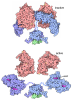
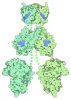
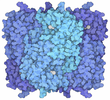
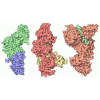
 集合体
集合体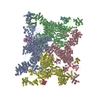

 Escherichia coli 'BL21-Gold(DE3)pLysS AG' (大腸菌)
 分子量: 65.409 Da / 分子数: 4 / 由来タイプ: 合成 / 式: Zn
 試料調製
試料調製 電子顕微鏡撮影
 FIELD EMISSION GUN / 加速電圧: 300 kV / 照射モード: FLOOD BEAM
 解析
解析
