beta-catenin destruction complex assembly / armadillo repeat domain binding / cell development / negative regulation of glycogen (starch) synthase activity / neuron projection organization / regulation of microtubule anchoring at centrosome / negative regulation of mesenchymal stem cell differentiation / negative regulation of type B pancreatic cell development / regulation of protein export from nucleus / superior temporal gyrus development ...beta-catenin destruction complex assembly / armadillo repeat domain binding / cell development / negative regulation of glycogen (starch) synthase activity / neuron projection organization / regulation of microtubule anchoring at centrosome / negative regulation of mesenchymal stem cell differentiation / negative regulation of type B pancreatic cell development / regulation of protein export from nucleus / superior temporal gyrus development / cellular response to interleukin-3 / positive regulation of protein localization to cilium / negative regulation of glycogen biosynthetic process / negative regulation of TORC2 signaling / negative regulation of dopaminergic neuron differentiation / positive regulation of protein localization to centrosome / maintenance of cell polarity / beta-arrestin-dependent dopamine receptor signaling pathway / regulation of long-term synaptic potentiation / heart valve development / CRMPs in Sema3A signaling / tau-protein kinase / beta-catenin destruction complex / APC truncation mutants have impaired AXIN binding / AXIN missense mutants destabilize the destruction complex / Truncations of AMER1 destabilize the destruction complex / positive regulation of mitochondrial outer membrane permeabilization involved in apoptotic signaling pathway / positive regulation of cilium assembly / negative regulation of calcineurin-NFAT signaling cascade / Maturation of nucleoprotein / Beta-catenin phosphorylation cascade / Signaling by GSK3beta mutants / CTNNB1 S33 mutants aren't phosphorylated / CTNNB1 S37 mutants aren't phosphorylated / CTNNB1 S45 mutants aren't phosphorylated / CTNNB1 T41 mutants aren't phosphorylated / negative regulation of TOR signaling / I-SMAD binding / regulation of microtubule-based process / positive regulation of cell-matrix adhesion / Wnt signalosome / glycogen metabolic process / AKT phosphorylates targets in the cytosol / regulation of axon extension / Disassembly of the destruction complex and recruitment of AXIN to the membrane / positive regulation of protein binding / negative regulation of protein localization to nucleus / positive regulation of ubiquitin-dependent protein catabolic process / regulation of neuron projection development / ER overload response / RUNX1 regulates transcription of genes involved in WNT signaling / Maturation of nucleoprotein / negative regulation of epithelial to mesenchymal transition / RUNX1 regulates estrogen receptor mediated transcription / tau-protein kinase activity / regulation of axonogenesis / establishment of cell polarity / regulation of dendrite morphogenesis / Constitutive Signaling by AKT1 E17K in Cancer / protein kinase A catalytic subunit binding / SMAD binding / canonical Wnt signaling pathway / R-SMAD binding / extrinsic apoptotic signaling pathway in absence of ligand / epithelial to mesenchymal transition / dynactin binding / negative regulation of extrinsic apoptotic signaling pathway via death domain receptors / Regulation of HSF1-mediated heat shock response / lateral plasma membrane / negative regulation of osteoblast differentiation / extrinsic apoptotic signaling pathway / NF-kappaB binding / negative regulation of protein-containing complex assembly / cellular response to glucose starvation / cellular response to retinoic acid / ubiquitin-like ligase-substrate adaptor activity / regulation of cellular response to heat / positive regulation of protein export from nucleus / positive regulation of type I interferon production / Wnt signaling pathway / Transcriptional and post-translational regulation of MITF-M expression and activity / signaling adaptor activity / presynaptic modulation of chemical synaptic transmission / positive regulation of autophagy / response to endoplasmic reticulum stress / negative regulation of TORC1 signaling / negative regulation of cell migration / protein serine/threonine kinase activator activity / excitatory postsynaptic potential / hippocampus development / positive regulation of protein ubiquitination / mitochondrion organization / protein serine/threonine kinase binding / cell periphery / positive regulation of cell differentiation / TCF dependent signaling in response to WNT / circadian rhythm / negative regulation of canonical Wnt signaling pathway / regulation of microtubule cytoskeleton organization / Ubiquitin-dependent degradation of Cyclin D Similarity search - Function
Axin beta-catenin binding / Axin-1/2, tankyrase-binding domain / Axin-like / Axin beta-catenin binding motif / Axin-1 tankyrase binding domain / RGS, subdomain 1/3 / DIX domain / DIX domain superfamily / DIX domain / DIX domain profile. ...Axin beta-catenin binding / Axin-1/2, tankyrase-binding domain / Axin-like / Axin beta-catenin binding motif / Axin-1 tankyrase binding domain / RGS, subdomain 1/3 / DIX domain / DIX domain superfamily / DIX domain / DIX domain profile. / Domain present in Dishevelled and axin / Glycogen synthase kinase 3, catalytic domain / : / Regulator of G protein signaling domain / RGS domain / RGS domain profile. / Regulator of G protein signalling domain / RGS, subdomain 2 / RGS domain superfamily / Ubiquitin-like domain superfamily / Phosphorylase Kinase; domain 1 / Phosphorylase Kinase; domain 1 / Transferase(Phosphotransferase) domain 1 / Transferase(Phosphotransferase); domain 1 / Serine/threonine-protein kinase, active site / Serine/Threonine protein kinases active-site signature. / Protein kinase domain / Serine/Threonine protein kinases, catalytic domain / Protein kinase, ATP binding site / Protein kinases ATP-binding region signature. / Protein kinase domain profile. / Protein kinase domain / Protein kinase-like domain superfamily / 2-Layer Sandwich / Orthogonal Bundle / Mainly Alpha / Alpha Beta Similarity search - Domain/homology
SHEET DETERMINATION METHOD: DSSP THE SHEETS PRESENTED AS "AA" IN EACH CHAIN ON SHEET RECORDS BELOW ... SHEET DETERMINATION METHOD: DSSP THE SHEETS PRESENTED AS "AA" IN EACH CHAIN ON SHEET RECORDS BELOW IS ACTUALLY AN 6-STRANDED BARREL THIS IS REPRESENTED BY A 7-STRANDED SHEET IN WHICH THE FIRST AND LAST STRANDS ARE IDENTICAL.
In the structure databanks used in Yorodumi, some data are registered as the other names, "COVID-19 virus" and "2019-nCoV". Here are the details of the virus and the list of structure data.
Jan 31, 2019. EMDB accession codes are about to change! (news from PDBe EMDB page)
EMDB accession codes are about to change! (news from PDBe EMDB page)
The allocation of 4 digits for EMDB accession codes will soon come to an end. Whilst these codes will remain in use, new EMDB accession codes will include an additional digit and will expand incrementally as the available range of codes is exhausted. The current 4-digit format prefixed with “EMD-” (i.e. EMD-XXXX) will advance to a 5-digit format (i.e. EMD-XXXXX), and so on. It is currently estimated that the 4-digit codes will be depleted around Spring 2019, at which point the 5-digit format will come into force.
The EM Navigator/Yorodumi systems omit the EMD- prefix.
Related info.:Q: What is EMD? / ID/Accession-code notation in Yorodumi/EM Navigator
Yorodumi is a browser for structure data from EMDB, PDB, SASBDB, etc.
This page is also the successor to EM Navigator detail page, and also detail information page/front-end page for Omokage search.
The word "yorodu" (or yorozu) is an old Japanese word meaning "ten thousand". "mi" (miru) is to see.
Related info.:EMDB / PDB / SASBDB / Comparison of 3 databanks / Yorodumi Search / Aug 31, 2016. New EM Navigator & Yorodumi / Yorodumi Papers / Jmol/JSmol / Function and homology information / Changes in new EM Navigator and Yorodumi
 Movie
Movie Controller

 Yorodumi
 Open data
 Basic information
 Components
 Keywords
 Function and homology information
 HOMO SAPIENS (human)
 X-RAY DIFFRACTION /
  Authors
 Citation
 Structure visualization
 Downloads & links
 Other downloads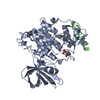
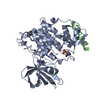
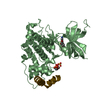
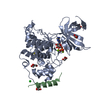

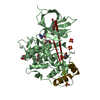
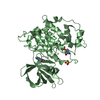
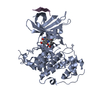
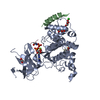
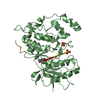
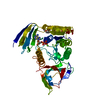
 PDBj
PDBj
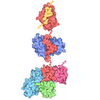
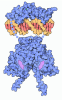
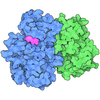
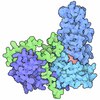
 Assembly

 SPODOPTERA FRUGIPERDA (fall armyworm)
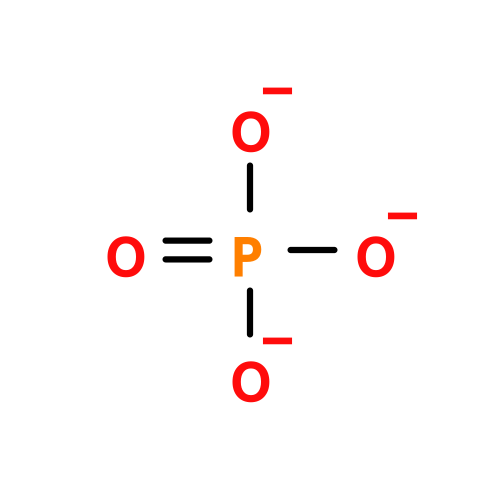 Mass: 94.971 Da / Num. of mol.: 1 / Source method: obtained synthetically / Formula: PO4
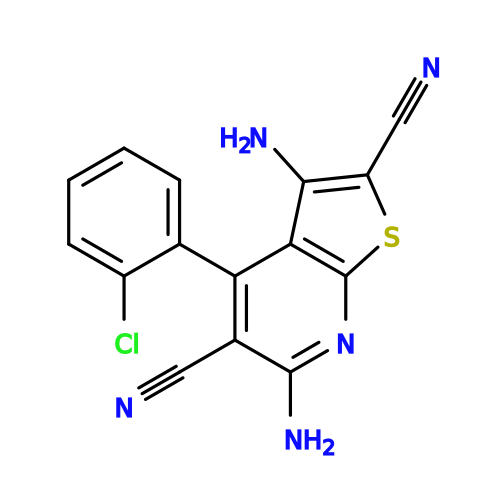 Mass: 325.776 Da / Num. of mol.: 1 / Source method: obtained synthetically / Formula: C15H8ClN5S
 Mass: 18.015 Da / Num. of mol.: 70 / Source method: isolated from a natural source / Formula: H2O
 Sample preparation
 / Beamline: I02 / Wavelength: 0.97
  Processing