- PDB-2xyj: Novel Sulfonylthiadiazoles with an Unusual Binding Mode as Partia... -
+
Open data
ID or keywords:
Loading...
-
Basic information
Entry
Database: PDB / ID: 2xyj
Title
Novel Sulfonylthiadiazoles with an Unusual Binding Mode as Partial Dual Peroxisome Proliferator-Activated Receptor (PPAR) gamma-delta Agonists with High Potency and In-vivo Efficacy
Components
PEROXISOME PROLIFERATOR-ACTIVATED RECEPTOR DELTA
Keywords
TRANSCRIPTION
Function / homology
Function and homology information
linoleic acid binding / positive regulation of myoblast proliferation / positive regulation of epidermis development / axon ensheathment / regulation of skeletal muscle satellite cell proliferation / proteoglycan metabolic process / D-glucose transmembrane transport / negative regulation of smooth muscle cell migration / positive regulation of skeletal muscle tissue regeneration / fatty acid catabolic process ...linoleic acid binding / positive regulation of myoblast proliferation / positive regulation of epidermis development / axon ensheathment / regulation of skeletal muscle satellite cell proliferation / proteoglycan metabolic process / D-glucose transmembrane transport / negative regulation of smooth muscle cell migration / positive regulation of skeletal muscle tissue regeneration / fatty acid catabolic process / negative regulation of myoblast differentiation / negative regulation of collagen biosynthetic process / phospholipid biosynthetic process / positive regulation of fatty acid oxidation / Carnitine shuttle / response to vitamin A / Signaling by Retinoic Acid / positive regulation of fatty acid metabolic process / fatty acid beta-oxidation / negative regulation of cholesterol storage / decidualization / nuclear steroid receptor activity / energy homeostasis / cholesterol metabolic process / response to glucose / positive regulation of fat cell differentiation / fatty acid transport / NF-kappaB binding / hormone-mediated signaling pathway / embryo implantation / intracellular receptor signaling pathway / cellular response to nutrient levels / fatty acid metabolic process / negative regulation of miRNA transcription / lipid metabolic process / apoptotic signaling pathway / response to activity / glucose metabolic process / positive regulation of insulin secretion involved in cellular response to glucose stimulus / negative regulation of smooth muscle cell proliferation / generation of precursor metabolites and energy / negative regulation of inflammatory response / vasodilation / negative regulation of cell growth / Nuclear Receptor transcription pathway / RNA polymerase II transcription regulator complex / DNA-binding transcription repressor activity, RNA polymerase II-specific / nuclear receptor activity / cell population proliferation / heart development / sequence-specific double-stranded DNA binding / transcription coactivator binding / cellular response to lipopolysaccharide / cell differentiation / DNA-binding transcription factor activity, RNA polymerase II-specific / RNA polymerase II cis-regulatory region sequence-specific DNA binding / apoptotic process / DNA-binding transcription factor activity / negative regulation of DNA-templated transcription / lipid binding / positive regulation of gene expression / regulation of transcription by RNA polymerase II / negative regulation of apoptotic process / positive regulation of DNA-templated transcription / chromatin / negative regulation of transcription by RNA polymerase II / positive regulation of transcription by RNA polymerase II / DNA binding / zinc ion binding / nucleoplasm / nucleus Similarity search - Function
Protocol: SINGLE WAVELENGTH / Monochromatic (M) / Laue (L): M / Scattering type: x-ray
Radiation wavelength
Wavelength: 0.934 Å / Relative weight: 1
Reflection
Resolution: 2.3→37.5 Å / Num. obs: 28063 / % possible obs: 99.9 % / Observed criterion σ(I): 0 / Redundancy: 3.7 % / Rmerge(I) obs: 0.08 / Net I/σ(I): 4
Reflection shell
Resolution: 2.3→2.42 Å / Redundancy: 3.7 % / Rmerge(I) obs: 0.263 / Mean I/σ(I) obs: 1.6 / % possible all: 100
-
Processing
Software
Name
Classification
BUSTER-TNT
refinement
MOSFLM
datareduction
SCALA
datascaling
AMoRE
phasing
Refinement
Method to determine structure: MOLECULAR REPLACEMENT Starting model: IN-HOUSE STRUCTURE Resolution: 2.3→20 Å / Cross valid method: THROUGHOUT / σ(F): 0 Details: RESIDUES 204-207 AND 229-233 ARE NOT VISIBLE. LIGAND MOLECULES 3 AND 4 ARE AT THE INTERFACE BETWEEN PROTEINS A AND B.
Rfactor
Num. reflection
% reflection
Selection details
Rfree
0.25
2321
8 %
RANDOM
Rwork
0.208
-
-
-
obs
-
28022
99.9 %
-
Displacement parameters
Biso mean: 43.9 Å2
Refinement step
Cycle: LAST / Resolution: 2.3→20 Å
Protein
Nucleic acid
Ligand
Solvent
Total
Num. atoms
4202
0
144
104
4450
+
About Yorodumi
-
News
-
Feb 9, 2022. New format data for meta-information of EMDB entries
New format data for meta-information of EMDB entries
Version 3 of the EMDB header file is now the official format.
The previous official version 1.9 will be removed from the archive.
In the structure databanks used in Yorodumi, some data are registered as the other names, "COVID-19 virus" and "2019-nCoV". Here are the details of the virus and the list of structure data.
Jan 31, 2019. EMDB accession codes are about to change! (news from PDBe EMDB page)
EMDB accession codes are about to change! (news from PDBe EMDB page)
The allocation of 4 digits for EMDB accession codes will soon come to an end. Whilst these codes will remain in use, new EMDB accession codes will include an additional digit and will expand incrementally as the available range of codes is exhausted. The current 4-digit format prefixed with “EMD-” (i.e. EMD-XXXX) will advance to a 5-digit format (i.e. EMD-XXXXX), and so on. It is currently estimated that the 4-digit codes will be depleted around Spring 2019, at which point the 5-digit format will come into force.
The EM Navigator/Yorodumi systems omit the EMD- prefix.
Related info.:Q: What is EMD? / ID/Accession-code notation in Yorodumi/EM Navigator
Yorodumi is a browser for structure data from EMDB, PDB, SASBDB, etc.
This page is also the successor to EM Navigator detail page, and also detail information page/front-end page for Omokage search.
The word "yorodu" (or yorozu) is an old Japanese word meaning "ten thousand". "mi" (miru) is to see.
Related info.:EMDB / PDB / SASBDB / Comparison of 3 databanks / Yorodumi Search / Aug 31, 2016. New EM Navigator & Yorodumi / Yorodumi Papers / Jmol/JSmol / Function and homology information / Changes in new EM Navigator and Yorodumi
 Movie
Movie Controller

 Yorodumi
 Open data
 Basic information
 Components
 Keywords
 Function and homology information
 HOMO SAPIENS (human)
 X-RAY DIFFRACTION /
  Authors
 Citation
 Structure visualization
 Downloads & links
 Other downloads





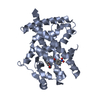
 PDBj
PDBj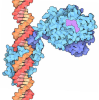
 Assembly
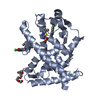


 ESCHERICHIA COLI (E. coli) / Strain (production host): BL21(DE3) / References: UniProt: Q03181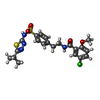
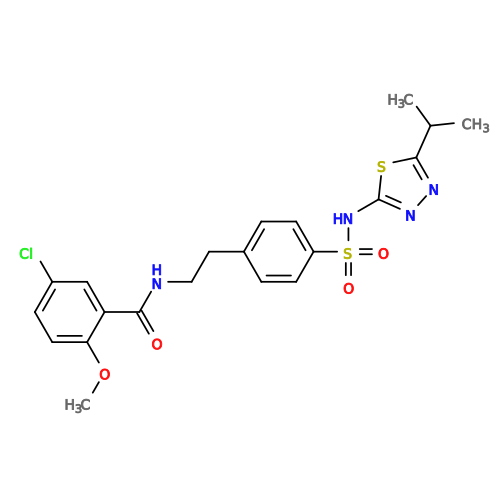 Mass: 495.015 Da / Num. of mol.: 4 / Source method: obtained synthetically / Formula: C21H23ClN4O4S2
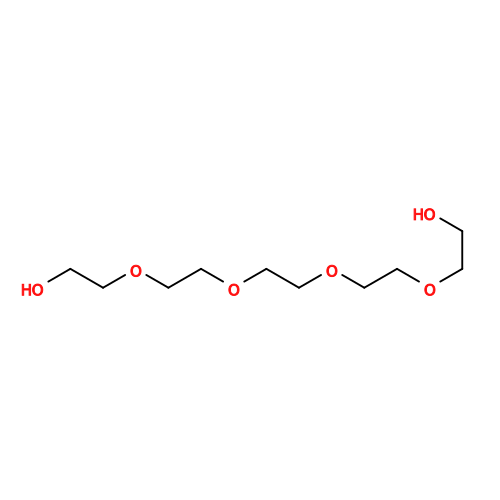 Mass: 238.278 Da / Num. of mol.: 1 / Source method: obtained synthetically / Formula: C10H22O6 / Comment: precipitant*YM
 Mass: 18.015 Da / Num. of mol.: 104 / Source method: isolated from a natural source / Formula: H2O
 Sample preparation
 / Beamline: ID14-2 / Wavelength: 0.934
  Processing