[English] 日本語
Yorodumi Papers
- Database of articles cited by EMDB/PDB/SASBDB data -

+
Search query

Keywords
Structure methods
Author
Journal
IF

-
Structure paper

TitleTargeting ryanodine receptors with allopurinol and xanthine derivatives for the treatment of cardiac and musculoskeletal weakness disorders.
Journal, issue, pagesProc Natl Acad Sci U S A, Vol. 122, Issue 24, Page e2422082122, Year 2025
Publish dateJun 17, 2025
AuthorsMarco C Miotto / Estefania Luna-Figueroa / Carl Tchagou / Laith Bahlouli / Steven Reiken / Haikel Dridi / Yang Liu / Gunnar Weninger / Andrew R Marks /
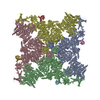
PubMed AbstractRyanodine receptors (RyRs) are intracellular Ca channels essential for muscle contraction. Caffeine, a xanthine derivative, has been known for decades to increase muscle contraction and enhance ...Ryanodine receptors (RyRs) are intracellular Ca channels essential for muscle contraction. Caffeine, a xanthine derivative, has been known for decades to increase muscle contraction and enhance activation of RyRs by increasing the sensitivity to Ca. We previously showed that xanthine, the only physiologically relevant xanthine derivative, also binds to and activates RyR2. Most xanthine derivatives and analogs are safe and widely prescribed, with the most popular being the xanthine oxidoreductase inhibitor allopurinol (~15M yearly prescriptions in USA). We propose that xanthine derivatives and analogs that enhance RyRs activity could be used for lead optimization and eventually for the treatment of the diseases that exhibit decreased muscle contraction and reduced RyRs activity, such as RyR1-related diseases, sarcopenia, and heart failure. Here, we show by cryo-EM that xanthine derivatives, analogs, and other related compounds bind to the xanthine/caffeine binding site and activate RyR1, and identify 4-oxopyrimidine as the minimal motif necessary for such interaction.
External linksProc Natl Acad Sci U S A / PubMed:40512792 / PubMed Central
MethodsEM (single particle)
Resolution2.12 - 4.49 Å
Structure data

EMDB-47336: Structure of PKA phosphorylated human RyR2-R2474S in the open state in the presence of Calmodulin - focused map on xanthine
Method: EM (single particle) / Resolution: 2.38 Å

EMDB-47357: Structure of RyR1 in the primed state in the presence of caffeine - focused map (reprocessed from EMPIAR-10997)
Method: EM (single particle) / Resolution: 2.12 Å

EMDB-47385, PDB-9e18:
Structure of RyR1 in the primed state in the presence of pentoxifylline
Method: EM (single particle) / Resolution: 2.68 Å

EMDB-47386, PDB-9e19:
Structure of RyR1 in the open state in the presence of pentoxifylline
Method: EM (single particle) / Resolution: 4.04 Å

EMDB-47387, PDB-9e1a:
Structure of RyR1 in the primed state in the presence of dyphylline
Method: EM (single particle) / Resolution: 3.35 Å

EMDB-47388, PDB-9e1b:
Structure of RyR1 in the open state in the presence of dyphylline
Method: EM (single particle) / Resolution: 4.49 Å

EMDB-47389, PDB-9e1c:
Structure of RyR1 in the primed state in the presence of IBMX
Method: EM (single particle) / Resolution: 2.63 Å

EMDB-47390, PDB-9e1d:
Structure of RyR1 in the primed state in the presence of enprofylline
Method: EM (single particle) / Resolution: 2.76 Å

EMDB-47391, PDB-9e1e:
Structure of RyR1 in the primed state in the presence of uracil
Method: EM (single particle) / Resolution: 2.92 Å

EMDB-47392, PDB-9e1f:
Structure of RyR1 in the primed state in the presence of allopurinol
Method: EM (single particle) / Resolution: 3.03 Å

EMDB-47393, PDB-9e1g:
Structure of RyR1 in the primed state in the presence of oxypurinol
Method: EM (single particle) / Resolution: 3.17 Å

EMDB-47394, PDB-9e1h:
Structure of RyR1 in the primed state in the presence of oxopyricid
Method: EM (single particle) / Resolution: 3.26 Å

EMDB-47395, PDB-9e1i:
Structure of RyR1 in the open state in the presence of oxopyricid
Method: EM (single particle) / Resolution: 3.2 Å

EMDB-47396: Structure of RyR1 in the primed state in the presence of pentoxifylline, focused refinement
Method: EM (single particle) / Resolution: 2.35 Å

EMDB-47397: Structure of RyR1 in the open state in the presence of pentoxifylline, focused refinement
Method: EM (single particle) / Resolution: 3.49 Å

EMDB-47398: Structure of RyR1 in the primed state in the presence of dyphylline, focused refinement
Method: EM (single particle) / Resolution: 3.14 Å

EMDB-47399: Structure of RyR1 in the open state in the presence of dyphylline, focused refinement
Method: EM (single particle) / Resolution: 4.16 Å

EMDB-47400: Structure of RyR1 in the primed state in the presence of IBMX, focused refinement
Method: EM (single particle) / Resolution: 2.34 Å

EMDB-47401: Structure of RyR1 in the primed state in the presence of enprofylline, focused refinement
Method: EM (single particle) / Resolution: 2.42 Å

EMDB-47402: Structure of RyR1 in the primed state in the presence of uracil, focused refinement
Method: EM (single particle) / Resolution: 2.47 Å

EMDB-47403: Structure of RyR1 in the primed state in the presence of allopurinol, focused refinement
Method: EM (single particle) / Resolution: 2.56 Å

EMDB-47404: Structure of RyR1 in the primed state in the presence of oxypurinol, focused refinement
Method: EM (single particle) / Resolution: 2.69 Å

EMDB-47405: Structure of RyR1 in the primed state in the presence of oxopyricid, focused refinement
Method: EM (single particle) / Resolution: 2.64 Å

EMDB-47406: Structure of RyR1 in the open state in the presence of oxopyricid, focused refinement
Method: EM (single particle) / Resolution: 2.65 Å

PDB-9e17:
Structure of RyR1 in the primed state in the presence of caffeine (reprocessed/reanalyzed from EMPIAR-10997, 7TZC, EMD-26205)
Method: ELECTRON MICROSCOPY / Resolution: 2.45 Å

Chemicals

ChemComp-CA:
Unknown entry

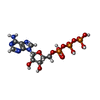
ChemComp-ATP:
ADENOSINE-5'-TRIPHOSPHATE / ATP, energy-carrying molecule*YM

ChemComp-ZN:
Unknown entry

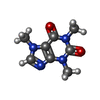
ChemComp-CFF:
CAFFEINE / medication*YM

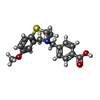
ChemComp-KVR:
4-[(7-methoxy-2,3-dihydro-1,4-benzothiazepin-4(5H)-yl)methyl]benzoic acid

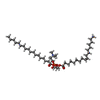
ChemComp-L9R:
(2S)-3-(octadecanoyloxy)-2-[(9Z)-octadec-9-enoyloxy]propyl 2-(trimethylammonio)ethyl phosphate / SOPC, phospholipid*YM

ChemComp-HOH:
WATER

ChemComp-PNX:
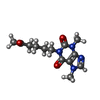
3,7-DIMETHYL-1-(5-OXOHEXYL)-3,7-DIHYDRO-1H-PURINE-2,6-DIONE

PDB-1bd2:
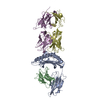
COMPLEX BETWEEN HUMAN T-CELL RECEPTOR B7, VIRAL PEPTIDE (TAX) AND MHC CLASS I MOLECULE HLA-A 0201

ChemComp-IBM:
3-ISOBUTYL-1-METHYLXANTHINE

PDB-1bd3:
STRUCTURE OF THE APO URACIL PHOSPHORIBOSYLTRANSFERASE, 2 MUTANT C128V

ChemComp-URA:
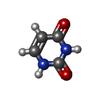
URACIL

PDB-1bd4:
UPRT-URACIL COMPLEX

ChemComp-141:
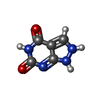
Oxypurinol

PDB-1bd5:
Unknown entry

Source
  • homo sapiens (human)
  • oryctolagus cuniculus (rabbit)
KeywordsTRANSPORT PROTEIN / calcium channel / sarcoplasmic reticulum

+
About Yorodumi Papers

-
News

-
Feb 9, 2022. New format data for meta-information of EMDB entries

New format data for meta-information of EMDB entries

  • Version 3 of the EMDB header file is now the official format.
  • The previous official version 1.9 will be removed from the archive.

Related info.:EMDB header

External links:wwPDB to switch to version 3 of the EMDB data model

-
Aug 12, 2020. Covid-19 info

Covid-19 info

URL: https://pdbj.org/emnavi/covid19.php

New page: Covid-19 featured information page in EM Navigator.

Related info.:Covid-19 info / Mar 5, 2020. Novel coronavirus structure data

+
Mar 5, 2020. Novel coronavirus structure data

Novel coronavirus structure data

Related info.:Yorodumi Speices / Aug 12, 2020. Covid-19 info

External links:COVID-19 featured content - PDBj / Molecule of the Month (242):Coronavirus Proteases

+
Jan 31, 2019. EMDB accession codes are about to change! (news from PDBe EMDB page)

EMDB accession codes are about to change! (news from PDBe EMDB page)

  • The allocation of 4 digits for EMDB accession codes will soon come to an end. Whilst these codes will remain in use, new EMDB accession codes will include an additional digit and will expand incrementally as the available range of codes is exhausted. The current 4-digit format prefixed with “EMD-” (i.e. EMD-XXXX) will advance to a 5-digit format (i.e. EMD-XXXXX), and so on. It is currently estimated that the 4-digit codes will be depleted around Spring 2019, at which point the 5-digit format will come into force.
  • The EM Navigator/Yorodumi systems omit the EMD- prefix.

Related info.:Q: What is EMD? / ID/Accession-code notation in Yorodumi/EM Navigator

External links:EMDB Accession Codes are Changing Soon! / Contact to PDBj

+
Jul 12, 2017. Major update of PDB

Major update of PDB

  • wwPDB released updated PDB data conforming to the new PDBx/mmCIF dictionary.
  • This is a major update changing the version number from 4 to 5, and with Remediation, in which all the entries are updated.
  • In this update, many items about electron microscopy experimental information are reorganized (e.g. em_software).
  • Now, EM Navigator and Yorodumi are based on the updated data.

External links:wwPDB Remediation / Enriched Model Files Conforming to OneDep Data Standards Now Available in the PDB FTP Archive

-
Yorodumi Papers

Database of articles cited by EMDB/PDB/SASBDB data

  • Database of articles cited by EMDB, PDB, and SASBDB entries
  • Using PubMed data

Related info.:EMDB / PDB / SASBDB / Yorodumi / EMN Papers / Changes in new EM Navigator and Yorodumi

Read more