






 9YAH
9YAH
Crystal structure of metallochaperone AccA from Neisseria gonorrhoeae
This is a non-PDB format compatible entry.
Summary for 9YAH
| Entry DOI | 10.2210/pdb9yah/pdb |
| Descriptor | Copper chaperone PCu(A)C, COPPER (II) ION, GLYCEROL (3 entities in total) |
| Functional Keywords | metallochaperone, metal binding protein |
| Biological source | Neisseria meningitidis serogroup A |
| Total number of polymer chains | 1 |
| Total formula weight | 17225.99 |
| Authors | Jobichen, C.,Kobe, B.,Dalton, H.Y.N.,Denis, T.,Karrera, D. (deposition date: 2025-09-15, release date: 2026-03-25, Last modification date: 2026-05-20) |
| Primary citation | Firth, S.,Earl, W.,Thaqi, D.,Hong, Y.,O'Hern, C.,Luscombe, G.,Ngu, D.H.Y.,Luo, Z.,Jobichen, C.,Kobe, B.,McEwan, A.,Djoko, K. AccA from Neisseria gonorrhoeae provides a new framework for understanding periplasmic copper metallochaperones. Chem Sci, 17:9270-9284, 2026 Cited by PubMed Abstract: Many bacteria use copper (Cu) to drive key redox reactions and energy metabolism, and they often rely on metallochaperones to deliver Cu to Cu-dependent enzymes. However, why delivery by metallochaperones is needed, and why Cu cannot transfer directly from cellular pools to the target enzymes, is not well understood. Here, we show that the PCuC-family metallochaperone AccA from the periplasm of delivers Cu to the Cu-dependent nitrite reductase AniA, enabling growth and nitrite respiration in O-limiting conditions. Although purified AccA binds both Cu(i) and Cu(ii) ions, only the Cu(i)-binding site is essential for activating AniA in cells. Unexpectedly, the Cu(i)-binding affinity of AniA is >50 times weaker than that of AccA, suggesting that Cu delivery occurs against a favourable affinity gradient. We propose that AccA is needed because AniA cannot compete with the periplasmic milieu for binding Cu, providing a new framework to understand why some Cu-dependent enzymes need metallochaperones to deliver Cu. PubMed: 41877990DOI: 10.1039/d5sc08738d PDB entries with the same primary citation |
| Experimental method | X-RAY DIFFRACTION (2.9 Å) |
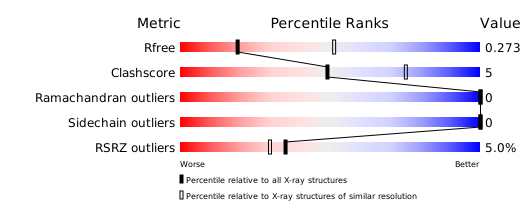
Structure validation
Download full validation report


