






 9W2K
9W2K
Structural basis of substrate promiscuity in the archaeal RNA-splicing endonuclease from Candidatus Micrarchaeum acidiphilum (ARMAN-2)
9W2K の概要
| エントリーDOI | 10.2210/pdb9w2k/pdb |
| 分子名称 | tRNA intron endonuclease, DNA/RNA (5'-R(P*AP*CP*CP*GP*AP*CP*CP*A)-D(P*U)-R(P*AP*GP*CP*U)-3'), RNA (5'-R(P*AP*GP*CP*GP*GP*UP*CP*A)-3'), ... (7 entities in total) |
| 機能のキーワード | archaea, trna, intron, novel catalytic reaction, splicing, splicing-rna complex, splicing/rna |
| 由来する生物種 | Candidatus Micrarchaeum acidiphilum ARMAN-2 詳細 |
| タンパク質・核酸の鎖数 | 5 |
| 化学式量合計 | 100345.69 |
| 構造登録者 | |
| 主引用文献 | Miyata, Y.,Yamagami, R.,Kawamura, T.,Hori, H.,Hirata, A. Structural basis of substrate diversity and functional evolution of archaeal RNA-splicing endonucleases. Nucleic Acids Res., 53:-, 2025 Cited by PubMed Abstract: Maturation of transfer RNA molecules often requires removal of intronic sequences by endonucleases that recognize diverse RNA secondary structures. Archaeal splicing endonucleases [versatile RNA-splicing endonucleases (VSENs)] exhibit remarkable substrate versatility, yet the structural basis for this broad specificity has remained unclear. Here, we report the 1.8-Å crystal structure of ARMAN-2, an ϵ2-type VSEN from Candidatus Micrarchaeum acidiphilum, in complex with a synthetic bulge-helix-bulge RNA. The structure reveals that a lineage-specific insertion, the ARMAN-specific loop (ASL), interacts with the bulged region of the RNA and helps to orient the scissile phosphate for catalysis via conserved tyrosine and lysine residues. Functional assays confirmed the essential role of the ASL in substrate binding and cleavage. Structural comparisons with (αβ)2-type Crenarchaeal VSENs, which contain a distinct Crenarchaea-specific loop (CSL), and with a eukaryotic equivalent, the TSEN complex, which harbors a previously uncharacterized eukaryotic-specific loop (ESL), uncovered mechanistic convergence across domains of life. We show that the ESL occupies a position analogous to the ASL and CSL, and likely supports bulge stabilization in long introns. These findings establish a mechanistic model for broad substrate recognition by VSENs and suggest that loop-mediated RNA positioning co-evolved with intron complexity in archaeal and eukaryotic lineages. PubMed: 40884401DOI: 10.1093/nar/gkaf845 主引用文献が同じPDBエントリー |
| 実験手法 | X-RAY DIFFRACTION (1.798 Å) |
構造検証レポート
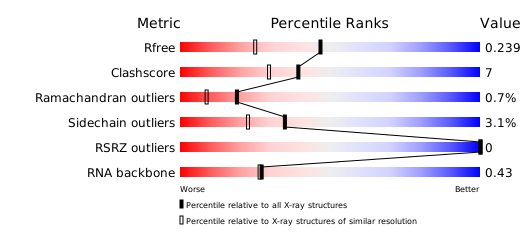
検証レポート(詳細版) をダウンロード
をダウンロード


