






 9VTS
9VTS
EBOV GP/1A10-VHH complex
Summary for 9VTS
| Entry DOI | 10.2210/pdb9vts/pdb |
| EMDB information | 65343 |
| Descriptor | Envelope glycoprotein,GP1, Envelope glycoprotein, nanobody 1A10, ... (4 entities in total) |
| Functional Keywords | ebolavirus, glycoprotein, nanobody, complex, membrane protein |
| Biological source | Zaire ebolavirus More |
| Total number of polymer chains | 9 |
| Total formula weight | 204087.12 |
| Authors | |
| Primary citation | Wang, M.,Zhang, X.,Li, W.,Yao, Y.,Li, E.,Zhang, B.,Zhou, J.,Liu, S.,Gao, Y.,Zhu, Z.,Zhu, L.,Liu, M.,Hu, J.,Peng, C.,Li, F.,Chen, M.,Liu, H.,Yao, C.,Shang, Y.,Yan, F.,Gong, P.,Jin, T.,Chiu, S. A highly potent nanobody-based bispecific therapeutic provides broad-spectrum protection against ebolavirus. Nat Commun, 17:-, 2026 Cited by PubMed Abstract: The highly lethal Ebola virus species-Zaire (EBOV), Sudan (SUDV), and Bundibugyo (BDBV)-pose persistent threats to global health. Current antibody therapies target EBOV but lack broad neutralization across ebolaviruses. Recent pan-ebolavirus strategies rely on antibody cocktails. Here, we identified two camelid-derived nanobodies (1A10 and BA2) that neutralize EBOV, SUDV, and BDBV in vitro and protect female rodents against these pathogens. High-resolution cryo-EM structures of their GP complexes showed that 1A10 and BA2 bind conserved but non-overlapping epitopes near the GP1 base and GP2's internal fusion loop (IFL), and biochemical analyses revealed their distinct neutralization mechanisms. To further improve efficacy, we engineered a bispecific antibody (BA2-1A10) via GS linker-mediated IgG-Fc fusion, which provided highly potent protection against all three viruses in female rodents model and positions it as a strong broad-spectrum anti-ebolavirus candidate. Our work demonstrates a structure-guided bispecific nanobody strategy for pan-ebolavirus therapy and highlights compact antibodies for next-generation antivirals. PubMed: 41839884DOI: 10.1038/s41467-026-70464-6 PDB entries with the same primary citation |
| Experimental method | ELECTRON MICROSCOPY (2.56 Å) |
Structure validation
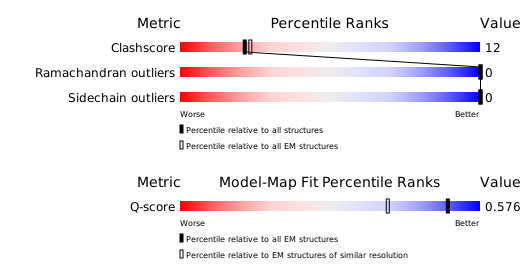
Download full validation report


