






 9VM0
9VM0
Crystal structure of computational designed protein CSD101
Summary for 9VM0
| Entry DOI | 10.2210/pdb9vm0/pdb |
| Descriptor | CSD101 (2 entities in total) |
| Functional Keywords | kinase, cell signalling, map kinase pathway, signaling protein |
| Biological source | synthetic construct |
| Total number of polymer chains | 1 |
| Total formula weight | 42041.16 |
| Authors | Sandholu, A.S.,Siba, A.,Arold, S.T. (deposition date: 2025-06-27, release date: 2026-07-15, Last modification date: 2026-07-29) |
| Primary citation | Talley, J.P.,Stern, J.A.,Alharbi, S.,Green, T.P.,Sandholu, A.,Argyle, M.,Heaps, W.P.,Chipman, D.,Bundy, B.C.,Arold, S.T.,Della Corte, D. Conformation-Specific Design: Engineering Extracellular Signal-Regulated Kinase 2 Variants with Bias toward Active or Inactive States. Acs Omega, 11:28717-28724, 2026 Cited by PubMed Abstract: Machine learning is revolutionizing protein design by enabling the rapid generation of sequences with precise structural and functional properties. Controlling protein conformational states remains a major challenge, particularly for enzymes regulated by complex structural switches. Here, using high-resolution structural data and probabilistic sequence-structure models, a machine learning-driven framework for conformationally biased protein design is presented titled Conformation-Specific Design or CSDesign. This approach generates sequences predicted to favor a desired conformation while disfavoring alternative states. As a proof-of-concept, this approach is applied to extracellular signal-regulated kinase 2 (ERK2), generating variants predicted to favor the active or inactive state. Experimental validation of relative kinase activity in a controlled assay confirmed that an active-biased variant, CSD104, exhibits robust kinase activity without native upstream phosphorylation, while an inactive-biased variant, CSD101, remains inactivated. Structural analysis suggests that engineered interactions stabilize active-like features in place of phosphorylation. These results demonstrate machine learning control of protein conformational ensembles, with potential to design enzymes and other conformationally regulated proteins without relying on phosphomimetic mutations or extensive experimental screening. PubMed: 42179606DOI: 10.1021/acsomega.6c01185 PDB entries with the same primary citation |
| Experimental method | X-RAY DIFFRACTION (1.9 Å) |
Structure validation
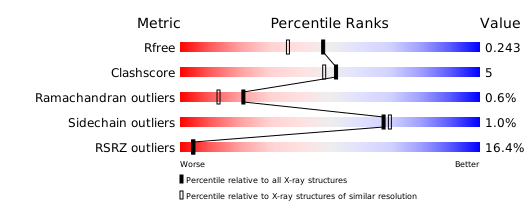
Download full validation report


