






 9UO5
9UO5
Cryo-EM structure of the human IgG-Fc hexamer
9UO5 の概要
| エントリーDOI | 10.2210/pdb9uo5/pdb |
| EMDBエントリー | 64373 |
| 分子名称 | Immunoglobulin gamma-1 heavy chain (1 entity in total) |
| 機能のキーワード | complex, polymeric antibody, immune system |
| 由来する生物種 | Homo sapiens (human) |
| タンパク質・核酸の鎖数 | 12 |
| 化学式量合計 | 340524.14 |
| 構造登録者 | |
| 主引用文献 | Zhang, R.,Ji, C.,Li, S.,Li, N.,Gao, N.,Xiao, J. Xenopus IgX informs engineering strategies of IgM and IgG hexamers. Sci Adv, 11:eaea3737-eaea3737, 2025 Cited by PubMed Abstract: Polymeric immunoglobulins are essential components of the immune system in jawed vertebrates. While mammalian immunoglobulin M (IgM) typically forms a pentamer linked by the joining chain (J-chain), IgX can assemble into a J-chain-independent polymer. Here, we present the cryo-electron microscopy (cryo-EM) structure of IgX, revealing its hexameric configuration. By incorporating the IgX tailpiece into human IgM, we achieved efficient IgM hexamer formation. Truncating IgM's natural tailpiece to a range of 11 to 16 residues also substantially enhanced hexamerization efficiency. Furthermore, introducing a shortened IgM tailpiece to IgG resulted in effective IgG hexamer formation. We further show that the engineered IgM and IgG hexamers targeting CD20 demonstrated robust complement-dependent cytotoxicity (CDC) against several B lymphoma cells. In addition, the IgG-Fc hexamer functioned as a decoy, attenuating CDC in cell cultures. These findings deepen our understanding of polymeric immunoglobulin evolution and introduce innovative strategies for the development of IgM- and IgG-based biologics. PubMed: 41191733DOI: 10.1126/sciadv.aea3737 主引用文献が同じPDBエントリー |
| 実験手法 | ELECTRON MICROSCOPY (2.75 Å) |
構造検証レポート
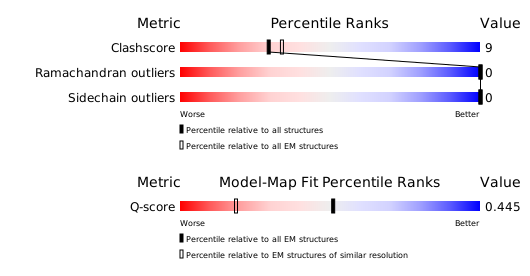
検証レポート(詳細版) をダウンロード
をダウンロード


