






9UK3
Crystal structure of WDR5 in complex with peptide Ac-MRTEPRPPAP-NH2
Summary for 9UK3
| Entry DOI | 10.2210/pdb9uk3/pdb |
| Descriptor | SCRIB overlapping open reading frame protein, WD repeat-containing protein 5 (3 entities in total) |
| Functional Keywords | wd repeat, win site, mll complex, nuclear protein |
| Biological source | Homo sapiens (human) More |
| Total number of polymer chains | 2 |
| Total formula weight | 35568.39 |
| Authors | Min, J.-R.,Zhang, M.,Chen, M.-X. (deposition date: 2025-04-17, release date: 2025-10-08, Last modification date: 2025-11-05) |
| Primary citation | Zhang, M.,Chen, M.,Li, P.,Min, J. Therapeutic targeting of WDR5-MLL1 by EMBOW-derived peptides suppresses leukemia progression. Cell Chem Biol, 2025 Cited by PubMed Abstract: WD40 repeat-containing protein 5 (WDR5) is a core component of the SET1/mixed lineage leukemia (MLL) complex that regulates gene expression via H3K4 methylation and plays a key role in maintaining oncogenic gene expression programs, particularly in MLL1-rearranged leukemias. In this study, we leveraged a microprotein, endogenous microprotein binder of WDR5 (EMBOW), to develop peptide-based inhibitors that specifically targeted WDR5. Through comprehensive biophysical analyses and high-resolution structural studies, we revealed that EMBOW mainly bound to the WDR5 interaction (WIN) site of WDR5. Structure-guided optimization led to the development of EMBOW-derived peptides, notably Ac7, which exhibited high affinity for WDR5 (K = 9.17 ± 4.01 nM). These peptides effectively inhibited H3K4 methylation, suppressed oncogenic gene expression, and impeded leukemia cell proliferation in vitro. Importantly, in xenograft mouse models, Ac7 demonstrated significant anti-tumor activity with low toxicity. This work offers a promising strategy for targeting epigenetic regulators with peptide-based therapeutics, providing a foundation for innovative treatments in leukemia. PubMed: 41135522DOI: 10.1016/j.chembiol.2025.10.002 PDB entries with the same primary citation |
| Experimental method | X-RAY DIFFRACTION (1.69 Å) |
Structure validation
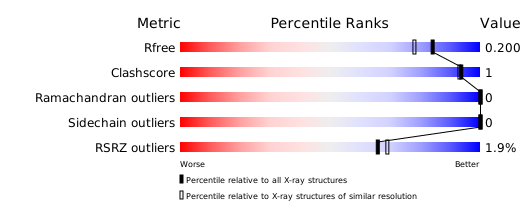
Download full validation report


