






9P1H
100K human S-adenosylmethionine decarboxylase
Summary for 9P1H
| Entry DOI | 10.2210/pdb9p1h/pdb |
| Descriptor | S-adenosylmethionine decarboxylase alpha chain, S-adenosylmethionine decarboxylase beta chain, 1,4-DIAMINOBUTANE, ... (6 entities in total) |
| Functional Keywords | polyamine biosynthesis, decarboxylase, adomet, lyase |
| Biological source | Homo sapiens (human) More |
| Total number of polymer chains | 4 |
| Total formula weight | 80819.56 |
| Authors | Patel, J.R.,Bonzon, T.J.,Bahkt, T.,Fagbohun, O.O.,Clinger, J.A. (deposition date: 2025-06-10, release date: 2025-09-17, Last modification date: 2025-10-08) |
| Primary citation | Patel, J.R.,Bonzon, T.J.,Bakht, T.F.,Fagbohun, O.O.,Clinger, J.A. Multi-Temperature Crystallography of S-Adenosylmethionine Decarboxylase Observes Dynamic Loop Motions. Biomolecules, 15:-, 2025 Cited by PubMed Abstract: S-adenosylmethionine decarboxylase (AdoMetDC) is an essential enzyme in the polyamine biosynthesis pathway and plays a key role in the synthesis of the polyamines spermidine and spermine, polycationic alkylamines that are present in millimolar levels in mammalian cells. Polyamines are metabolic molecules that are involved in many fundamental processes, including regulation of protein and nucleic acid synthesis, stabilization of chromatin, differentiation, apoptosis, protection from oxidation, and regulation of ion channels. Multiple oncogenic pathways lead to dysregulation of polyamines, making polyamines a potential biomarker for cancer and polyamine biosynthesis a target for therapeutic intervention. This study uses multi-temperature crystallography to probe the structure and dynamics of AdoMetDC by collecting diffraction data at 100 K, 273 K, and 293 K. Differential loop behavior is observed across the collected datasets, with dramatic residue rearrangements. In the loop containing residues 20-28, the ambient temperature datasets show a large motion relative to the cryo structure. In a second loop containing residues 164-174, previous cryo structures do not report ordered positions. This loop is ordered in our 100 K structure, while assuming different conformations in the 273 K and 293 K data. These results further illustrate the usefulness of ambient data collection for understanding the structure and dynamics of proteins, especially in loop regions which are less restrained than protein cores. PubMed: 41008581DOI: 10.3390/biom15091274 PDB entries with the same primary citation |
| Experimental method | X-RAY DIFFRACTION (1.81 Å) |
Structure validation
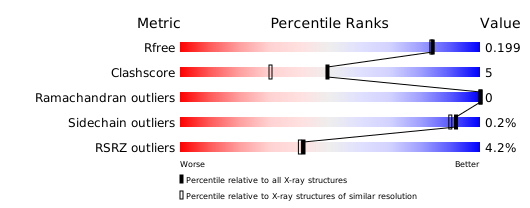
Download full validation report


