






 9OIM
9OIM9OIM の概要
| エントリーDOI | 10.2210/pdb9oim/pdb |
| 分子名称 | Elongin-B, Elongin-C, von Hippel-Lindau disease tumor suppressor, ... (6 entities in total) |
| 機能のキーワード | vhl, e3 ligase, fragment-based drug discovery, protein transport |
| 由来する生物種 | Homo sapiens (human) 詳細 |
| タンパク質・核酸の鎖数 | 12 |
| 化学式量合計 | 175799.06 |
| 構造登録者 | Amporndanai, K.,Katinas, J.M.,Chopra, A.,Fesik, S.W. (登録日: 2025-05-06, 公開日: 2025-07-09, 最終更新日: 2025-09-03) |
| 主引用文献 | Amporndanai, K.,Katinas, J.M.,Chopra, A.,Kayode, O.,Vadukoot, A.K.,Waterson, A.G.,Fesik, S.W. NMR-Based Fragment Screen of the von Hippel-Lindau Elongin C&B Complex. Acs Med.Chem.Lett., 16:1648-1654, 2025 Cited by PubMed Abstract: von Hippel-Lindau (VHL) is an E3 ligase that has been widely exploited for the development of PROTACs to induce degradation of disease-associated target proteins. Nearly all VHL-recruiting PROTACs contain a hydroxyproline moiety based on the endogenous peptide substrate that occupies the HIF1α-binding site of VHL. However, the development of orally bioavailable PROTACs with hydroxyproline-based VHL ligands remains a significant hurdle, due to both the hydroxyproline and the peptidic nature of the VHL ligand. Here, we describe an NMR-based fragment screen against the VHL-Elongin C-Elongin B (VCB) complex. Several hits were shown by X-ray crystallography to bind to the HIF1α active site in VHL of the VCB complex, which opens the possibility for the discovery of new nonhydroxyproline-based VHL ligands for use in VHL-recruiting PROTACs. PubMed: 40832550DOI: 10.1021/acsmedchemlett.5c00316 主引用文献が同じPDBエントリー |
| 実験手法 | X-RAY DIFFRACTION (2.61 Å) |
構造検証レポート
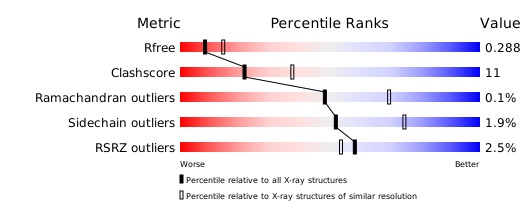
検証レポート(詳細版) をダウンロード
をダウンロード


