






9OGC
Cryo-EM structure of human exportin-1 conjugated with KPT-185 and bound to human ASB8-ELOB/C
Summary for 9OGC
| Entry DOI | 10.2210/pdb9ogc/pdb |
| EMDB information | 70461 |
| Descriptor | Exportin-1, Ankyrin repeat and SOCS box protein 8, Elongin-C, ... (5 entities in total) |
| Functional Keywords | nuclear export, inhibitor, protein degradation, protein transport |
| Biological source | Homo sapiens (human) More |
| Total number of polymer chains | 4 |
| Total formula weight | 178011.37 |
| Authors | Wing, C.E.,Fung, H.Y.J.,Chook, Y.M. (deposition date: 2025-04-30, release date: 2025-11-26, Last modification date: 2025-12-03) |
| Primary citation | Wing, C.E.,Fung, H.Y.J.,Kwanten, B.,Cagatay, T.,Niesman, A.B.,Jacquemyn, M.,Gharghabi, M.,Permentier, B.,Shakya, B.,Nandi, R.,Ready, J.M.,Kashyap, T.,Shacham, S.,Landesman, Y.,Lapalombella, R.,Daelemans, D.,Chook, Y.M. SINE compounds activate exportin-1 degradation via an allosteric mechanism. Biorxiv, 2025 Cited by PubMed Abstract: The nuclear export receptor exportin 1 (XPO1/CRM1) is often overexpressed in cancer cells, leading to the mislocalization of numerous cancer-related protein cargoes . Selinexor, a covalent XPO1 inhibitor, and other Selective Inhibitor of Nuclear Export (SINEs) restore proper nuclear localization by blocking XPO1-cargo binding . SINEs also induce XPO1 degradation via the Cullin-RING E3 ubiquitin ligase (CRL) substrate receptor ASB8 . Here we elucidate the mechanism underlying the high-affinity engagement of CRL5 with SINE-conjugated XPO1. Cryogenic electron microscopy (cryoEM) structures reveal that ASB8 binds to a cryptic site on XPO1, which becomes accessible only upon SINE conjugation. While molecular glue degraders typically interact with both CRL and the substrate , SINEs bind to XPO1 without requiring interaction with ASB8 for efficient XPO1 degradation. Instead, an allosteric mechanism facilitates high affinity XPO1-ASB8 interaction, leading to XPO1 ubiquitination and degradation. ASB8-mediated degradation is also observed upon treatment of the endogenous itaconate derivate 4-octyl itaconate, which suggests a native mechanism that is inadvertently exploited by synthesized XPO1 inhibitors. This allosteric XPO1 degradation mechanism of SINE compounds expands the known modes of targeted protein degradation beyond the well-characterized molecular glue degraders and proteolysis targeting chimeras of CRL4. PubMed: 39416201DOI: 10.1101/2024.10.07.617049 PDB entries with the same primary citation |
| Experimental method | ELECTRON MICROSCOPY (3.37 Å) |
Structure validation
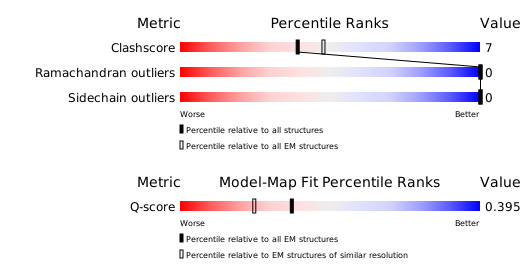
Download full validation report


