






 9O15
9O15
Crystal Structure of BCL-2 (G101V) mutant in complex with a stapled BAD BH3 peptide BAD SAHB 4.2
Summary for 9O15
| Entry DOI | 10.2210/pdb9o15/pdb |
| Descriptor | Apoptosis regulator Bcl-2,Bcl-2-like protein 1, stapled BAD BH3 peptide BAD SAHB 4.2 (3 entities in total) |
| Functional Keywords | apoptosis regulator, stapled peptide, apoptosis |
| Biological source | Homo sapiens (human) More |
| Total number of polymer chains | 14 |
| Total formula weight | 138647.39 |
| Authors | Seo, H.-S.,DeAngelo, T.M.,Bird, G.H.,Walensky, L.D.,Dhe-Paganon, S. (deposition date: 2025-04-03, release date: 2025-10-08, Last modification date: 2025-10-15) |
| Primary citation | DeAngelo, T.M.,Adhikary, U.,Korshavn, K.J.,Seo, H.S.,Brotzen-Smith, C.R.,Camara, C.M.,Dhe-Paganon, S.,Bird, G.H.,Wales, T.E.,Walensky, L.D. Structural insights into chemoresistance mutants of BCL-2 and their targeting by stapled BAD BH3 helices. Nat Commun, 16:8623-8623, 2025 Cited by PubMed Abstract: BCL-2 is a central regulator of apoptosis and inhibits cell death by sequestering pro-apoptotic BH3 alpha-helices within a hydrophobic surface groove. While venetoclax, a BH3-mimetic drug, has transformed the treatment of BCL-2-driven malignancies, its efficacy is increasingly limited by acquired resistance mutations that disrupt small-molecule binding yet preserve anti-apoptotic function-reflecting a remarkable structural adaptation. Here, we employ hydrocarbon-stapled alpha-helices derived from the BAD BH3 motif as conformation-sensitive molecular probes to investigate this therapeutic challenge. The stapled peptides not only retain high-affinity binding to all BCL-2 variants but also show enhanced potency to select venetoclax-resistant mutants. Structural analyses, including X-ray crystallography and hydrogen-deuterium exchange mass spectrometry (HDX MS), demonstrate that these stapled helices restore native BH3 engagement by reversing the conformational consequences of resistance mutations. Notably, we identify a serendipitous interaction between the α3-α4 region of BCL-2 and hydrocarbon staple, which further compensates for altered groove conformation and contributes to mutant binding affinity. Together, these findings offer mechanistic insights into BCL-2 drug resistance and reveal a blueprint for designing next-generation inhibitors that overcome this clinically significant barrier to durable treatment responses. PubMed: 41022713DOI: 10.1038/s41467-025-63657-y PDB entries with the same primary citation |
| Experimental method | X-RAY DIFFRACTION (1.99 Å) |
Structure validation
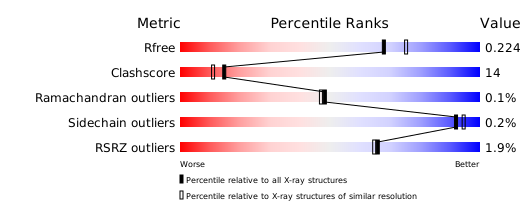
Download full validation report


