






9O11
Kv2.1 with voltage sensor in the up conformation under low potassium
9O11 の概要
| エントリーDOI | 10.2210/pdb9o11/pdb |
| EMDBエントリー | 49994 |
| 分子名称 | Potassium voltage-gated channel subfamily B member 1 (1 entity in total) |
| 機能のキーワード | voltage-gated potassium channel, membrane protein |
| 由来する生物種 | Homo sapiens (human) |
| タンパク質・核酸の鎖数 | 4 |
| 化学式量合計 | 384006.84 |
| 構造登録者 | |
| 主引用文献 | Mandala, V.S.,MacKinnon, R. Electric field-induced pore constriction in the human K v 2.1 channel. Proc.Natl.Acad.Sci.USA, 122:e2426744122-e2426744122, 2025 Cited by PubMed Abstract: Gating in voltage-dependent ion channels is regulated by the transmembrane voltage. This form of regulation is enabled by voltage-sensing domains (VSDs) that respond to transmembrane voltage differences by changing their conformation and exerting force on the pore to open or close it. Here, we use cryogenic electron microscopy to study the neuronal K2.1 channel in lipid vesicles with and without a voltage difference across the membrane. Hyperpolarizing voltage differences displace the positively charged S4 helix in the voltage sensor by one helical turn (~5 Å). When this displacement occurs, the S4 helix changes its contact with the pore at two different interfaces. When these changes are observed in fewer than four voltage sensors, the pore remains open, but when they are observed in all four voltage sensors, the pore constricts. The constriction occurs because the S4 helix, as it displaces inward, squeezes the right-handed helical bundle of pore-lining S6 helices. A similar conformational change occurs upon hyperpolarization of the EAG1 channel but with two helical turns displaced instead of one. Therefore, while K2.1 and EAG1 are from distinct architectural classes of voltage-dependent ion channels, called domain-swapped and non-domain-swapped, the way the voltage sensors gate their pores is very similar. PubMed: 40366685DOI: 10.1073/pnas.2426744122 主引用文献が同じPDBエントリー |
| 実験手法 | ELECTRON MICROSCOPY (3.3 Å) |
構造検証レポート
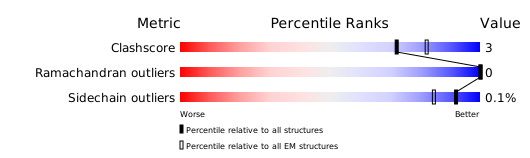
検証レポート(詳細版) をダウンロード
をダウンロード


