






 9MUD
9MUD
Cryo-EM structure of CRISPR-associated cA4 bound Cat1 Pentagonal filament assembly
9MUD の概要
| エントリーDOI | 10.2210/pdb9mud/pdb |
| EMDBエントリー | 48629 |
| 分子名称 | RNA (5'-R(P*AP*AP*AP*A)-3'), Cat1 (CRISPR associated TIR 1) pentagonal filament (2 entities in total) |
| 機能のキーワード | crispr, antiphage defense, adaptive immunity, filament, carf, tir, ca4, antiviral protein |
| 由来する生物種 | bacterium 詳細 |
| タンパク質・核酸の鎖数 | 45 |
| 化学式量合計 | 923595.75 |
| 構造登録者 | |
| 主引用文献 | Baca, C.F.,Majumder, P.,Hickling, J.H.,Patel, D.J.,Marraffini, L.A. Cat1 forms filament networks to degrade NAD + during the type III CRISPR-Cas antiviral response. Science, 388:eadv9045-eadv9045, 2025 Cited by PubMed Abstract: Type III CRISPR-Cas systems defend against viral infection in prokaryotes by using an RNA-guided complex that recognizes foreign transcripts and synthesizes cyclic oligoadenylate (cOA) messengers to activate CRISPR-associated Rossmann-fold (CARF) immune effectors. In this study, we investigated a protein containing a CARF domain-fused Toll/interleukin-1 receptor (TIR) domain, Cat1. We found that Cat1 provides immunity by cleaving and depleting oxidized nicotinamide adenine dinucleotide (NAD) molecules from the infected host, inducing a growth arrest that prevents viral propagation. Cat1 forms dimers that stack upon each other to generate long filaments that are maintained by bound cOA ligands, with stacked TIR domains forming the NAD cleavage catalytic sites. Furthermore, Cat1 filaments assemble into distinct trigonal and pentagonal networks that enhance NAD degradation. Cat1 presents an unprecedented chemistry and higher-order protein assembly for the CRISPR-Cas response. PubMed: 40208959DOI: 10.1126/science.adv9045 主引用文献が同じPDBエントリー |
| 実験手法 | ELECTRON MICROSCOPY (3.4 Å) |
構造検証レポート
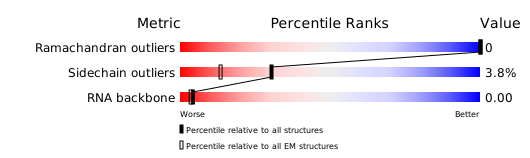
検証レポート(詳細版) をダウンロード
をダウンロード


