






 9MJM
9MJM9MJM の概要
| エントリーDOI | 10.2210/pdb9mjm/pdb |
| 分子名称 | Son of sevenless homolog 1, 2-({(1R)-1-[2-methyl-3-(trifluoromethyl)phenyl]ethyl}amino)-3-(2-oxaspiro[3.3]heptan-6-yl)-5,6,7,8-tetrahydropyrido[4,3-d]pyrimidin-4(3H)-one, 1,2-ETHANEDIOL, ... (5 entities in total) |
| 機能のキーワード | oncology, exchange factor, protein-ligand complex, oncoprotein |
| 由来する生物種 | Homo sapiens (human) |
| タンパク質・核酸の鎖数 | 1 |
| 化学式量合計 | 57993.26 |
| 構造登録者 | |
| 主引用文献 | Leffler, A.E.,Houang, E.M.,Gray, F.,Placzek, A.T.,Ruvinsky, A.M.,Bell, J.A.,Wang, H.,Sun, S.,Svensson, M.,Greenwood, J.R.,Frye, L.L.,Igawa, H.,Atsriku, C.,Levinson, A.M. Exploiting Solvent Exposed Salt-Bridge Interactions for the Discovery of Potent Inhibitors of SOS1 Using Free-Energy Perturbation Simulations. Acs Med.Chem.Lett., 16:444-453, 2025 Cited by PubMed Abstract: Small molecules that bind the Son of Sevenless 1 protein (SOS1), thereby preventing activation of RAS, have been widely pursued as a means for cell proliferation inhibition and antitumor activity. Guided by free-energy perturbation (FEP+) simulations, we discovered that two acidic residues on the perimeter of a known small molecule binding site on SOS1, E906 and E909, constitute a potency handle that can improve inhibitor affinity by as much as 750-fold when targeted with basic groups to form salt bridges, despite being solvent exposed. Structure-Activity Relationship (SAR) and X-ray crystallographic studies demonstrate that this effect is attributable to the electrostatic interaction between the protein and ligand. This interaction could be repurposed to create new SOS1 inhibitors, documenting its general utility for core exploration. Additional recent examples in the literature suggest that this phenomenon may be applicable to a number of target classes and are highlighted herein. PubMed: 40104782DOI: 10.1021/acsmedchemlett.4c00602 主引用文献が同じPDBエントリー |
| 実験手法 | X-RAY DIFFRACTION (2.17 Å) |
構造検証レポート
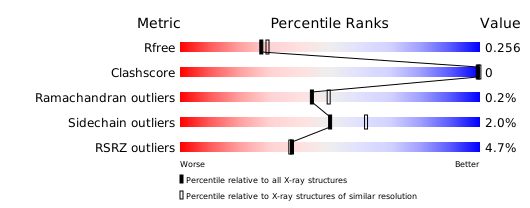
検証レポート(詳細版) をダウンロード
をダウンロード


