






9KQ9
The structure of the YcfA-GTP from Erwinia amylovora
Summary for 9KQ9
| Entry DOI | 10.2210/pdb9kq9/pdb |
| Descriptor | Asparagine synthetase domain-containing protein, GUANOSINE-5'-TRIPHOSPHATE (3 entities in total) |
| Functional Keywords | adenylation, catalyze, tetradecamer, complex, biosynthetic protein |
| Biological source | Erwinia amylovora ATCC 49946 |
| Total number of polymer chains | 14 |
| Total formula weight | 369592.89 |
| Authors | Zhang, L. (deposition date: 2024-11-25, release date: 2025-10-01, Last modification date: 2025-10-22) |
| Primary citation | Zhang, L.,Dou, C.,Yan, W.,Chen, P.,Jia, X.,Zhang, N.,Zhou, D.,Long, Z.,Zhang, L.,Zhu, X.,Cheng, W. The mechanism of thioamide formation by the YcfA-YcfC system in 6-thioguanine biosynthesis. Nat Commun, 16:8840-8840, 2025 Cited by PubMed Abstract: 6-thioguanine (6-TG) is a therapeutic medication for childhood acute lymphoblastic leukemia (ALL) and a potent antimicrobial agent. Its biosynthesis relies on the YcfA-YcfC system, yet the formation of its critical thioamide moiety remains incompletely understood. Here, we provide a detailed biochemical and structural characterization of YcfA, including apo and substrate-bound crystal structures, which reveal that substrate adenylation and L-cysteine addition are key initial steps in the reaction cascade. Cryo-electron microscopy (cryo-EM) and functional analyses highlight YcfA's assembly into a two-layered heptameric structure, essential for the enzymatic function. GTP serves a dual role as a substrate and oligomerization enhancer. Additionally, pyridoxal 5'-phosphate (PLP), a cofactor for YcfC, the partner enzyme in this system, promotes YcfA oligomerization but inhibits its activity by obstructing GTP binding. Biochemical and structural evidence confirms that YcfC acts as a C‒S lyase, which is essential for thioamide formation in the presence of PLP. Exploiting substrate flexibility, we synthesized a seleno analog with antimicrobial properties. Multi-omics analyses of the biosynthetic precursor underscore its potential as an antibiotic. Collectively, our findings unravel the distinct architecture and functionality of the YcfA-YcfC system, offering an evolutionary perspective on noncanonical thioamide biosynthesis and a foundation for synthetic biology applications in drug development. PubMed: 41044055DOI: 10.1038/s41467-025-63937-7 PDB entries with the same primary citation |
| Experimental method | X-RAY DIFFRACTION (2.59 Å) |
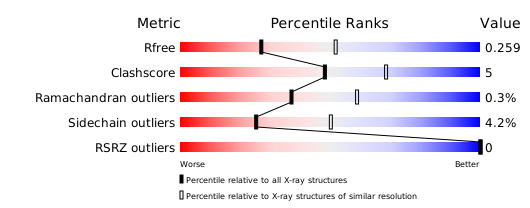
Structure validation
Download full validation report


