






9KP0
Crystal structure of Oryza sativa HPPD
Summary for 9KP0
| Entry DOI | 10.2210/pdb9kp0/pdb |
| Related | 9KOY 9KOZ |
| Descriptor | 4-hydroxyphenylpyruvate dioxygenase, COBALT (II) ION, ACETIC ACID, ... (5 entities in total) |
| Functional Keywords | oxidoreductase |
| Biological source | Oryza sativa |
| Total number of polymer chains | 2 |
| Total formula weight | 94821.07 |
| Authors | Nishio, T.,Nishijima, N.,Kubota, T.,Furuhata, Y.,Kato, Y. (deposition date: 2024-11-22, release date: 2025-06-25, Last modification date: 2025-07-02) |
| Primary citation | Nishio, T.,Nishijima, N.,Kubota, T.,Furuhata, Y.,Nanao, Y.,Permana, H.,Furuhashi, T.,Kato, Y. Mechanism of Herbicidal Action and Rice Selectivity of Iptriazopyrid: A Novel Azole Carboxamide-Based Inhibitor of 4-Hydroxyphenylpyruvate Dioxygenase. J.Agric.Food Chem., 73:15950-15958, 2025 Cited by PubMed Abstract: 4-hydroxyphenylpyruvate dioxygenase (HPPD) inhibitors are widely used as herbicides. However, the emergence of herbicide-resistant weeds necessitates the development of new herbicides with more diverse chemical structures. Therefore, we evaluated the herbicidal and HPPD inhibitory activities of iptriazopyrid, a novel azole carboxamide compound. Phytotoxic tests on demonstrated that iptriazopyrid caused chlorosis at a concentration approximately 10 times lower than that required for the common commercial HPPD inhibitor mesotrione. Furthermore, iptriazopyrid showed strong selectivity for over the weed in the greenhouse-scale experiment. X-ray crystallography and inhibitory assays revealed that iptriazopyrid was bound to the enzyme active pocket of HPPD and worked as a slow-binding inhibitor. These findings indicate that this inhibitor has potent herbicidal activity with a chemical structure different from those of existing HPPD inhibitors. Thus, it has potential applications as a novel scaffold in herbicide development. PubMed: 40495343DOI: 10.1021/acs.jafc.4c11831 PDB entries with the same primary citation |
| Experimental method | X-RAY DIFFRACTION (2 Å) |
Structure validation
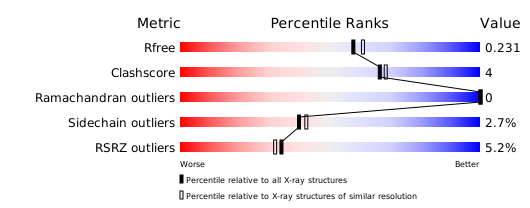
Download full validation report


