






 9JS2
9JS2Summary for 9JS2
| Entry DOI | 10.2210/pdb9js2/pdb |
| Descriptor | 4-hydroxyphenylpyruvate dioxygenase, 1,5-dimethyl-6-(2-oxidanyl-6-oxidanylidene-cyclohexen-1-yl)carbonyl-3-propoxy-quinoxalin-2-one, COBALT (II) ION, ... (4 entities in total) |
| Functional Keywords | inhibitor, complex, oxidoreductase, oxidoreductase-oxidoreductase inhibitor complex, oxidoreductase/oxidoreductase inhibitor |
| Biological source | Arabidopsis thaliana (thale cress) |
| Total number of polymer chains | 1 |
| Total formula weight | 44771.16 |
| Authors | Ying, R.-N.,Lin, H.-Y.,Yang, G.-F. (deposition date: 2024-09-30, release date: 2025-10-08, Last modification date: 2026-04-22) |
| Primary citation | Cai, Z.M.,Ying, R.N.,Wang, X.Q.,Bai, R.Y.,Sun, A.,Kandegama, W.,Lin, H.Y.,Wang, D.W.,Yang, G.F. Design, Synthesis, and Bioactivity of Triketone-quinoxalin-2-ones as a Novel HPPD Inhibition Herbicide. J.Agric.Food Chem., 73:27328-27337, 2025 Cited by PubMed Abstract: 4-Hydroxyphenylpyruvate dioxygenase (HPPD) is recognized as one of the most promising herbicide targets for sustainable weed control in modern agricultural practices. To address agricultural demands, we designed and synthesized a novel series of triketone-quinoxalin-2-ones as potent HPPD inhibitors. In vitro evaluation revealed that the newly synthesized compounds demonstrated remarkable HPPD (HPPD) inhibitory activity. Significantly, compound , 3-(4-chloro-2-fluorophenyl)-6-(2-hydroxy-6-oxocyclohex-1-ene-1-carbonyl)-1,5-dimethylquinoxalin-2(1)-one, showed the strongest HPPD inhibition with an IC value of 0.034 μM, 10-fold more potent than mesotrione (IC = 0.350 μM). Furthermore, the postemergence herbicidal activity evaluation showed that compound exhibited 100% inhibition of , , , and at 150 g ai/ha, and 90% inhibition of , showing enhanced activity compared to mesotrione. The crystal structure of the HPPD complex demonstrated that compound engaged in a key bidentate chelating interaction with the metal ion in the catalytic active site and a π-π interaction with Phe381 and Phe424. Moreover, established hydrophobic interactions with Leu427, Leu368, and Met335. These results indicate that the triketone-quinoxalin-2-one hybrid is a promising scaffold and can be considered a viable lead compound for the development of HPPD inhibitors. PubMed: 41100756DOI: 10.1021/acs.jafc.5c08188 PDB entries with the same primary citation |
| Experimental method | X-RAY DIFFRACTION (1.94 Å) |
Structure validation
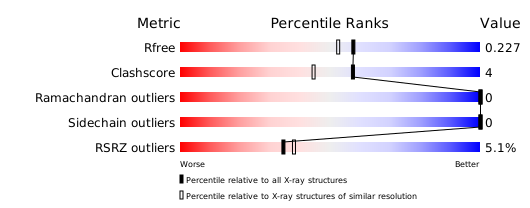
Download full validation report


