






 9ITB
9ITB
LPA-bound LPAR6 in complex with miniGq
9ITB の概要
| エントリーDOI | 10.2210/pdb9itb/pdb |
| EMDBエントリー | 60857 |
| 分子名称 | engineered miniGaq, Guanine nucleotide-binding protein G(I)/G(S)/G(T) subunit beta-1, Nb35, ... (8 entities in total) |
| 機能のキーワード | gpcr-g-protein complex, membrane protein |
| 由来する生物種 | Homo sapiens (human) 詳細 |
| タンパク質・核酸の鎖数 | 5 |
| 化学式量合計 | 140462.74 |
| 構造登録者 | |
| 主引用文献 | Duan, Y.,Xu, Z.,Hao, B.,Zhang, A.,Guo, C.,He, Y. Molecular mechanism of ligand recognition and activation of lysophosphatidic acid receptor LPAR6. Proc.Natl.Acad.Sci.USA, 122:e2415426122-e2415426122, 2025 Cited by PubMed Abstract: Lysophosphatidic acid (LPA) exerts its physiological roles through the endothelialdifferentiation gene (EDG) family LPA receptors (LPAR1-3) or the non-EDG family LPA receptors (LPAR4-6). LPAR6 plays crucial roles in hair loss and cancer progression, yet its structural information is very limited. Here, we report the cryoelectron microscopy structure of LPA-bound human LPAR6 in complex with a mini G or G protein. These structures reveal a distinct ligand binding and recognition mode that differs significantly from that of LPAR1. Specifically, LPA uses its charged head to form an extensive polar interaction network with key polar residues on the extracellular side of transmembrane helix 5-6 and the extracellular loop 2. Structural comparisons and homology analysis suggest that the EDG and non-EDG families use two distinct modes for LPA binding. The structural observations are validated through functional mutagenesis studies. We further uncover the mechanisms of LPAR6 activation and principles of G-protein coupling. The structural information revealed by our study lays the groundwork for understanding LPAR6 signaling and provides a rational basis for designing compounds targeting LPAR6. PubMed: 39847322DOI: 10.1073/pnas.2415426122 主引用文献が同じPDBエントリー |
| 実験手法 | ELECTRON MICROSCOPY (2.89 Å) |
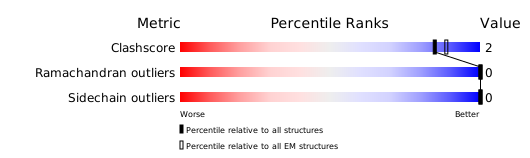
構造検証レポート
検証レポート(詳細版) をダウンロード
をダウンロード


