






9HYE
Structure of the Mus musclus Langerin carbohydrate recognition domain with depleted Calcium
Summary for 9HYE
| Entry DOI | 10.2210/pdb9hye/pdb |
| Descriptor | C-type lectin domain family 4 member K, CHLORIDE ION (3 entities in total) |
| Functional Keywords | c-type lectin, glycoprotein, carbohydrate binding protein, calcium binding, crd domain, lectin, immune system |
| Biological source | Mus musculus (house mouse) |
| Total number of polymer chains | 2 |
| Total formula weight | 35996.16 |
| Authors | Ruwolt, M.,Neu, U.,Loll, B. (deposition date: 2025-01-09, release date: 2025-11-19, Last modification date: 2025-11-26) |
| Primary citation | Ning, Y.,Efrem, N.L.,Amoussa, M.,Turhan, E.,Zheng, D.,Lefebre, J.,Ruwolt, M.,Neu, U.,Besch, M.,Loll, B.,Kurzbach, D.,Kohnke, J.,Nazare, M.,Rademacher, C. Calcium Competitive Inhibition of Langerin by Thiazolopyrimidinones. J.Med.Chem., 2025 Cited by PubMed Abstract: C-Type lectins are a large family of carbohydrate-binding proteins. Langerin is a member of this family and is expressed by Langerhans cells, involved in pathogen recognition and innate immune activation, making it a target for small-molecule modulation in immunology and infectious diseases. We previously identified thiazolopyrimidinones as a series of allosteric inhibitors, but the underlying mechanism remained unclear. In this study, Ca NMR demonstrated that these fragments induce Ca release from the receptor. Our ITC data suggested a competitive relationship between inhibitors and Ca, which was further validated by F NMR spectroscopy showing inhibition of carbohydrate binding. Surprisingly, the fragment binding site was found to be located beneath the long loop, which supports the dynamic nature of the long loop being highly Ca dependent. Our findings provide insight into the novel Ca-competitive inhibitory mechanism of murine langerin and are the first report on such an inhibitory mechanism for a C-type lectin. PubMed: 41261040DOI: 10.1021/acs.jmedchem.5c01756 PDB entries with the same primary citation |
| Experimental method | X-RAY DIFFRACTION (1.64 Å) |
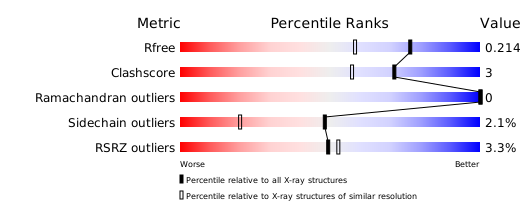
Structure validation
Download full validation report


