






 9HTD
9HTD
Peptide-substrate-binding (PSB) domain of human type II collagen prolyl 4-hydroxylase complexed with Pro-Hyp-Gly-Pro-Ala-Gly-Pro-Hyp-Gly.
9HTD の概要
| エントリーDOI | 10.2210/pdb9htd/pdb |
| 関連するPDBエントリー | 6EVL 6EVM 6EVN 6EVO 6EVP |
| 分子名称 | Prolyl 4-hydroxylase subunit alpha-2, GLY-PRO-ALA-GLY-PRO-HYP-GLY, GLYCINE, ... (5 entities in total) |
| 機能のキーワード | collagen, tetratricopeptide, extracellular matrix, protein binding |
| 由来する生物種 | Homo sapiens (human) 詳細 |
| タンパク質・核酸の鎖数 | 2 |
| 化学式量合計 | 13094.42 |
| 構造登録者 | |
| 主引用文献 | Rahman, M.M.,Sulu, R.,Adediran, B.,Tu, H.,Salo, A.M.,Murthy, S.,Myllyharju, J.,Wierenga, R.K.,Koski, M.K. Binding Differences of the Peptide-Substrate-Binding Domain of Collagen Prolyl 4-Hydroxylases I and II for Proline- and Hydroxyproline-Rich Peptides. Proteins, 93:1732-1746, 2025 Cited by PubMed Abstract: Collagen prolyl 4-hydroxylase (C-P4H) catalyzes the 4-hydroxylation of Y-prolines of the XYG-repeat of procollagen. C-P4Hs are tetrameric αβ enzymes. The α-subunit provides the N-terminal dimerization domain, the middle peptide-substrate-binding (PSB) domain, and the C-terminal catalytic (CAT) domain. There are three isoforms of the α-subunit, complexed with a β-subunit that is protein disulfide isomerase, forming C-P4H I-III. The PSB domain of the α-subunit binds proline-rich peptides, but its function with respect to the prolyl hydroxylation mechanism is unknown. An extended mode of binding of proline-rich peptides (PPII, polyproline type-II, conformation) to the PSB-I domain has previously been reported for the PPG-PPG-PPG and P9 peptides. Crystal structures now show that peptides with the motif PxGP (PPG-PRG-PPG, PPG-PAG-PPG) (where x, at Y-position 5, is not a proline) bind to the PSB-I domain differently, more deeply, in the peptide-binding groove. The latter mode of binding has previously been reported for structures of the PSB-II domain complexed with these PxGP-peptides. In addition, it is shown here by crystallographic binding studies that the POG-PAG-POG peptide (with 4-hydroxyprolines at Y-positions 2 and 8) also adopts the PxGP mode of binding to PSB-I as well as to PSB-II. Calorimetric binding studies show that the affinities of these peptides are lower for PSB-I than for PSB-II, with, respectively, K values of about 70 μM for PSB-I and 20 μM for PSB-II. The importance of these results for understanding the reaction mechanism of C-P4H, in particular concerning the function of the PSB domain, is discussed. PubMed: 40386874DOI: 10.1002/prot.26839 主引用文献が同じPDBエントリー |
| 実験手法 | X-RAY DIFFRACTION (1.751 Å) |
構造検証レポート
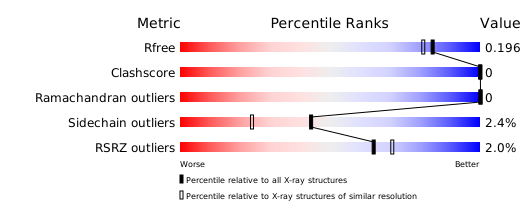
検証レポート(詳細版) をダウンロード
をダウンロード


