






 9HHQ
9HHQ
Human monocarboxylate transporter 10
9HHQ の概要
| エントリーDOI | 10.2210/pdb9hhq/pdb |
| EMDBエントリー | 52173 |
| 分子名称 | Monocarboxylate transporter 10 (1 entity in total) |
| 機能のキーワード | slc16, msf, transporter, membrane protein |
| 由来する生物種 | Homo sapiens (human) |
| タンパク質・核酸の鎖数 | 1 |
| 化学式量合計 | 55537.28 |
| 構造登録者 | |
| 主引用文献 | Bagenholm, V.,Nordlin, K.P.,Pasquadibisceglie, A.,Belinskiy, A.,Holm, C.M.,Hotiana, H.A.,Gotfryd, K.,Delemotte, L.,Nour-Eldin, H.H.,Pedersen, P.A.,Gourdon, P. Cryo-EM structure of the human monocarboxylate transporter 10. Structure, 33:891-, 2025 Cited by PubMed Abstract: The monocarboxylate transporter (MCT) membrane protein family has 14 human members that perform key cellular functions, such as regulating metabolism. MCT8 and MCT10 have unique cargo specificity, transporting thyroid hormone and, in the case of MCT10, aromatic amino acids. Dysfunctional MCT8 causes the severe Allan-Herndon-Dudley syndrome, yet the (patho)physiology and function of MCT8 and MCT10 are not clearly understood, especially at a structural level. We present the cryoelectron microscopy (cryo-EM) structure of MCT10, displaying the classical major facilitator superfamily fold, caught in an inward-open configuration. Together with cargo docking models, the outward-open MCT10 AlphaFold model and validating functional analysis, cargo specificity and transport principles are proposed. These findings significantly enhance our understanding of the structure and function of MCTs, information that also may be valuable for the development of novel treatments against MCT-related disorders to address global challenges such as diabetes, obesity, and cancer. PubMed: 40112803DOI: 10.1016/j.str.2025.02.012 主引用文献が同じPDBエントリー |
| 実験手法 | ELECTRON MICROSCOPY (3.5 Å) |
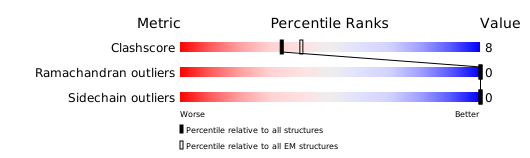
構造検証レポート
検証レポート(詳細版) をダウンロード
をダウンロード


