






 9H8B
9H8B9H8B の概要
| エントリーDOI | 10.2210/pdb9h8b/pdb |
| EMDBエントリー | 51935 |
| 分子名称 | CanX, CALCIUM ION, 2-acetamido-2-deoxy-beta-D-glucopyranose (3 entities in total) |
| 機能のキーワード | nanotube archaea helical protein fiber dna-binding, protein fibril |
| 由来する生物種 | Pyrodictium abyssi DSM 6158 |
| タンパク質・核酸の鎖数 | 154 |
| 化学式量合計 | 2939374.59 |
| 構造登録者 | |
| 主引用文献 | Sleutel, M.,Sonani, R.R.,Miller, J.G.,Wang, F.,Socorro, A.G.,Chen, Y.,Martin, R.,Demeler, B.,Rudolph, M.J.,Alva, V.,Remaut, H.,Egelman, E.H.,Conticello, V.P. Donor Strand Complementation and Calcium Ion Coordination Drive the Chaperone-free Polymerization of Archaeal Cannulae. Biorxiv, 2024 Cited by PubMed Abstract: Cannulae are tubular protein filaments that accumulate on the extracellular surface of the hyperthermophilic archaeon during cell division. Cannulae have been postulated to act as a primitive extracellular matrix through which cells could communicate or exchange material, although their native biological function remains obscure. Here, we report cryoEM structural analyses of cannulae and of protein assemblies derived from recombinant cannula-like proteins. Three-dimensional reconstructions of cannulae revealed that the structural interactions between protomers in the native and recombinant filaments were based on donor strand complementation, a form of non-covalent polymerization in which a donor β-strand from one subunit is inserted into an acceptor groove in a β-sheet of a neighboring subunit. Donor strand complementation in cannulae is reinforced through calcium ion coordination at the interfaces between structural subunits in the respective assemblies. While donor strand complementation occurs during the assembly of chaperone-usher pili, this process requires the participation of accessory proteins that are localized in the outer membrane. In contrast, we demonstrate that calcium ions can induce assembly of cannulae in the absence of other co-factors. Crystallographic analysis of a recombinant cannula-like protein monomer provided evidence that calcium ion binding primes the precursor for donor strand invasion through unblocking of the acceptor groove. Bioinformatic analysis suggested that structurally homologous cannula-like proteins occurred within the genomes of other hyperthermophilic archaea and were encompassed within the TasA superfamily of biomatrix proteins. CryoEM structural analyses of tubular filaments derived from assembly of a recombinant cannula-like protein from an uncultured species revealed a common mode of assembly to the cannulae, in which donor strand complementation and calcium ion binding stabilized longitudinal and lateral assembly in tubular 2D sheets. PubMed: 39803462DOI: 10.1101/2024.12.30.630787 主引用文献が同じPDBエントリー |
| 実験手法 | ELECTRON MICROSCOPY (2.3 Å) |
構造検証レポート
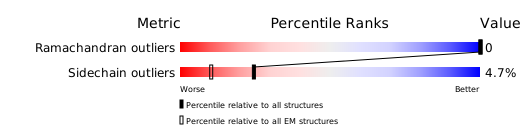
検証レポート(詳細版) をダウンロード
をダウンロード


