






9GTI
X-ray crystal structure of mouse NPTN N-terminal domain
Summary for 9GTI
| Entry DOI | 10.2210/pdb9gti/pdb |
| Related | 9GSY |
| Descriptor | Neuroplastin, DI(HYDROXYETHYL)ETHER, 4-(2-HYDROXYETHYL)-1-PIPERAZINE ETHANESULFONIC ACID, ... (4 entities in total) |
| Functional Keywords | ig like domain, cell surface protein, membrane associated, cell adhesion |
| Biological source | Mus musculus (house mouse) |
| Total number of polymer chains | 4 |
| Total formula weight | 75175.88 |
| Authors | Vinayagam, D.,Raunser, S.,Sistel, O.,Shulte, U.,Constantin, C.E.,Prubaum, D.,Zolles, G.,Fakler, B. (deposition date: 2024-09-17, release date: 2025-08-06, Last modification date: 2025-10-15) |
| Primary citation | Vinayagam, D.,Sitsel, O.,Schulte, U.,Constantin, C.E.,Oosterheert, W.,Prumbaum, D.,Zolles, G.,Fakler, B.,Raunser, S. Molecular mechanism of ultrafast transport by plasma membrane Ca 2+ -ATPases. Nature, 646:236-245, 2025 Cited by PubMed Abstract: Tight control of intracellular Ca levels is fundamental as they are used to control numerous signal transduction pathways. Plasma membrane Ca-ATPases (PMCAs) have a crucial role in this process by extruding Ca against a steep concentration gradient from the cytosol to the extracellular space. Although new details of PMCA biology are constantly being uncovered, the structural basis of the most distinguishing features of these pumps, namely, transport rates in the kilohertz range and regulation of activity by the plasma membrane phospholipid PtdIns(4,5)P, has so far remained elusive. Here we present the structures of mouse PMCA2 in the presence and absence of its accessory subunit neuroplastin in eight different stages of its transport cycle. Combined with whole-cell recordings that accurately track PMCA-mediated Ca extrusion in intact cells, these structures enable us to establish the first comprehensive transport model for a PMCA, reveal the role of disease-causing mutations and uncover the structural underpinnings of regulatory PMCA-phospholipid interaction. The transport cycle-dependent dynamics of PtdIns(4,5)P are fundamental for its role as a 'latch' promoting the fast release of Ca and opening a passageway for counter-ions. These actions are required for maintaining the ultra-fast transport cycle. Moreover, we identify the PtdIns(4,5)P-binding site as an unanticipated target for drug-mediated manipulation of intracellular Ca levels. Our work provides detailed structural insights into the uniquely fast operation of native PMCA-type Ca pumps and its control by membrane lipids and drugs. PubMed: 40836084DOI: 10.1038/s41586-025-09402-3 PDB entries with the same primary citation |
| Experimental method | X-RAY DIFFRACTION (2.03 Å) |
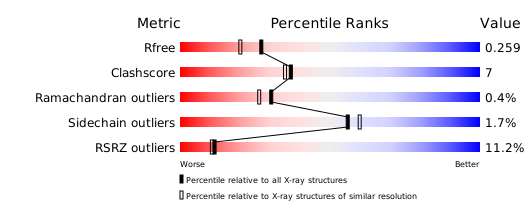
Structure validation
Download full validation report


