






 9GCE
9GCE
Ang-1 domain of the HupE/UreJ-2 protein from Rhodobacteraceae bacterium RbAng-1a with Cu bound
Summary for 9GCE
| Entry DOI | 10.2210/pdb9gce/pdb |
| Descriptor | Membrane protein, ZINC ION, COPPER (II) ION, ... (4 entities in total) |
| Functional Keywords | metalloprotein, oxygenase, peroxygenase, metal binding protein |
| Biological source | Rhodobacteraceae bacterium PD-2 |
| Total number of polymer chains | 1 |
| Total formula weight | 17971.40 |
| Authors | Franco Cairo, J.P.L.,Correa, T.L.R.,Offen, W.A.,Nairn, A.,Walton, J.,Davies, G.J.,Walton, P.H.,Sweeney, S.T. (deposition date: 2024-08-01, release date: 2025-09-10, Last modification date: 2025-10-29) |
| Primary citation | Franco Cairo, J.P.L.,Correa, T.L.R.,Offen, W.A.,Nairn, A.K.,Walton, J.,Sweeney, S.T.,Davies, G.J.,Walton, P.H. Signal-strapping as a protein-sequence search method for the discovery of metalloproteins. Nat Commun, 16:9244-9244, 2025 Cited by PubMed Abstract: Metalloprotein discovery is often made post hoc, in which activity studies following protein isolation reveal a metal-ion dependence. Herein we take a different approach to finding metalloproteins, by building on the discovery of copper-containing lytic polysaccharide monooxygenases (LPMOs), which include an N-terminal histidine as part of their sequence. This residue acts as a natural chelator for transition metal ions, irrespective of the structure of the protein. We report the method of signal strapping, where sequences of N-terminal signal peptides artificially appended with a histidine residue at their C-terminus are used to bootstrap a proteomic search. These searches return sequences of proteins with an N-terminal histidine capable of coordinating a metal ion. We exemplify the approach by the discovery and characterisation of four classes of bacterial metalloproteins, including two that we denote as anglerases reflecting their potential to capture transition metal ions from the bacterial environment. PubMed: 41115942DOI: 10.1038/s41467-025-64309-x PDB entries with the same primary citation |
| Experimental method | X-RAY DIFFRACTION (2.25 Å) |
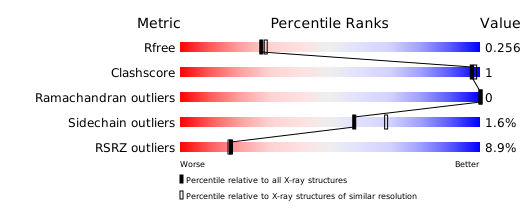
Structure validation
Download full validation report


