






 9FYS
9FYS
D11 mAbs bound to alpha-Bungarotoxin
9FYS の概要
| エントリーDOI | 10.2210/pdb9fys/pdb |
| 分子名称 | heavy chain, Alpha-bungarotoxin, D11 mAbs Light chain, ... (5 entities in total) |
| 機能のキーワード | mabs, bungarotoxin, antibody:toxin complex, toxin |
| 由来する生物種 | Homo sapiens 詳細 |
| タンパク質・核酸の鎖数 | 6 |
| 化学式量合計 | 77311.15 |
| 構造登録者 | Wade, J.,Bohn, M.F.,Laustsen, A.H.,Morth, J.P. (登録日: 2024-07-03, 公開日: 2025-07-16, 最終更新日: 2025-11-19) |
| 主引用文献 | Wade, J.,Strancar, N.,Fernandez-Quintero, M.L.,Siebenhaar, S.,Jansen, T.,Meier, E.P.W.,Jenkins, T.P.,Bjorn, S.P.,Nguyen, G.T.T.,Lomonte, B.,Gutierrez, J.M.,Sorensen, C.V.,Loeffler, J.R.,Paul, A.,Tulika, T.,Arnsdorf, J.,Schoffelen, S.,Lundquist, E.V.S.,Sorensen, J.,Ward, A.B.,Voldborg, B.G.,Bohn, M.F.,Rivera-de-Torre, E.,Morth, J.P.,Laustsen, A.H. Rational design of antibodies with pH-dependent antigen-binding properties using structural insights from broadly neutralizing antibodies against alpha-neurotoxins. Mabs, 17:2553624-2553624, 2025 Cited by PubMed Abstract: Antibodies that bind in a pH-dependent manner to their antigens show promise for enhanced neutralization potency and blocking capacity against extracellular targets. However, because the mechanisms governing pH-dependent antigen binding remain poorly understood, engineering approaches are often limited to incorporating histidine residues in the antibody complementarity-determining regions. Here, we use a panel of human monoclonal antibodies with neutralizing activity to long-chain α-neurotoxins (LNTxs) to investigate pH-dependent antigen binding. The antibodies vary in their light chains but have conserved histidine residues in their variable domains, allowing us to explore how other residues may affect pH dependence. Comparative structural and molecular dynamics studies between two antibodies with and without pH-dependent antigen-binding properties reveal that both antibodies neutralize LNTxs by mimicking LNTx-receptor interactions through their heavy chains. We hypothesize that part of the pH-dependency can be controlled by the light chain through modulation of water access to residues at the heavy-light-chain interface. We show that pH-dependent antigen-binding properties can be introduced into monoclonal antibodies through the substitution of selected residues at the heavy-light-chain interface. Specifically, we replaced tyrosine residues in the light chain with small polar and apolar amino acid residues in a structurally related anti-LNTx antibody with limited inherent pH-dependent antigen-binding properties, and found that these smaller substitutions enhanced pH-dependence more effectively than histidine substitutions alone. Our findings suggest a strategy for engineering pH-dependent antigen binding in antibodies that goes beyond the exclusive use of histidine doping. PubMed: 40936197DOI: 10.1080/19420862.2025.2553624 主引用文献が同じPDBエントリー |
| 実験手法 | X-RAY DIFFRACTION (1.32 Å) |
構造検証レポート
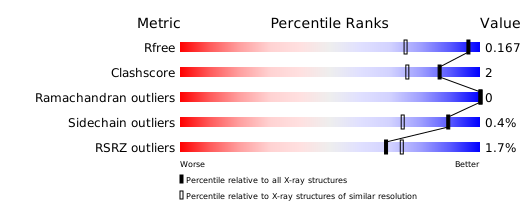
検証レポート(詳細版) をダウンロード
をダウンロード


